
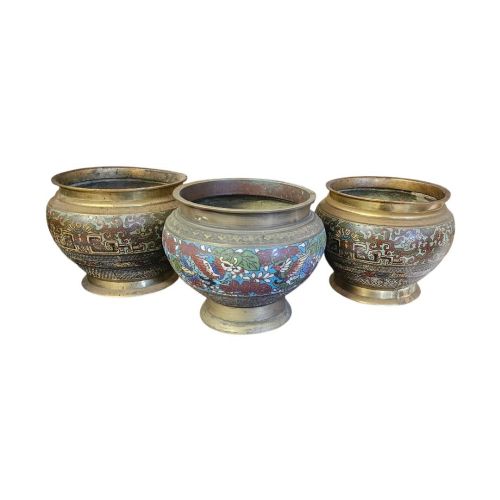


Oriental Brass Jardiniere
These oriental brass jardiniere vessels bring distinctive form and substantial weight to interior spaces, offering timeless appeal for plant displays.
Oriental Brass Jardiniere
An oriental brass jardiniere functions primarily as a decorative planter or bowl designed to hold indoor plants and floral arrangements. Buyers searching this phrase encounter substantial vessels that draw heavily upon nineteenth century design traditions.
The selections on this page span several key periods, featuring nineteenth century and Victorian examples alongside specific pieces from the Qing Dynasty and Japanese Meiji period. Forms range from large troughs and deep bowls to smaller desk pots and mounted dishes.
Originating largely from Chinese and Japanese workshops, these vessels often incorporate stylistic elements of Victorian Orientalism. Most commonly, buyers meet heavy bronze, brass and cloisonné examples designed for prominent display within a room.
How they were made
Makers utilised heavy casting techniques for the foundational bodies of these pieces, working primarily in brass, bronze and copper. Metalwork forms often display substantial weight, ranging from compact desk pots to heavy bowls exceeding two kilograms.
Enamel work frequently enhances the metallic surfaces, with artisans employing champlevé and cloisonné techniques to create intricate coloured designs. Selected troughs and bowls also feature internal linings of zinc or incorporate supporting hardwood stands.
Several heavy specimens push the scales past two kilograms, proving that nineteenth century desk pots meant business.
What varies in quality
The refinement of the casting and the depth of the metalwork dictate the standard of an oriental brass jardiniere. Superior examples display crisp definition in decorative motifs and robust structural integrity across heavy walls and rims.
Enamelling quality creates a clear division in the range, where precise cell work and well-preserved surface colours distinguish finer items from simpler decorative vessels. The integration of supplementary materials, such as fitted zinc linings or carved hardwood stands, further marks out superior production.
The Oriental Brass Jardiniere Glossary
- Jardiniere
- An ornamental pot or stand for holding plants or flowers. These vessels form the central object type found across the listings.
- Cloisonne
- An enamel technique where metal wire creates raised barriers to hold coloured pastes before firing. This method appears frequently on Chinese bronze bowls.
- Champleve
- An enamelling process where troughs or cells are hollowed out of the metal surface and filled with enamel. It provides rich surface decoration on nineteenth century pieces.
- Meiji Period
- A Japanese historical era lasting from eighteen sixty-eight to nineteen twelve. Pieces from this time demonstrate distinct craftsmanship in bronze bowls.
- Qing Dynasty
- The final imperial dynasty of China, spanning from sixteen forty-four to nineteen twelve. Items originating from this period carry significant cultural style.
Oriental Brass Jardiniere: Frequently Asked Questions
What is an oriental brass jardiniere?
An oriental brass jardiniere is a heavy decorative vessel used historically to hold plants and floral displays within a room.
These pieces typically originate from nineteenth century Chinese or Japanese workshops and incorporate traditional metalworking techniques.
How were these jardinieres used originally?
Households placed these vessels on tables, desks or stands to display potted plants and large cut floral arrangements.
Their substantial weight and waterproof metal construction made them practical containers for indoor greenery.
How do I style a jardiniere at home?
These bowls suit placement on heavy furniture surfaces, either left empty to showcase the metalwork or filled with foliage.
Pairing them with traditional stands or placing them in nineteenth century interior schemes highlights their original aesthetic.
How can I tell the period?
Dating relies on examining the manufacturing techniques, metal composition and surface decoration styles present on the vessel.
References to Qing Dynasty, Meiji period or Victorian production offer key indicators of age and origin.