




Onyx Mantel Clock
Onyx mantel clocks are striking timepieces shaped by Victorian grandeur and Art Deco geometry, offering a sophisticated centrepiece for a room.
What an onyx mantel clock is
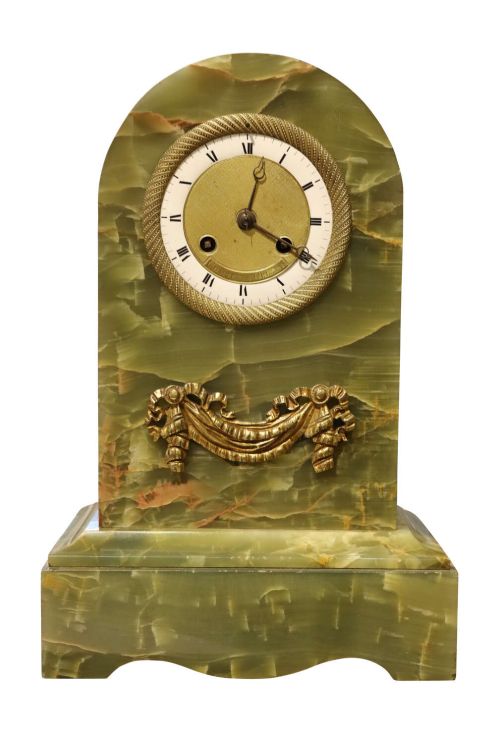
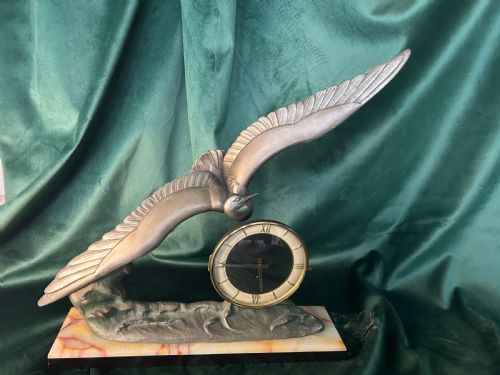
An onyx mantel clock combines natural stone with metal fittings to sit upon a fireplace or sideboard. The pieces listed under onyx mantel clock encompass Victorian designs, French Belle Epoque models, and 1930s Art Deco creations.
The dominant forms on this page include standard mantel clocks, three-piece garniture sets, and four-glass models. They frequently incorporate brass, gilt bronze, marble, and spelter details alongside the stone body.
How they were made
The construction relies on shaping dense natural stone to form the architectural housing for the clock movement. Craftsmen combined onyx with marble, brass, and gilt bronze, often mounting enamel dials behind protective glass faces.
Metal ornaments such as spelter figures, ormolu mounts, or champleve enamel panels were integrated into the stone structure. These varied materials required precise joining techniques to support the heavy internal mechanisms securely.
Retail Price Guide 2026
Typical UK retail prices for onyx mantel clock, calculated from the Sellingantiques database of over a million retail prices indexed since 2003. This retail price guide relies exclusively on Sellingantiques data; no external sources or auction records are used, so the figures do not describe the wider market.
The site's listings for onyx mantel clock include Victorian, 1930, 1900, and 19th Century pieces utilising onyx, brass, glass, spelter, gilt bronze, marble, and enamel.
What varies in quality
Quality differences depend on the richness of the materials used and the finesse of the metalwork. Pieces featuring champleve enamel, finely cast gilt bronze, or matched garniture sets stand apart from simpler stone housings.
The refinement of the decorative mounts and the integration of subsidiary figures, such as William Shakespeare or matching side urns, elevate the distinction of individual examples.
Samuel Marti
The Onyx Mantel Clock Glossary
- Onyx
- A banded variety of chalcedony used extensively for the heavy stone bodies of these clocks. Its natural translucence and varied veining give each clock a distinct appearance.
- Garniture
- A set consisting of a central clock flanked by matching decorative objects such as urns or vases. These sets were designed to display symmetrically on a mantelpiece.
- Champleve
- An enamelling technique where troughs are dug into a metal surface and filled with vitreous enamel before firing. It appears on the dial surrounds and columns of finer French models.
- Four glass clock
- A style of mantel clock featuring bevelled glass panels on all four sides to expose the mechanical movement within. They are frequently housed in brass and onyx frames.
- Spelter
- A zinc alloy commonly used for decorative figures and mounts on nineteenth-century clocks. It was often painted or electroplated to resemble bronze.
Frequently Asked Questions
What is an onyx mantel clock?
An onyx mantel clock is a domestic timepiece built around a carved stone housing, typically designed to rest upon a fireplace shelf. These clocks date from the nineteenth and early twentieth centuries.
They combine natural stone with metals like brass, bronze, and marble to create decorative architectural forms that double as functional timekeepers.
How do I wind a vintage clock?
Winding requires a matching key inserted into the winding holes on the enamel dial face. Care must be taken not to over-wind the mainspring.
Most mechanical movements require attention at regular intervals to maintain accurate timekeeping, depending on whether they are thirty-hour or eight-day mechanisms.
Are garniture sets common?
Garniture sets include the main clock alongside a matching pair of side ornaments, such as urns or vases. They were popular for creating balanced mantel displays.
Surviving complete sets remain desirable because the clock and its flanking pieces share identical stone and metalwork details.
How are Art Deco clocks different?
Art Deco onyx clocks from the 1930s lean into streamlined geometric shapes rather than the ornate classical revival styles of the Victorian era. They often feature starker contrasts in stone colour.
The aesthetic shifts away from complex bronze casting toward clean lines and modernist dial designs.