


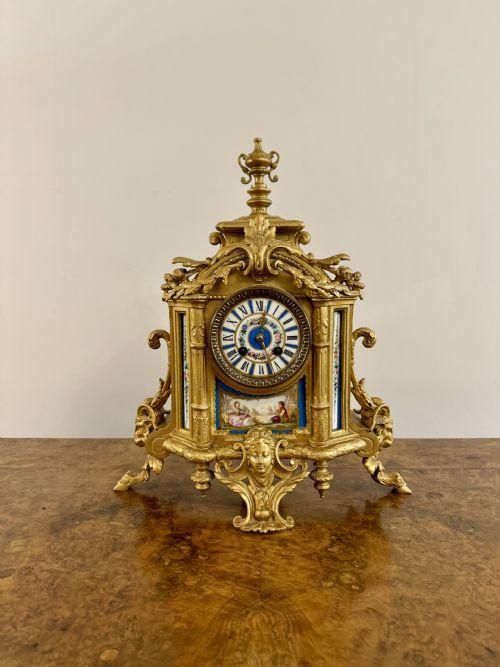


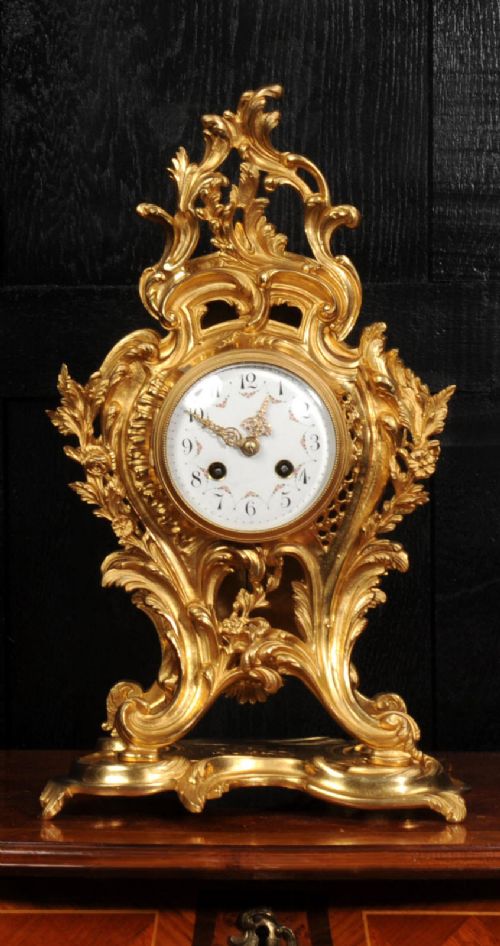


Gold Metal Clock
A gold metal clock brings warmth and architectural presence to a room, ranging from ornate French rococo mantel pieces to sleek mid-century designs.
Gold Metal Clock
A gold metal clock encompasses a diverse range of timepieces, spanning mantel clocks, carriage clocks, wall clocks, and clock garnitures. These objects date from the nineteenth century through to the mid-twentieth century, originating primarily from French and English workshops.
The selection on this page relies heavily on nineteenth-century examples, particularly French mantel clocks and English fusee designs. Buyers encounter everything from miniature carriage clocks to large portico and cartel wall clocks.
Stylistic variations are broad, covering French Rococo Revival, Baroque, Gothic Revival, Art Deco, and mid-century modern idioms. Many pieces incorporate supplementary materials such as porcelain plaques, enamel dials, and marble bases.
How they were made
Construction typically involves brass, bronze, or cast metal subjected to gilding, ormolu, and patination techniques. Ormolu surfaces required the application of finely ground gold mercury amalgam onto bronze before firing.
Dials frequently integrate white enamel with painted Roman or Arabic numerals, sometimes protected behind curved glass bezels. Intricate cases combine cast metal frameworks with inset porcelain panels decorated with hand-painted scenes.
Listings feature brass, bronze, and gilt metal alongside enamel, porcelain, and marble elements across multiple nineteenth-century periods.
What varies in quality
Quality rests in the crispness of the metal casting, the depth and durability of the gilding, and the refinement of the dial work. Finer cases display sharp relief work on scrollwork, figures, and foliage without smoothing from over-cleaning.
The sophistication of the internal movement dictates mechanical merit, distinguishing standard striking mechanisms from fusee movements or complex grand-sonnerie and alarm complications.
Japy Freres·Leon Message·Jollet et Cie·John Barwise of London·Bently and Beck London·P.H Mourey·Wm Gilbert USA·Jaeger LeCoultre
The Gold Metal Clock Glossary
- Ormolu
- A gold-coloured bronze alloy finished through mercury gilding or similar chemical processes. This technique imparts a rich, lasting metallic lustre to nineteenth-century clock cases.
- Fusee
- A conical pulley used in spring-driven clocks to maintain even power delivery as the mainspring unwinds. It is a hallmark of superior English clockmaking.
- Cartel clock
- A wall-mounted clock featuring an ornate metal case, often designed in asymmetrical rococo or baroque scrollwork. These pieces hang directly on interior walls.
- Champlevé
- An enamelling technique where troughs are dug into a metal surface and filled with vitreous enamel before firing. It frequently appears on miniature carriage and strut clocks.
- Garniture
- A set comprising a central clock accompanied by matching decorative side pieces such as vases or candelabra. These sets were designed to sit symmetrically on mantelpieces.
Gold Metal Clock: Frequently Asked Questions
Where should a gold metal clock be placed?
These clocks find a natural home on mantelpieces, console tables, and desks where their reflective surfaces catch the light. Wall-mounted cartel versions suit hallways or drawing rooms.
Ensure the location protects the mechanism from excessive humidity, direct sunlight, and vibrations that might disrupt the pendulum.
How do I wind an antique clock?
Winding requires a dedicated key inserted into the winding holes on the dial face. Turn the key gently until resistance indicates the mainspring is fully tensioned.
Avoid overwinding, as this places undue stress on the brass gears and internal springs of nineteenth-century movements.
How do I distinguish French and English movements?
English makers like those in London frequently utilised fusee movements designed for precise timekeeping. French workshops often employed barrel spring movements, sometimes incorporating elaborate striking trains and porcelain dials.
Signatures on the dial or backplate usually indicate the maker and country of origin.