




French Onyx Clock
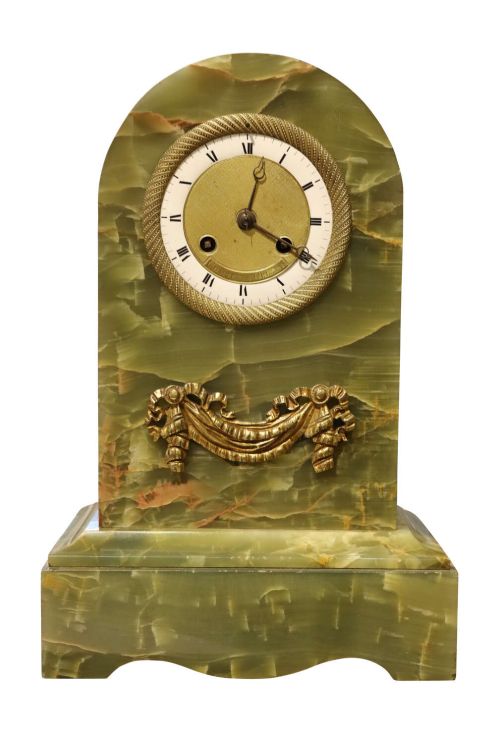
A french onyx clock brings weight and structure to a mantelpiece, combining natural stone with cast metal and traditional movement.
French Onyx Clock
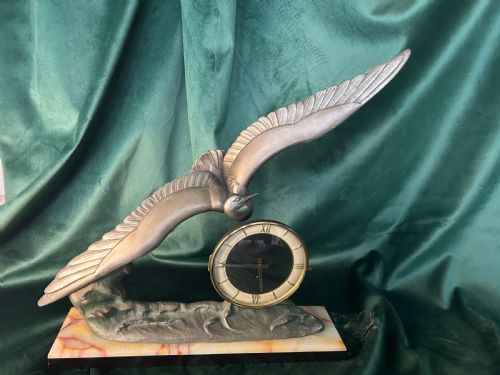
A french onyx clock sits firmly on a mantelpiece or tabletop, frequently accompanied by matching garnitures or side vases to form a complete decorative set. These pieces range from simple single clocks to large three-piece suites designed to anchor a room.
The materials span standard onyx and green onyx alongside marble and brass, housing enamelled dials that show the passage of hours in domestic and formal interiors.
Originating across the nineteenth and early twentieth centuries, these objects encompass styles from Victorian and Louis XVI Revival to Art Deco.
Materials and Construction
Makers shaped blocks of natural onyx and marble to form the heavy architectural cases, often mounting them with brass, ormolu, gilt bronze, and gilt metal details.
Figural elements cast in spelter or bronze portray subjects such as animals, literary figures, and classical deities like Amphitrite, while glass panels enclose crystal regulators and champlevé enamel adds colour to the dials.
Judging Quality
The refinement of the casting in the metal mounts and figural sculptures dictates the distinction between standard production and superior work. Sculptors of note and established makers elevate a piece above ordinary workshop output.
The richness of the green onyx panels and the crisp execution of champlevé enamel distinguish the more ambitious designs from simpler stone cases.
Charles à Orléans·Samuel Marti·Louis Japy·Auguste Moreau·Michel Decoux·F. H. Danvin·H F Moreau·Japy Freres
The French Onyx Clock Glossary
- Garniture
- A set of matching ornamental objects for a mantelpiece, usually consisting of a central clock flanked by two matching urns or side pieces.
- Champlevé
- An enamelling technique where troughs are dug into metal and filled with vitreous enamel before firing.
- Spelter
- A zinc alloy commonly utilised as a less costly alternative to bronze for casting decorative figures.
- Crystal Regulator
- A clock housed in a glass-panelled case that allows the movement and pendulum to be viewed from multiple sides.
- Ormolu
- Gilded bronze or brass applied to furniture and clock cases for decorative effect.
French Onyx Clock: Frequently Asked Questions
What is a french onyx clock garniture?
A garniture comprises a central clock accompanied by a matching pair of side pieces, such as vases or urns, designed to sit together on a mantelpiece.
This arrangement creates a balanced display that was popular in nineteenth-century and early twentieth-century interiors.
How do I care for a french onyx clock?
Keep the clock away from direct sunlight and damp environments to protect the stone and the metal mounts.
Dust the stone gently with a dry cloth and avoid harsh chemical cleaners that might damage the polished surface or the enamel dial.
Were these clocks used in every room?
These clocks were primarily made for principal rooms like drawing rooms, parlours, and dining spaces where guests would admire them.
Their substantial weight and striking appearance suited formal entertaining areas rather than private family quarters.