

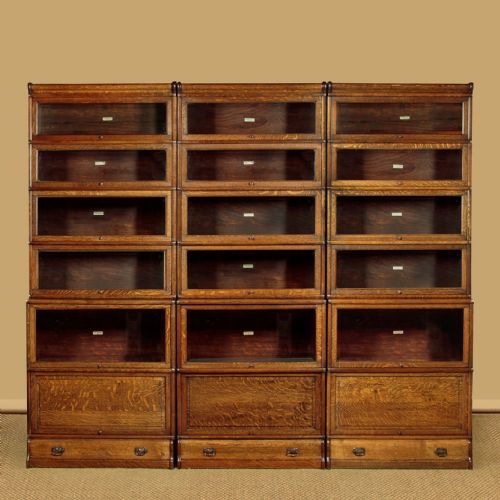


Office Barrister Cabinet
An office barrister cabinet offers modular storage with glazed front sections, combining practical book protection with classic period office design.
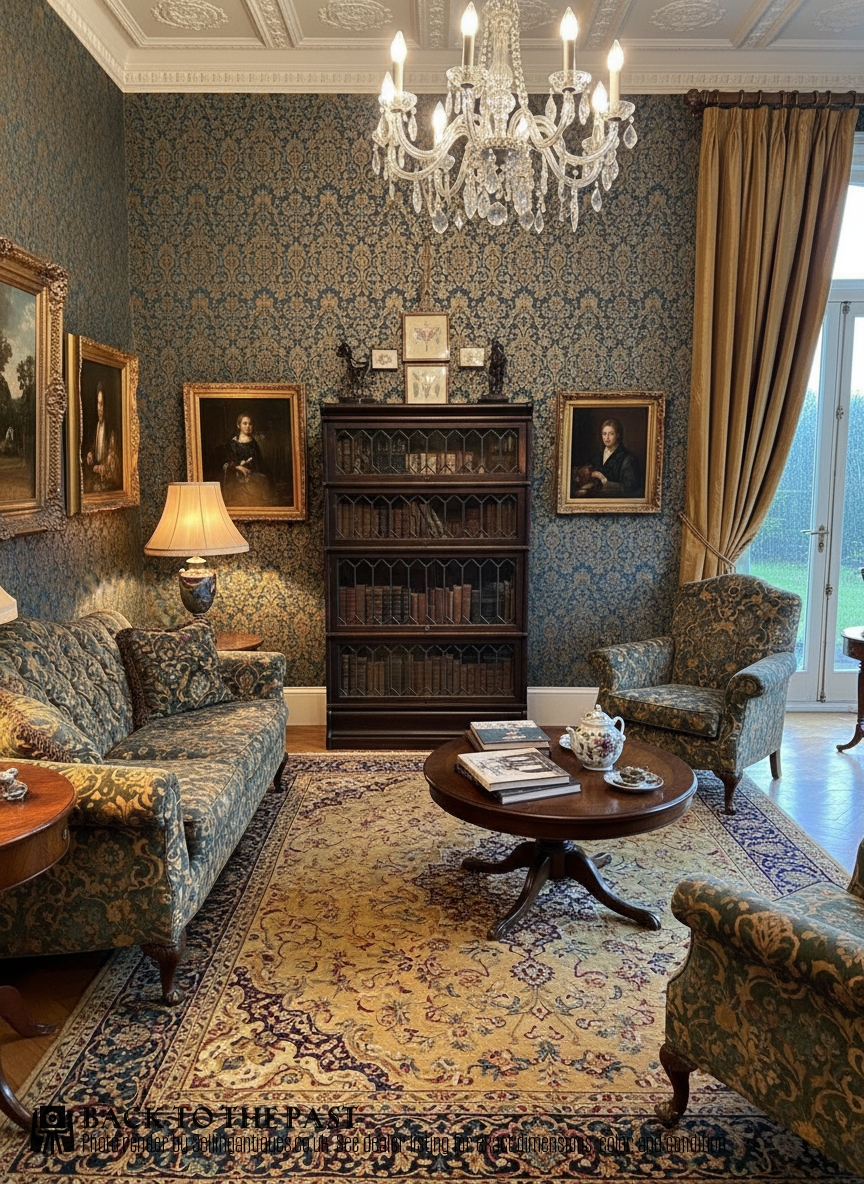
Office Barrister Cabinet
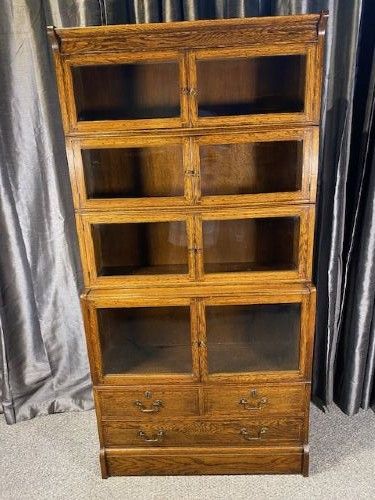
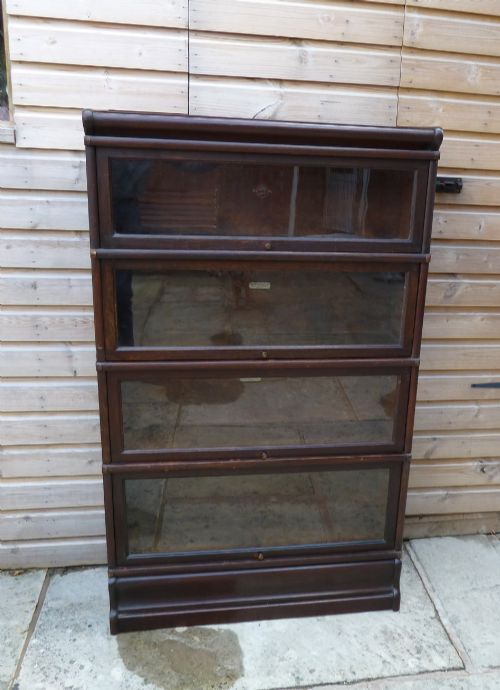
When you search for an office barrister cabinet, you are looking at sectional, modular bookcases designed for easy access to volumes while keeping them free from dust. The form relies on stacking tiers, each topped with its own glazed door that lifts and slides into the cabinet body.
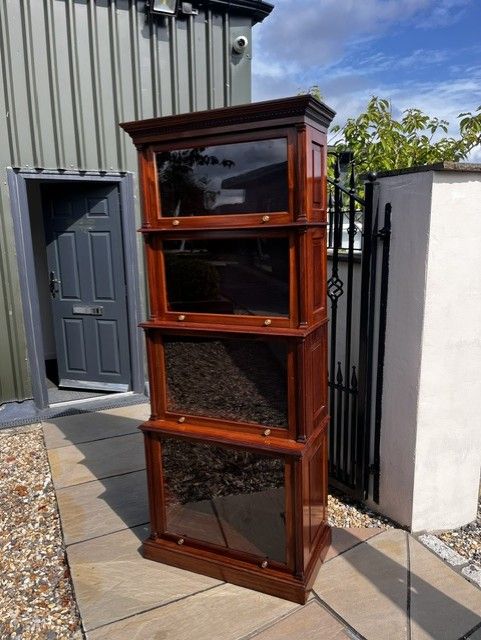
On this page, the pieces you are most likely to meet span the Edwardian period through to the 1930s, constructed predominantly in oak with occasional solid mahogany examples. These cabinets originate from the early twentieth century, reflecting the functional requirements of professional offices and studies from 1900 to 1930.
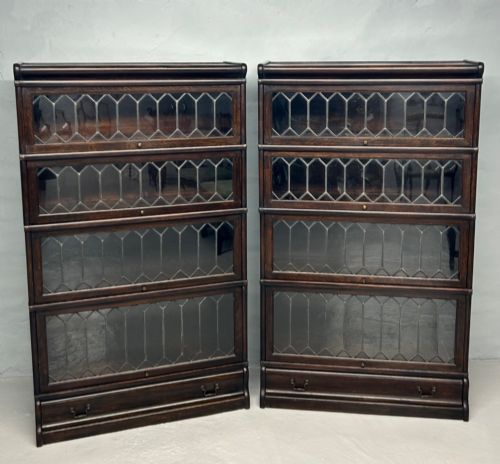
The object types seen here are strictly bookcases, often organised into modular tiers with glass panels and brass hardware. Makers such as Globe Wernicke and Gunn dominate the offerings, providing both standard oak versions and specialised leaded glass configurations.
How they were made
The construction relies heavily on solid oak and solid mahogany, timbers selected for their durability and grain pattern in commercial environments. Timber preparation involved precise joinery to ensure each modular tier aligned correctly when stacked.
Glazing is a central technique, utilising clear or leaded glass housed within timber frames that operate via internal lifting mechanisms. Metal and brass components are integrated into the door tracks and handles to facilitate smooth vertical movement.
Every barrister secretly practises opening all four glass doors at once to see if the mechanism still glides like butter.
What varies in quality
The standard of timber selection and the figuring of the oak or mahogany set the baseline for quality across these stacking bookcases. Golden oak finishes and rich grain patterns distinguish finer examples from plain utility pieces.
Mechanical precision in the stacking tiers and the action of the glazed doors dictate the overall grade of the piece. Well-engineered lifting mechanisms and intact brass hardware indicate superior production by established makers.
Globe Wernicke·Gunn
The Office Barrister Cabinet Glossary
- Stacking bookcase
- A modular bookcase built from separate tiers that sit one upon another. This design allows the cabinet to be expanded by adding further sections.
- Sectional bookcase
- An alternative term for a modular bookcase comprising individual framed tiers. Each tier functions as a standalone box with its own glazed door.
- Globe Wernicke
- A prominent manufacturing firm known for patenting and producing modular barrister bookcases. Their pieces often feature distinct mechanical lifting mechanisms for the glass doors.
- Leaded doors
- Glazing held together by lead caming rather than a single large pane. This traditional method creates geometric patterns within the window frame.
- Tier
- An individual modular section of a stacking bookcase. Tiers can vary in height to accommodate different sizes of books.
Office Barrister Cabinet: Frequently Asked Questions
What is an office barrister cabinet?
An office barrister cabinet is a modular, sectional bookcase featuring glass doors that lift and slide into the cabinet. It was designed to protect law books and reference volumes from dust in professional offices.
The design allows individual tiers to be stacked or separated, making relocation and expansion straightforward.
How do the glass doors work?
The glass doors utilise a mechanical scissor or pivot arm mechanism mounted inside the tier. When pushed, the glazed panel slides horizontally back into the upper cavity of the section.
This ingenious system keeps the door out of the way while you select or return a book.
How do I date these cabinets?
You can date these cabinets by examining the timber, hardware, patent marks, and overall style characteristics. Pieces from the Edwardian era and the 1920s often feature specific maker stamps and golden oak finishes.
Later Art Deco examples from the 1930s tend to show cleaner lines and slightly different proportions.
Can I add more tiers later?
Yes, because these cabinets are modular stacking bookcases, matching tiers from the same maker and period can theoretically be added. Finding an exact match in timber tone and dimensions requires careful searching.
Most units consist of a base, multiple interchangeable glazed tiers, and a top cornice.