
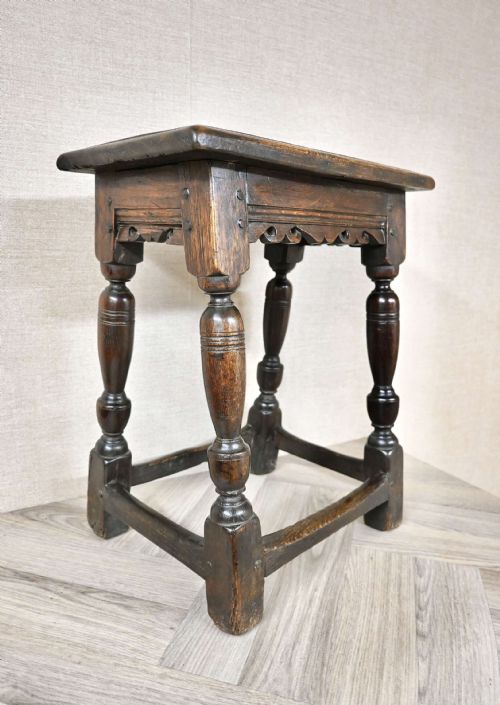
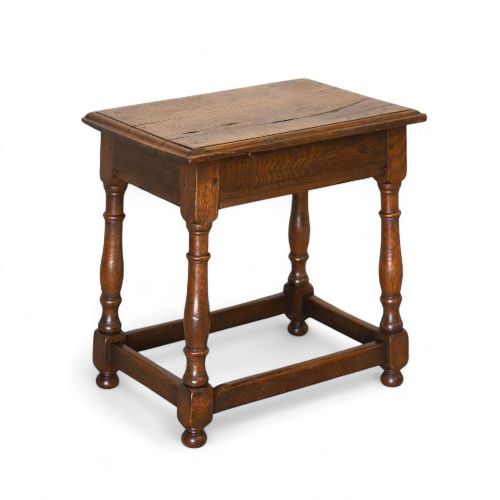
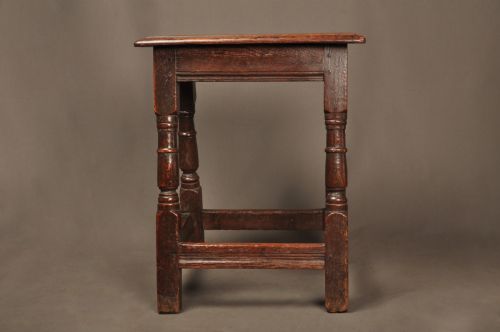


Oak Joyned Stool
These robust oak joyned stool pieces offer the authentic weight of early English domestic life, bringing honest seventeenth-century character directly into your home.
Oak Joyned Stool
An oak joyned stool represents a sturdy form of early seating, constructed with pegged mortise and tenon joints rather than traditional nailing. These pieces primarily emerge from the seventeenth century, alongside provincial examples from the eighteenth and nineteenth centuries.
The version most commonly encountered on this page is the rectangular seventeenth-century English provincial form. Such examples display straightforward turnings and solid timber construction designed for daily household utility.
How they were made
Constructed entirely from solid oak, these pieces rely on traditional joinery methods rather than metal fixings. Pegs secure the structural joints firmly in place.
Makers shaped the uprights using simple turning techniques on a lathe, balancing structural strength with straightforward domestic function.
Childs joyned stool pieces survive from the seventeenth century, proving that even toddlers required proper seventeenth-century seating.
What varies in quality
The distinction between ordinary and superior examples lies in the integrity of the original timber and the presence of untouched surfaces. Pieces retaining their early rich colour and minimal structural replacement command greater appreciation.
Proportion and the crispness of surviving turned details separate provincial execution from finer period work. Better examples maintain their original height and structural rigidity without excessive timber shrinkage.
The Oak Joyned Stool Glossary
- Joint stool
- A piece of seating furniture constructed using joined timber framework rather than simpler carpentry. This term derives from the joined method of construction.
- Jacobean
- A design style associated with the early seventeenth-century reign of James the First. It is characterised by solid construction and geometric turned elements.
- Provincial
- Describing items made in the regions outside London by local craftsmen. These pieces often display simpler, more utilitarian characteristics.
- Untouched
- A description for surfaces that retain their original finish and patination without modern stripping or excessive restoration. This quality preserves the historical integrity of the timber.
Oak Joyned Stool: Frequently Asked Questions
How were joint stools used?
These items served primarily as flexible seating around the seventeenth-century household, easily tucked beneath tables when not in use.
They also functioned as small side tables or stands for holding household objects during daily domestic routines.
How do I date an oak joint stool?
Dating relies on examining the construction methods, the turning style of the legs, and the natural ageing of the oak timber. Seventeenth-century examples typically show hand-split peg construction and distinct regional turning patterns.
Later nineteenth-century interpretations often exhibit different tool marks, machine-sawn components, and a uniformity in the timber that differs from earlier work.
Are seventeenth-century stools durable?
The thick oak construction and pegged joinery provide exceptional structural strength that has endured for centuries. These items remain robust for everyday use if kept away from excessive central heating.
Proper environmental conditions prevent the timber from drying out and ensure the pegged joints stay secure.