

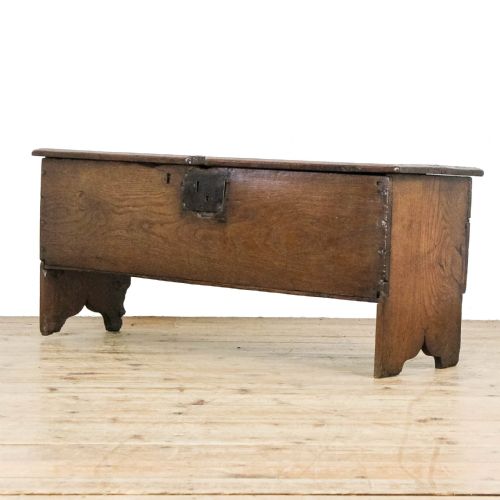


Oak Board Chest
An oak board chest is a heavy storage box built from solid timber planks, prized for its raw utility and sixteenth- or seventeenth-century origins.
Oak Board Chest
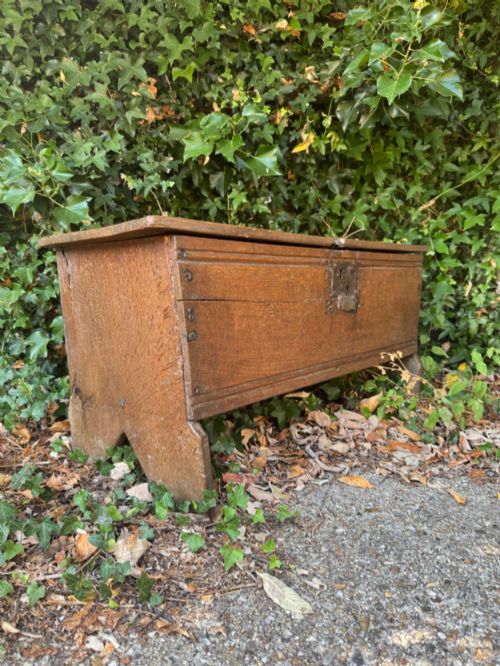
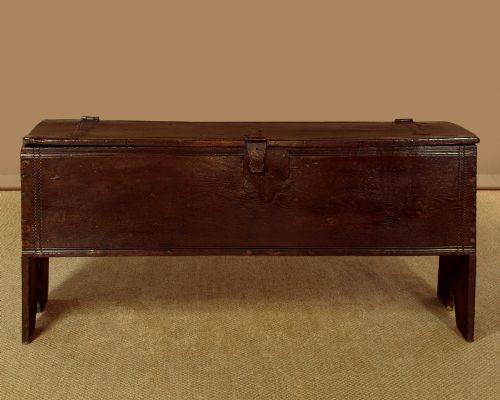
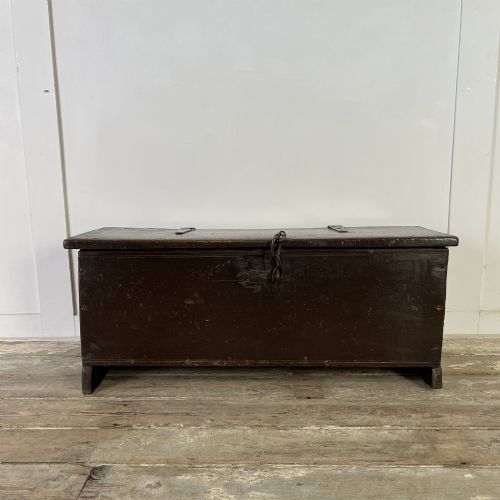
An oak board chest, also known as a plank coffer or six-plank chest, represents the most primitive form of domestic storage furniture from the sixteenth and seventeenth centuries. The pieces on this page span styles from Elizabethan and Jacobean periods to Welsh vernacular expressions, typically constructed with vertical ends housing the horizontal base and lid.
Buyers seeking an oak board chest often encounter long sword chests, meal arks, and compact boxes intended for blankets or valuables. The domestic records show heavy reliance on solid oak boards joined simply, carrying centuries of wear from country houses and farmsteads.
Quality and Proportion
Quality in an oak board chest rests upon the thickness of the original planks, the integrity of the baseboards, and the retention of early ironwork. Pieces retaining their original feet and unreduced heights command greater regard than those trimmed down by later owners.
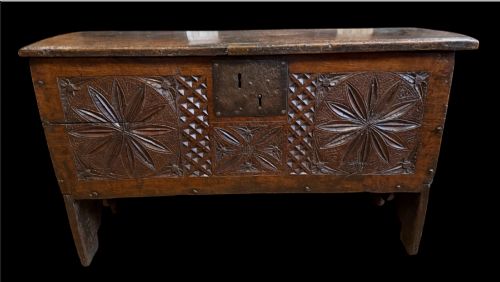
The sophistication of the timber figure and the restraint of any carved decoration dictate the upper tier of examples. Lesser items exhibit extensive board replacement, replaced hinges, or heavy timber shrinkage that alters the primitive silhouette.
Listings feature periods spanning from the sixteenth to the nineteenth century, constructed entirely in solid oak with wrought iron.
The Oak Board Chest Glossary
- Boarded chest
- A simple storage box constructed by joining vertical and horizontal planks directly with pegs or nails, omitting a separate frame.
- Six-plank coffer
- The foundational form of chest made from six distinct boards forming the front, back, ends, lid, and bottom.
- Sword chest
- An elongated variant of the board chest traditionally proportioned to accommodate sidearms or rapiers.
- Meal ark
- A specialised storage chest with a gabled or sloping lid, historically utilised for keeping dry foodstuffs in rural dwellings.
- Vernacular
- Furniture rooted in local traditions and materials rather than high-style court designs, often exhibiting regional eccentricities.
Oak Board Chest: Frequently Asked Questions
What is an oak board chest used for?
These vessels originally secured valuable textiles, documents, weapons, or dry provisions within domestic settings.
Today, they function as heavy storage furniture or coffee tables in traditional and contemporary interiors alike.
How old are these chests typically?
The core examples date from the sixteenth and seventeenth centuries, originating during the Tudor and Stuart periods.
Later vernacular pieces extend into the eighteenth century while maintaining the traditional plank construction method.
How do I identify a six-plank chest?
A six-plank chest uses single boards for each of the four sides, the bottom, and the lid without an internal framework.
The ends typically extend to the floor to serve as feet supporting the box.
Where were these chests made?
Makers constructed them across English counties and Welsh border regions using locally felled timber.
Regional variations appear in the method of edge-joining and the application of primitive chip-carving.