


Norfolk Landscape Art
Norfolk landscape art captures the distinctive coastal marshlands and broads through nineteenth-century watercolours and twentieth-century oils.
Norfolk Landscape Art
Norfolk landscape art brings together paintings and watercolours depicting specific coastal and inland locations across the county, including Cromer, Brancaster Staithe, and the Broads. Buyers searching this phrase look for topographical accuracy combined with regional school traditions that document local waterways and architecture.
The version most commonly met on this page is the nineteenth-century watercolour on paper, often framed in wood and glass. These works frequently record specific scenes such as river sailing, marshland windpumps, and maritime views along the coast.
Later twentieth-century examples also appear, showing post-war impressionist approaches to the same regional subjects. These pieces maintain a focus on local geography while employing broader brushwork and modern colour palettes.
Materials and Techniques
Artists utilised watercolour pigment on paper and card, often mounted within wooden frames under glass to protect the delicate media. Early works rely on transparent washes and fine brushwork to capture atmospheric coastal light.
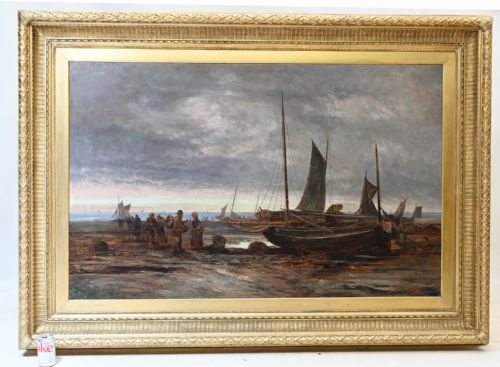
Oil on canvas works employ heavier pigment applications, sometimes set within giltwood frames. These paintings capture the texture of rural scenes, maritime vessels, and flooded marshlands through layered paint.
Several watercolours meticulously record precise muddy riverbanks where nineteenth-century horses once hauled timber.
Assessing Quality
Quality separates through the precision of topographical observation and the artist's handling of atmospheric light. Finer works demonstrate a confident command of perspective, capturing the distinct flatness of the regional horizon and the movement of water.
Condition of the paper, pigment stability, and framing influence the presentation of watercolours. Stronger examples retain their original colour saturation without excessive fading or paper discolouration.
Edward Seago·Sir Thomas Newenham Dean·Frederick William Hattersley·John Edward Bale·Leslie Rackham·Charles Harmony Harrison·H.E. Tidmarsh·Stephen John Batchelder·George De Paris·John Joseph Cotman·Henry Bright·Joseph West·John Thirttle·Thomas Lound
The Norfolk Landscape Art Glossary
- Norwich School
- A regional movement of painters sharing a local focus on Norfolk scenery, working primarily in watercolour and oil during the nineteenth century. This group forms a foundational part of regional landscape art.
- Staithe
- A landing stage or small wharf beside a river or broad, frequently appearing as a focal point in local maritime and river scenes. Artists often depicted loading timber or moored boats at these sites.
- Watercolour pigment
- A water-soluble medium applied to paper or card to create transparent washes of colour. It requires protection behind glass to prevent moisture damage and fading.
- Giltwood
- Wood carved and coated with a thin layer of gold leaf, used historically for framing fine paintings. These frames add decorative weight to oil canvases.
Norfolk Landscape Art: Frequently Asked Questions
What subjects appear in these paintings?
The artworks primarily depict local waterways, coastal cliffs, marshlands, and village churches across the region. Common locations include Cromer, Brancaster Staithe, and the Broads.
Many pieces also record maritime activity, including boats on the hard and timber loading at river staithes.
How do watercolours differ from oils here?
Watercolours utilise pigment on paper, typically presented under glass to prevent environmental damage. They tend to emphasise atmospheric light and delicate topographical detail.
Oils use heavy paint applied to canvas, often housed in giltwood frames, providing a textured surface suitable for post-war impressionist river scenes.
How do I identify the period of a piece?
Nineteenth-century works often feature detailed brushwork recording specific topography and maritime vessels. They frequently utilise paper or card supports.
Twentieth-century examples, including post-war pieces, display broader impressionist techniques and modern handling of colour across canvas supports.
How should I display these artworks?
Works on paper require glass protection and stable indoor environments away from direct sunlight to preserve watercolour pigments. Proper framing safeguards the delicate medium from moisture.
Canvas oil paintings require less rigid protection but benefit from secure wall hanging away from extreme temperature shifts.