
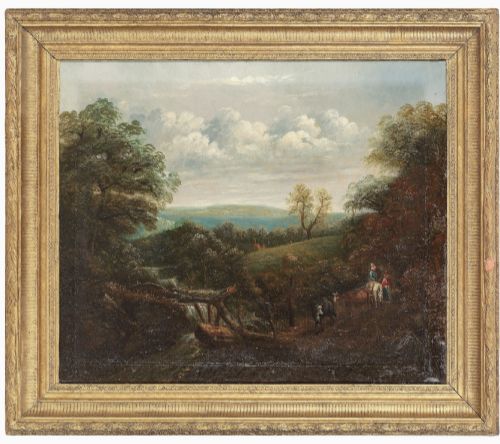


Antique Norwich Paintings
These antique norwich paintings capture local landscapes and figures through the regional school, offering a direct view into eighteenth and nineteenth-century Norfolk.
Antique Norwich Paintings
Buyers seeking antique norwich paintings encounter works rooted in the regional artistic tradition, spanning the late eighteenth century through the Victorian era. The selection includes both oil paintings on canvas or wood panel and watercolours on paper, reflecting the local scenery and portraits of the period.
Landscapes form a prominent part of these listings, featuring subjects such as windmills, river scenes, country paths, and cathedral architecture. These works connect closely to the topography of Norwich and the surrounding Norfolk countryside.
Portraits also appear among the offerings, capturing local figures of the era with distinct regional associations. Works range in date from the early nineteenth century into the Victorian period, representing artists associated with the Norwich School.
How they were made
Painters of this regional school worked primarily in oil on canvas or wood panel, as well as watercolour pigment on paper. These traditional media defined the output of local artists working in the eighteenth and nineteenth centuries.
Many works retain their period framing, utilising gilt wood and glass to protect the watercolours and oil paintings. The combination of paper, canvas, wood, and pigment forms the physical foundation of these historical pieces.
A sturdy local brewer sits permanently at his desk, caught forever in eighteenth-century oil and pigment.
What varies in quality
The distinction between works rests upon the handling of the medium and the sureness of the draughtsmanship across the landscape or portrait. Stronger examples demonstrate confident brushwork in oil or precise control of watercolour pigment on paper.
Compositional depth and the atmospheric rendering of Norfolk light and weather separate standard local depictions from more accomplished pieces. The preservation of the original surface and the quality of the period framing also influence the character of each work.
Thomas Lound·George De Paris·Joseph Clover·John Joseph Cotman·Henry Bright·John Thirttle·Joseph Paul
The Antique Norwich Paintings Glossary
- Norwich School
- A regional movement of artists working in Norfolk during the late eighteenth and nineteenth centuries. They focused heavily on local landscapes, river views, and rural scenes.
- Watercolour
- A painting method where fine pigment is suspended in a water-based solution and applied to paper. Many nineteenth-century Norfolk views utilised this technique.
- Oil on Canvas
- Pigment mixed with drying oil applied to a stretched fabric support. This durable medium allowed artists to build rich textures and deep tones.
- Wood Panel
- A rigid wooden support used by painters instead of canvas. Several regional works utilise this solid foundation for oil painting.
- Gilt Wood
- Timber treated with gold leaf or a gold-coloured finish. This material is typical for the historical frames enclosing these artworks.
Antique Norwich Paintings: Frequently Asked Questions
What is the Norwich School?
The Norwich School represents the first provincial art movement in Britain, flourishing outside London during the late eighteenth and nineteenth centuries. Artists in this circle drew inspiration directly from the Norfolk landscape, coastlines, and local architecture.
Key figures captured rivers, windmills, and rural paths with a distinct local identity. Their output encompasses both detailed watercolours on paper and expressive oil paintings on canvas or wood panel.
How do I care for these paintings?
Protect antique watercolours and oil paintings by keeping them away from direct sunlight and damp conditions. Ultraviolet light fades pigments on paper, while fluctuating humidity damages canvas and wood panels.
Display the works in stable indoor environments using appropriate framing and glass protection where original. Regular dusting of the frames with a soft dry cloth helps preserve their condition.
Are these works framed?
Many listings include historical frames constructed from materials such as gilt wood, which complement the age of the artwork. These surrounds often feature traditional decorative details appropriate for the nineteenth century.
Buyers should examine the specific details for each piece to confirm whether the artwork retains its period frame or comes unmounted. The physical combination of frame and painting preserves the overall historical object.
How do I date a piece?
Dating relies on recorded artist lifespans, stylistic markers of the Victorian or Georgian periods, and documented exhibition histories. Signatures, inscriptions, and medium choices also provide clear chronological indicators.
Works span from the late eighteenth century through the Victorian era, reflecting shifts in British landscape painting. Comparing the subject matter and technique to known dated works helps establish the timeframe.