


Nineteenth Century Music Holder
A nineteenth century music holder organises scores and sheets while anchoring a room with period timber and brass.
Nineteenth Century Music Holder
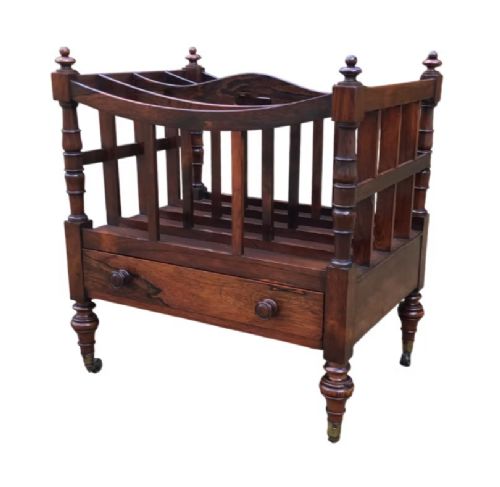
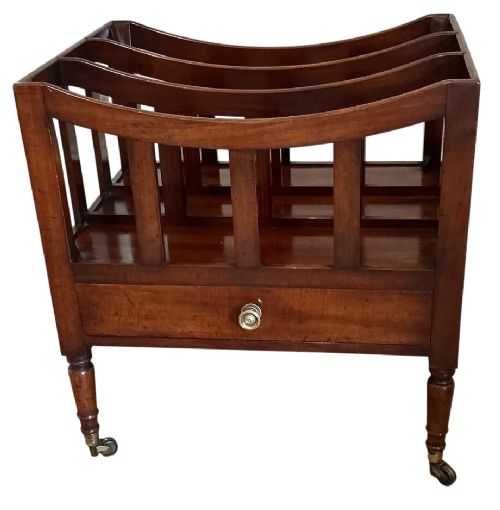
When you search for a nineteenth century music holder, you encounter pieces designed to hold sheet music, scores, and folios in domestic parlours. These items primarily take the form of canterburys, music stands, and magazine racks originating from the Regency, Victorian, William IV, and George IV eras.
The version you are most likely to meet on this page is the mahogany or rosewood canterbury, typically featuring slatted dividers for partitions and often fitted with low castors. These functional stands served households by keeping performance materials upright and accessible near pianos and drawing room instruments.
How they were made
Cabinet makers utilised dense hardwoods such as mahogany, rosewood, walnut, and burr walnut to construct these pieces, frequently applying intricate inlay work and carved details. Wood surfaces were smoothed and polished to highlight natural grain patterns, while structural dividers were tenoned and jointed into sturdy base platforms.
Metal components like brass castors and fittings were incorporated into the designs to allow smooth movement across carpets and floorboards. Certain examples integrated painted wood finishes or delicate carvings to match the prevailing Regency and Victorian aesthetic standards of the workshop.
Several canterburys include tiny internal drawers just deep enough for a stray tuning key or a forgotten pencil.
What varies in quality
The standard of timber selection and decorative technique separates standard utility items from finer workshop commissions. Pieces featuring figured burr walnut, elaborate inlay, or precise carving demonstrate greater artisan investment than plain mahogany variants.
Structural complexity also dictates distinction, where multi-division frames, X-frame designs, and combined music stand tables show more advanced cabinet making than simple single-tier racks.
Edwards & Roberts·Gillows of Lancaster
The Nineteenth Century Music Holder Glossary
- Canterbury
- A low stand fitted with vertical divisions used for holding sheet music, folios, and periodicals. It usually incorporates a small drawer beneath and stands upon short legs with castors.
- Duet music stand
- A specialised stand designed to hold scores for two musicians playing together. These pieces often feature adjustable or pivoting tops supported by carved pedestals.
- Inlay
- A decorative technique where contrasting woods or materials are inserted into recessed portions of the primary surface. This method creates geometric patterns or pictorial motifs.
- X-frame
- A structural configuration where supporting members cross in the shape of the letter X. This design provides both lateral stability and visual lightness to the piece.
Nineteenth Century Music Holder: Frequently Asked Questions
How were canterburys used?
Canterburys were placed near pianos or music tables to hold unbound sheet music, folios, and scores upright in slotted compartments. The lower drawers often stored smaller accessories or tuning keys.
Their mobility on small castors allowed servants or residents to reposition them easily around the room during musical evenings.
How do I identify a Regency music holder?
Regency music holders often feature classical proportions, boat-shaped frames, and restrained brass detailing. They frequently utilise mahogany or rosewood with clean architectural lines.
Later Victorian examples tend to introduce heavier proportions, burr walnut veneers, and more elaborate carving or inlay work.
Can these hold modern magazines?
These stands accommodate modern magazines, newspapers, and contemporary art folios within their original slatted divisions. Their sturdy timber construction handles current reading materials just as well as historical sheet music.
Placing them in a modern living space provides functional tabletop or rack storage with period character.