


Neoclassical Stone Planters
Neoclassical stone planters bring classical architectural formality and sculpted grace directly into garden schemes and interior spaces.
Neoclassical Stone Planters
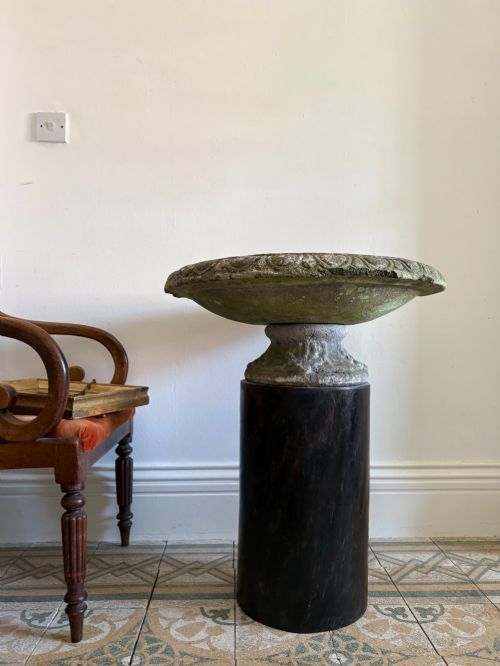
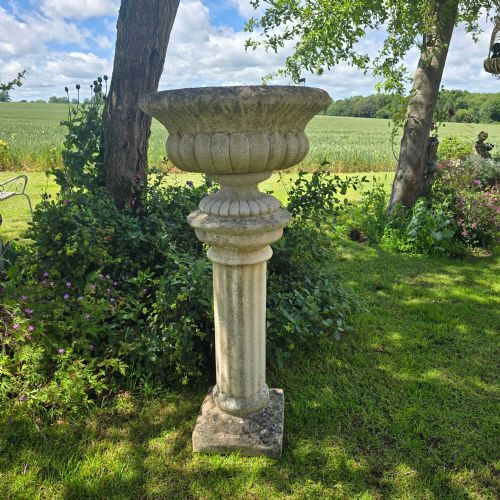
These neoclassical stone planters encompass garden urns, birdbath planters, tazza urns, and architectural cisterns shaped by classical antiquity. The examples met on this page span the eighteenth century, the nineteenth century, the Edwardian period, and early decades of the twentieth century, reflecting enduring revivalist tastes.
Forms draw heavily on ancient models, featuring campana shapes, pedestals, and plinths adorned with motifs such as acanthus leaves. Materials range from durable cast and reconstituted stone to carved marble, limestone, alabaster, and stoneware.
Originating largely from British and Italian workshops, these pieces function both outdoors as garden focal points and indoors as plant stands or decorative vessels. Buyers encounter everything from weathered cast stone birdbaths to finely carved Italian marble campana urns.
Materials and construction methods
Makers utilised traditional carving techniques for pieces fashioned from solid blocks of marble, limestone, and alabaster, working the stone by hand to achieve crisp classical detailing. Surviving items demonstrate precise chisel work on surfaces intended for both interior display and external architectural settings.
Cast and reconstituted stone pieces relied on moulding processes, capturing intricate relief work like acanthus foliage efficiently while offering robust durability for garden use. Iron and paint sometimes supplemented these stone compositions, particularly on associated bases or structural elements.
Current listings feature materials spanning carved marble, alabaster, cast stone, limestone, and stoneware across the eighteenth, nineteenth, and early twentieth centuries.
Distinctions in quality and execution
Quality rests upon the crispness of the carved or moulded detail, where deeply undercut acanthus leaves and well-proportioned campana silhouettes distinguish superior works from simpler productions. The choice of medium also dictates grade, with fine-grained Italian marble and uniform alabaster sitting above coarser cast stone variants.
Age and weathering impart distinct character, though the integrity of the original form and the harmonious pairing of urns with their matching pedestals or plinths govern overall desirability.
The Neoclassical Stone Planters Glossary
- Campana
- A bell-shaped vessel form with a flared rim, widely utilised for classical urns and planters. This silhouette originates from ancient metal and ceramic drinking vessels.
- Tazza
- A shallow cup or urn set upon a high foot and pedestal, frequently carved from marble. These pieces served decorative functions in grand interiors and formal gardens.
- Reconstituted stone
- A composite material manufactured from crushed stone aggregates bound with cement, cast into moulds to replicate carved stonework. It gained popularity for garden ornaments during the nineteenth and twentieth centuries.
- Plinth
- A heavy rectangular or square base supporting an urn, statue, or column. It elevates the planter to enhance its architectural presence.
Neoclassical Stone Planters: Frequently Asked Questions
Can these stone planters stay outside all winter?
Most cast stone and heavy limestone planters tolerate outdoor placement year-round, developing a desirable weathered patina over decades of exposure to the elements.
However, porous stones like alabaster and certain finely carved marbles are better suited to sheltered garden rooms or indoor display to prevent frost damage.
How do I clean a weathered stone urn?
Gentle brushing with warm water and a soft-bristle brush removes accumulated dirt without damaging the historical surface or stripping away pleasing lichen growth.
Avoid harsh chemical cleaners and pressure washers, which can erode soft stone and destroy the aged character accumulated since the nineteenth or early twentieth century.
Are these urns heavy to move?
Solid marble, limestone, and cast stone pieces possess substantial weight due to their dense material composition and thick walls. Moving larger garden urns typically requires mechanical assistance or multiple people to ensure safe handling.
Smaller alabaster or plaster examples prove much lighter and sit comfortably on interior tables or plant stands.
How do I date a neoclassical planter?
Dating relies on examining the material consistency, tool marks, and stylistic nuances that align with periods like the Regency, Victorian era, or early twentieth century. Cast stone compositions and specific moulding techniques often correspond to manufacturing patents from the Edwardian and 1920s eras.
Carved marble pieces displaying hand-chiseled surfaces frequently point towards eighteenth or nineteenth-century Italian and British workshops.