




White Marble Mantel Urns
White marble mantel urns bring neoclassical restraint and gilt warmth to a room, offering the refined symmetry collectors expect from nineteenth-century French and British mantel pieces.
White Marble Mantel Urns
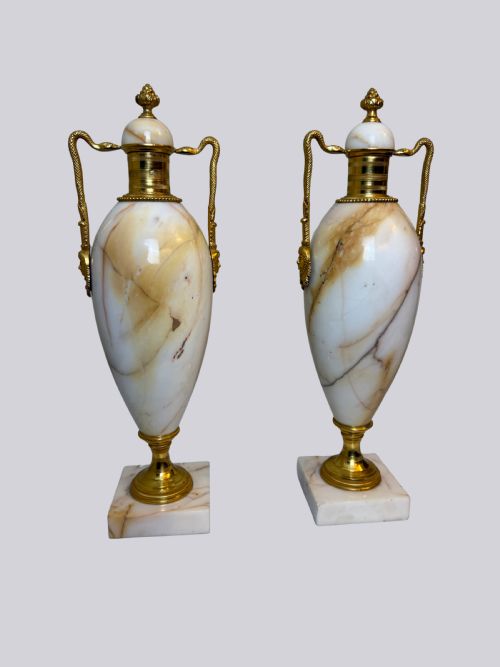
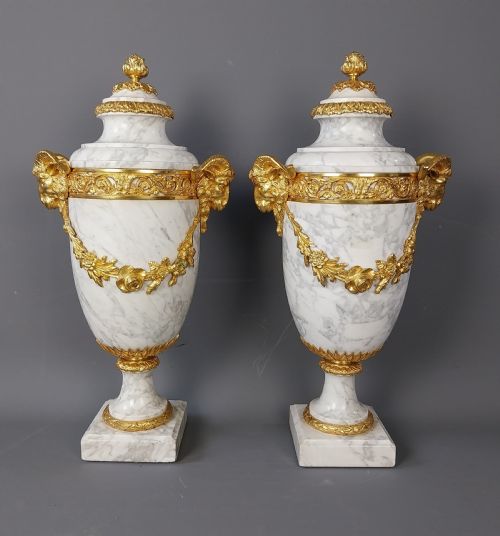
When you search for white marble mantel urns, you are looking at decorative vessels and garniture sets designed to sit upon a fireplace mantelpiece. The pieces found on this page span the eighteenth and nineteenth centuries, taking forms such as standalone decorative urns, cassolettes, and flanking elements within larger clock garnitures.
You are most likely to meet French Louis XVI style or Louis XVI revival examples from the late nineteenth century alongside British Victorian interpretations. These objects often appear paired, accompanied by matching candelabras or centred around a portico or mantel clock.
The aesthetic draws heavily on neoclassical design principles, favouring clean architectural lines, classical proportions, and balanced ornamentation. They function primarily as decorative focal points for a room, carrying the weight of traditional interior styling.
How they were made
The foundational body of these pieces is carved from white marble or white onyx, shaped on a lathe or hand-chiselled into classical vessel forms. This pale stone provides a smooth, cool surface that reflects light across the mantelpiece.
Gilt bronze, ormolu, and brass mounts are applied to the marble structures, offering structural contrast and decorative detail in the neoclassical manner. Enamel elements and black marble accents also appear in the construction, adding colour variation and textural depth to the finished objects.
Listings feature white marble, white onyx, and black marble combined with gilt bronze, ormolu, and enamel across the nineteenth century.
What varies in quality
Quality in white marble mantel urns rests upon the crispness of the stonework and the weight and chasing of the metal mounts. Finer examples display deeply chiselled ormolu with sharp definition in the cast foliage and classical motifs, whereas simpler versions rely on plainer metalwork.
The selection of the marble itself creates a distinction, with dense, uniform white stone and well-matched pairs representing the upper end of production. Integrated garniture sets demonstrate greater ambition in design, requiring harmonious craftsmanship across the clock and its flanking urns or candelabras.
Louis Goret·Sacre·James Ritchie and Son
The White Marble Mantel Urns Glossary
- Ormolu
- Gilded bronze used for decorative mounts on furniture and clocks. The technique involves applying a gold amalgam to bronze and heating it to leave a rich metallic finish.
- Garniture
- A set of matching decorative objects designed to be displayed together on a mantelpiece. These typically consist of a central clock flanked by two urns or candelabras.
- Cassolette
- A decorative vessel that functions as a perfume burner or transforms into a candle holder by reversing the lid. They are frequently encountered in French neoclassical designs.
- Portico clock
- A mantel clock featuring an architectural case supported by columns resembling a classical portico. These often incorporate marble and gilt bronze elements.
- Neoclassical
- A style of art and architecture inspired by the classical art and culture of ancient Greece and Rome. It emphasises symmetry, straight lines, and classical proportions.
White Marble Mantel Urns: Frequently Asked Questions
What are white marble mantel urns?
These are decorative stone vessels created during the eighteenth and nineteenth centuries to ornament fireplace mantelpieces. They often feature classical proportions influenced by neoclassical design movements.
Many examples survive as pairs or as part of larger matching clock garniture sets involving gilt bronze and brass mounts.
How were mantel urns used?
They served as ornamental centrepieces on drawing room and parlour mantelpieces, often accompanied by matching candelabras or a clock. Some specialised forms like cassolettes doubled as functional vessels for burning perfumes.
Their primary role was aesthetic, signalling taste and refinement through association with classical antiquity.
How do I clean white marble?
White marble requires gentle maintenance using a soft, dry cloth to remove dust from the carved surfaces and metal mounts. Avoid harsh chemical cleaners or abrasive agents that can etch the stone or damage the gilt bronze.
Professional advice should be sought if the ormolu mounts require deeper restoration or conservation.
How can I tell the period?
Dating relies on examining the style of the metal mounts, the turning of the marble, and any maker signatures on the associated clock movements. Eighteenth-century pieces exhibit different cast qualities and proportions compared to late nineteenth-century revival items.
Matching garnitures often provide clues through the uniformity of the patination and the construction methods of the bronze elements.