



Neoclassical Ormolu Candelabra
Neoclassical ormolu candelabra bring imposing symmetry and gilded warmth to a room, combining cast metal and classical restraint.
Neoclassical Ormolu Candelabra
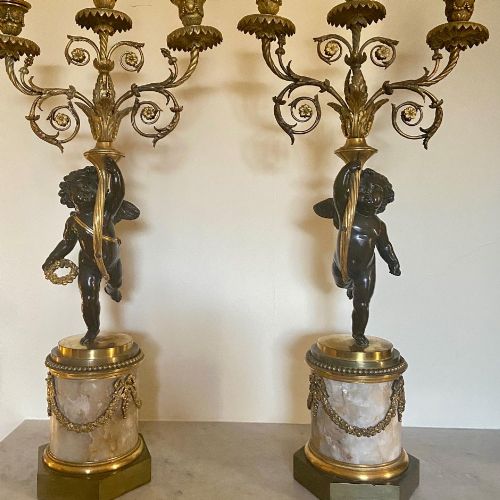
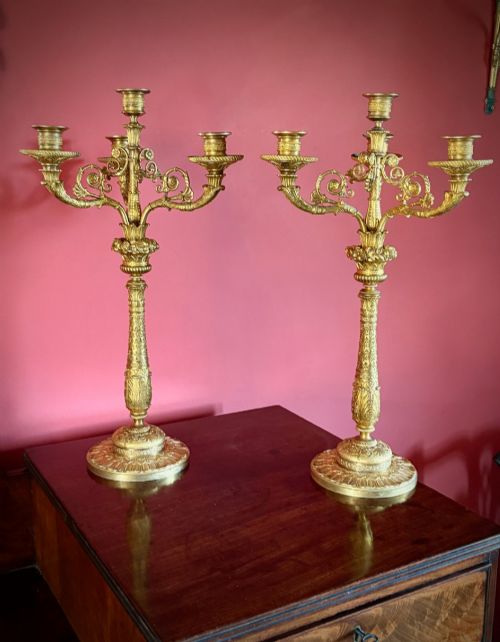
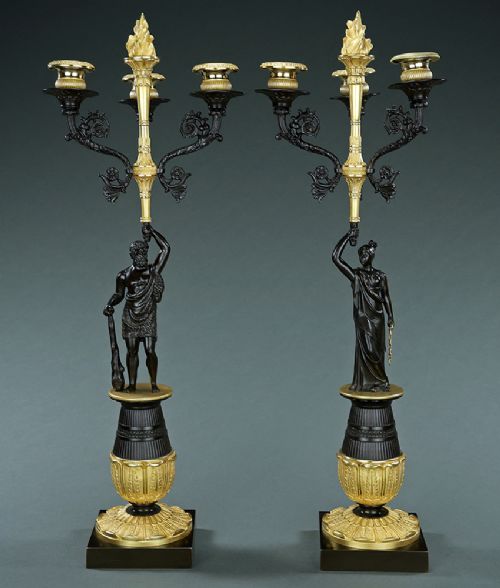
Neoclassical ormolu candelabra stand as sculptural lighting pieces, frequently appearing in pairs as part of broader mantel clock garnitures or standalone table lights. The pieces draw upon French Empire, Louis XVI, and Regency styles, reflecting classical motifs through figures such as putti, Hercules, and classical drapery.
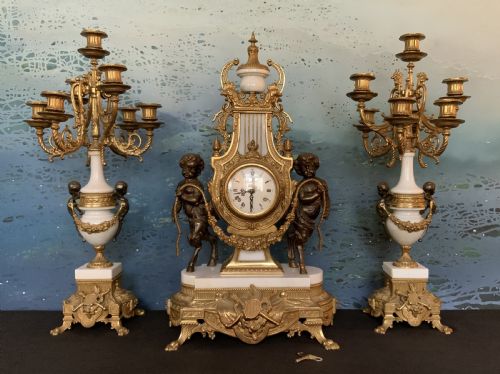
Buyers encounter forms ranging from two-arm and four-arm candelabra to three-piece garniture sets comprising a central clock flanked by matching candelabra. The selection includes standard lamps, wall sconces, and chandeliers sharing the same vocabulary of gilt bronze, marble, and patinated metal.
Most items date from the nineteenth century, spanning periods from the early French Empire era through to late nineteenth-century Louis XVI revivals. Occasional twentieth-century examples also emerge, maintaining traditional forms in bronze and marble.
Materials and Construction
Maker workshops utilised gilt bronze, often termed ormolu, alongside contrasting patinated bronze or metal to create depth and texture within a single piece. White marble and slate serve as stable, weighty bases that anchor the upward thrust of the metal branches.
Casting methods allowed for intricate detailing, capturing the musculature of figures, the folds of garments, and the crisp leaf-scrolls of classical ornament. Gilding was applied to bronze surfaces to achieve a brilliant metallic sheen that catches ambient light.
Hercules and Hesione occasionally share a bronze mantelpiece, bringing an unexpected mythological rescue mission directly to the dining room.
Judging Quality and Finish
Quality rests upon the crispness of the bronze chasing and the depth of the mercury gilding, where sharper details and richer golden tones separate superior work from simpler castings. The integration of materials also dictates standard, with tightly fitted marble bases and securely joined bronze elements showing greater workshop discipline.
Pieces bearing signatures from notable makers or demonstrating ambitious sculptural groups, such as patinated putti or mythological figures, represent the upper tier of the range. Simpler brass or gilt metal variants without hand-chased definition occupy the baseline.
Francois Redmond·Rabiat·Claude Clodion·AD Mougin Paris·Thomas Hope
The Neoclassical Ormolu Candelabra Glossary
- Ormolu
- Gilded bronze produced by applying a mercury and gold amalgam to a bronze base before heating. This historical technique creates a durable, luminous golden finish characteristic of fine antique metalwork.
- Garniture
- A set of matching decorative ornaments designed to be displayed together on a mantelpiece. Typically, a garniture consists of a central clock accompanied by a pair of matching candelabra or vases.
- Patinated Bronze
- Bronze treated to produce a dark, weathered surface colouration. This contrasting dark finish highlights the bright, reflective quality of adjacent ormolu sections.
- Louis XVI Style
- A decorative aesthetic rooted in eighteenth-century French classical revival, prioritising straight lines, symmetry, and classical motifs. Ormolu candelabra from later nineteenth-century revivals frequently adopt this vocabulary.
Neoclassical Ormolu Candelabra: Frequently Asked Questions
How do I identify French Empire style?
French Empire style draws heavily on the classical antiquity of Greece and Rome, displaying heavy proportions, military trophies, and mythological figures. You will frequently see patinated bronze figures paired with bright ormolu mounts.
This aesthetic flourished during the early nineteenth century and conveys a sense of imperial grandeur and architectural structure.
Where should I place candelabra?
Candelabra look best positioned on mantelpieces, large sideboards, or console tables where their height and symmetry can anchor a room. They function effectively as decorative centrepieces even when unlit.
Ensure the surface is stable and level, as the combination of bronze and marble makes these pieces exceptionally heavy.
How do I clean ormolu?
Clean ormolu gently using a soft, dry microfibre cloth to remove dust without scratching the delicate gilded surface. Avoid abrasive cleaners, chemical polishes, or water, as these can strip the historical mercury gilding.
Professional conservation is recommended if deeper cleaning is required to address stubborn grime or oxidation.