

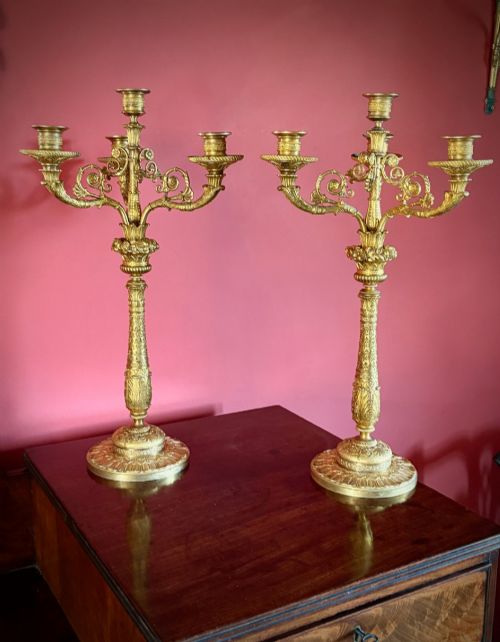
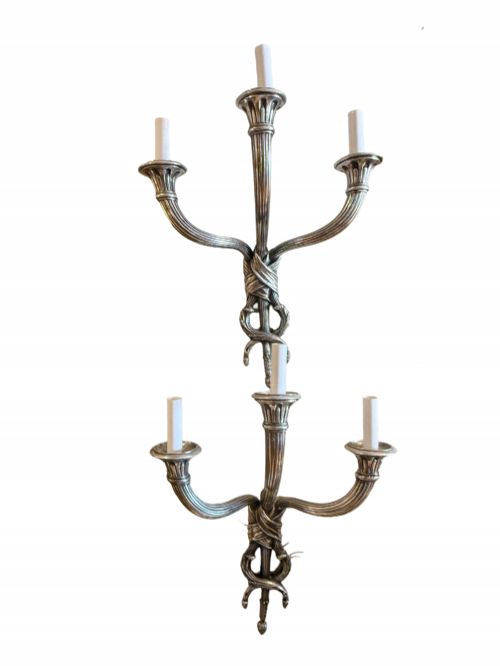


Neoclassical Metal Candelabra
Neoclassical metal candelabra bring classical order and formal symmetry to a room, offering grand lighting shaped by centuries of revival design.
Neoclassical Metal Candelabra
When you search for neoclassical metal candelabra, you find branched lighting and garnitures rooted in ancient Greek and Roman motifs. These pieces range from compact twin-arm table lights to large paired floor standards.
The selections here span the nineteenth century into the early twentieth century, taking in Victorian examples alongside French Empire and Regency interpretations. You are most likely to meet paired items finished in gilt or patinated metals.
Forms extend beyond traditional table candelabra to include wall sconces, clock garnitures, and adapted lamps. Each piece relies on architectural proportions, urn motifs, and symmetrical branch arrangements to establish its character.
Materials and construction
Construction relies on cast and chased metals, predominantly bronze, brass, and gilt metal, combined with patinated surfaces to create tonal contrast. Ormolu and gilt bronze finishes provide a bright, reflective sheen that highlights classical ornamentation.
Many examples incorporate secondary materials such as white marble and slate to anchor the metal components and add structural weight. Individual branches, nozzles, and figures were cast separately before being assembled into rigid multi-arm structures.
Object forms on this site include wall sconces, clock garnitures, standard lamps, and table lamps alongside traditional multi-armed candelabra.
Assessing quality and execution
Quality shows in the crispness of the chasing and the precision with which decorative details are defined in the metal. Superior examples display sharply rendered acanthus leaves, figures, and beaded borders rather than softened, shallow casting.
The weight and stability of the piece, particularly in bases made from marble or slate, indicate the standard of manufacture. Better proportions and balanced branch distribution separate refined decorative objects from heavier, less harmonious alternatives.
The Neoclassical Metal Candelabra Glossary
- Ormolu
- A gilded bronze finish achieved by applying an amalgam of mercury and gold to a bronze base. This technique was widely utilised in French and English workshops during the eighteenth and nineteenth centuries.
- Candelabrum
- A branched candlestick designed to hold multiple taper candles at once. The plural form candelabra refers to these multi-armed fixtures.
- Garniture
- A coordinated set of decorative objects, typically consisting of a central clock flanked by matching candelabra or vases. These sets were designed to sit upon mantelpieces.
- Patinated metal
- Metal whose surface has been deliberately darkened or aged through chemical treatment or natural oxidation. This process emphasises contours and subdues the brightness of raw base metals.
- French Empire
- A decorative style spanning the early nineteenth century characterised by grand classical military and imperial motifs. Pieces from this period often incorporate dark bronze alongside bright ormolu mounts.
Neoclassical Metal Candelabra: Frequently Asked Questions
What are neoclassical metal candelabra?
These are branched lighting fixtures and decorative objects styled after the architecture and ornamentation of classical antiquity. They use symmetrical layouts and motifs such as urns, columns, and acanthus leaves.
They appear in various forms, including table candelabra, wall sconces, and complete mantelpiece garnitures set with marble or slate bases.
How were these candelabra used?
They were designed to hold candles that illuminated formal rooms, dining tables, and mantelpieces in large houses. Their reflective surfaces helped amplify the flickering light of multiple tapers.
Over time, many surviving examples were adapted with electrical fittings to function as table lamps or standard lamps while retaining their original metal branches.
How do you clean patinated metal?
Dusting gently with a soft, dry cloth is the safest way to maintain patinated bronze, brass, or iron surfaces. Avoid abrasive cleaners or harsh polishes that can strip away the historical patina.
Gilt surfaces require particular care to prevent the thin layer of gold from wearing away under vigorous rubbing.
How do I spot a Regency pair?
Regency pieces often display restrained classical lines influenced by French styles, frequently combining dark patinated metal with bright ormolu mounts. Look for precise casting of classical figures, drapery, and foliate scrolls.
Proportions tend to be balanced and rigorous, reflecting early nineteenth-century interpretations of Greek and Roman antiquities.
What is a clock garniture?
A clock garniture is a matched set comprising a central timepiece accompanied by side pieces such as candelabra or urns. They were created to display together on a mantelpiece or sideboard.
The materials and decorative motifs match across the set, linking the clock and its companion pieces into a single composition.