



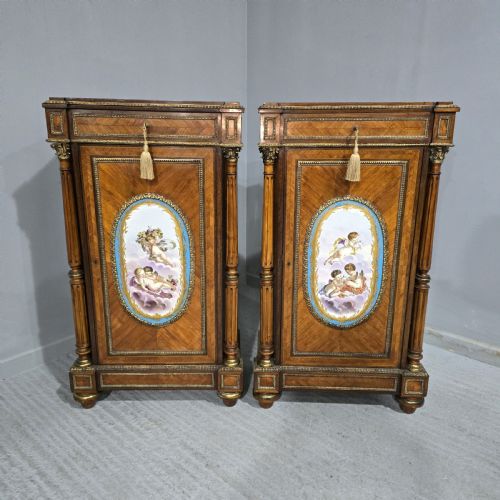
Neoclassical Marquetry Cupboard
A neoclassical marquetry cupboard brings deliberate geometric marquetry and classical proportion into a room, offering both display and concealed storage.
Neoclassical Marquetry Cupboard
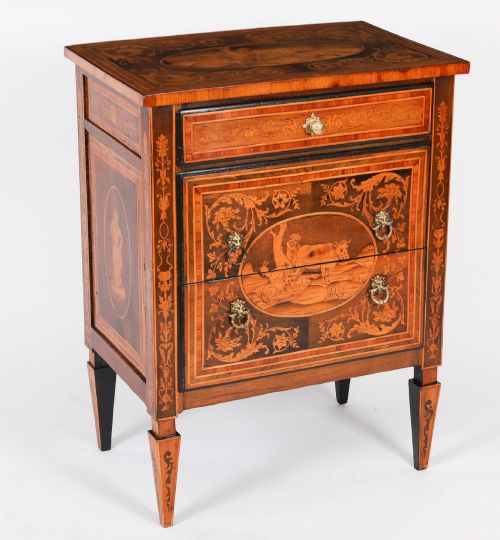
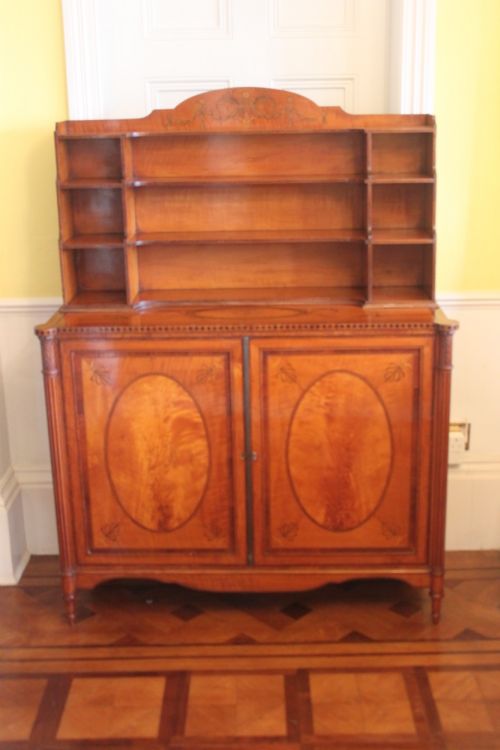
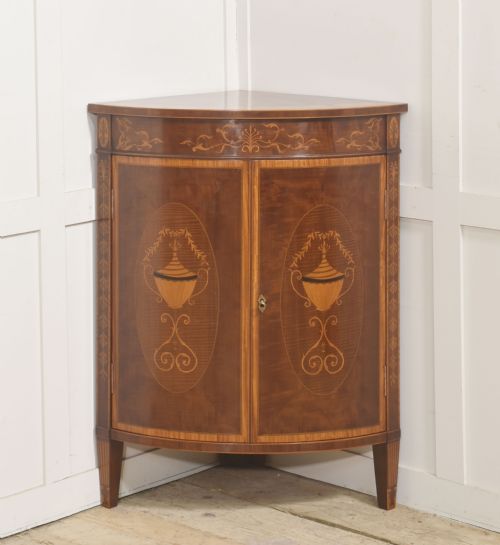
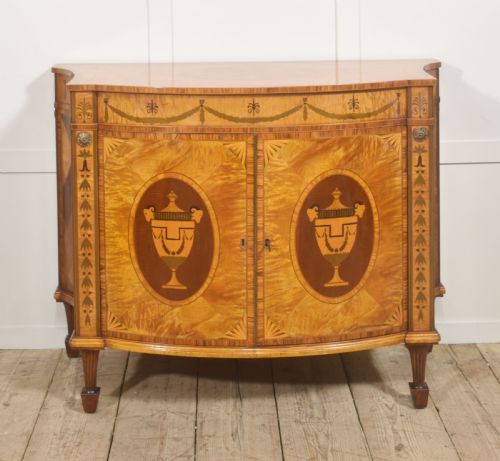
A neoclassical marquetry cupboard takes many cabinet forms, ranging from corner cabinets and bedside commodinos to expansive sideboards, side cabinets, and tall display pieces.
The pieces appearing on this page span the eighteenth century through to the twentieth century, encompassing Georgian origins alongside later revival phases such as Sheraton Revival, Adam Revival, and Louis XVI styles.
Buyers will most frequently encounter satinwood and mahogany carcases embellished with intricate boxwood, rosewood, and harewood inlay, following classical architectural lines and symmetrical floral or urn motifs.
Materials and construction
Cabinet makers constructed these carcases using solid timbers such as mahogany, walnut, and maple, frequently applying fine veneers of satinwood and harewood to the primary surfaces.
Marquetry decoration was achieved by cutting contrasting timbers, including boxwood and rosewood, into intricate pictorial or geometric patterns and fitting them precisely into shaped recesses.
Many examples incorporate cast brass mounts, parcel gilding, marble tops, and glazed doors, combining cabinetmaking with specialised veneer work and metal detailing.
Neoclassical Marquetry Cupboard Retail Price Guide 2026
Typical asking prices for neoclassical marquetry cupboard among the pieces listed under this phrase on Sellingantiques today, from the lower quarter to the upper quarter. They describe what is for sale here now, not the wider market.
Listings here feature eighteenth-century origins alongside nineteenth-century Sheraton and Adam revivals, constructed in satinwood, mahogany, and walnut.
Judging quality and execution
The distinction between standard production and top-tier workshop output lies in the precision of the timber matching and the complexity of the marquetry cutting, where tighter joints and varied natural grain shading elevate the piece.
The choice of secondary timbers and the crispness of applied brass or gilt mounts indicate the level of care invested during construction, separating ambitious revival pieces from simpler utility furniture.
Maple and Co.·Pietro Ferrario·Edwards and Roberts
The Neoclassical Marquetry Cupboard Glossary
- Marquetry
- Decorative veneer work arranged in pictorial or geometric patterns using various coloured woods. It differs from inlay by covering the entire surface rather than resting within hollowed-out channels.
- Satinwood
- A durable tropical hardwood with a lustrous, golden-yellow sheen prized in eighteenth-century and revival furniture. It serves as a primary ground for intricate marquetry panels.
- Demi-lune
- A half-moon shape characteristic of side cabinets and console tables designed to sit flush against a wall. This curved form requires specialised bending of veneers and accurate marquetry fitting.
- Commodino
- A small bedside cabinet or chest of drawers originating in Italy. These compact pieces often display floral marquetry on walnut or mahogany carcases.
- Harewood
- Sycamore timber treated to a warm greyish-brown hue by being stained with green iron sulfate. Cabinet makers utilised it to provide subtle tonal contrast in floral and architectural marquetry.
Neoclassical Marquetry Cupboard: Frequently Asked Questions
How do I spot a revival piece?
Revival pieces display secondary woods, machine-cut veneers, and hardware styles characteristic of the nineteenth or early twentieth century rather than the eighteenth century.
Examining the drawer linings, backboards, and internal construction methods clarifies whether a cabinet dates to the original neoclassical period or subsequent revival movements.
Where should I place a corner cabinet?
Corner cabinets fit directly into room angles, utilising dead space while providing display or storage capacity through fitted shelving.
Their angled footprint makes them practical for dining rooms, hallways, or drawing rooms where straight-sided furniture would block natural pathways.
Are bedside cabinets matching pairs?
Many bedside cabinets appear as matched pairs, though some survive as single items depending on their original domestic context.
Pairs often show mirrored marquetry motifs designed to flank a bedstead symmetrically.
How do I care for satinwood veneer?
Satinwood veneer requires stable indoor humidity and protection from direct sunlight to prevent the golden timber from fading or the underlying glue from drying.
Periodic dusting with a dry cloth and gentle waxing help preserve the polished surface without damaging the delicate marquetry borders.