
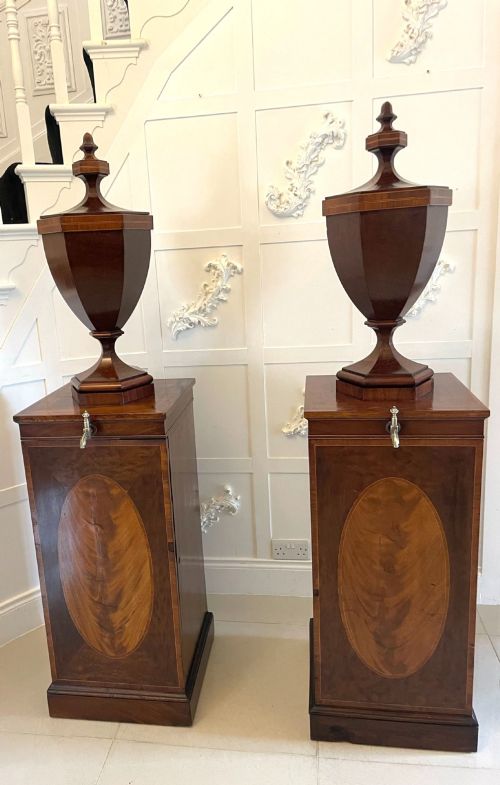
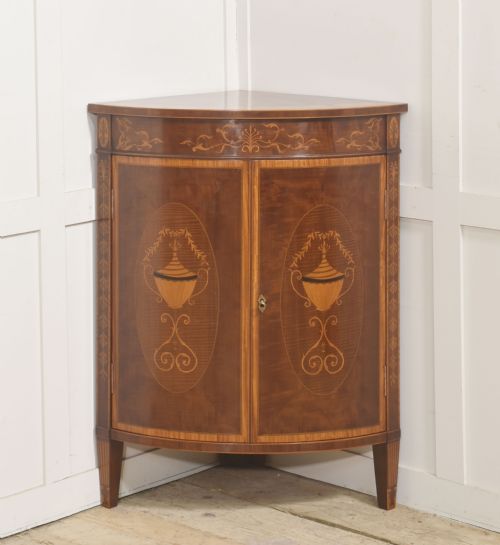


Neoclassical Mahogany Cupboards
Neoclassical mahogany cupboards are refined storage pieces combining classical restraint with rich timber, highly prized for bringing formal symmetry and warmth to a room.
Neoclassical Mahogany Cupboards
Neoclassical mahogany cupboards span a variety of forms designed for formal rooms, ranging from corner cabinets and side cabinets to display pieces and bedside furniture. Buyers seeking neoclassical mahogany cupboards encounter items originating from the late eighteenth century through the Edwardian period and into the twentieth century, reflecting revivals of George III, Sheraton, and Adam styles.
The most common versions met on this page include Sheraton Revival corner cabinets and side cabinets, often enhanced with satinwood inlay, alongside French Empire pieces featuring marble tops and brass details. These storage items serve both decorative and functional roles in domestic interiors.
Origins stretch across English, French, Italian, and Dutch workshops, showing how continental neoclassical tastes adapted mahogany to varied regional forms like demi-lune commodes and tambour front cupboards.
Materials and Technique
Makers built these pieces primarily using solid mahogany and mahogany veneers over secondary timbers, selecting straight-grained stock for stability and figured cuts for visual depth on doors and panels. Satinwood, boxwood, and maple provided contrasting tones for elaborate inlaid decoration.
Surface ornamentation relied on precise marquetry, parquetry, and stringing, often combined with cast brass or ormolu mounts, handles, and sabots. Marble tops appeared frequently on French Empire models, offering a durable and cool contrasting surface to the dark timber.
Some gentleman's robes manage to sneak in among the polite company of dainty display cabinets.
Assessing Quality
The distinction between standard and superior pieces rests on the precision of the cabinetmaker's joinery and the crispness of the inlay work. Finer examples display tightly executed marquetry where contrasting woods fit seamlessly without excessive filler.
Quality also shows in the choice of secondary woods, the weight and finish of applied ormolu or brass hardware, and the structural integrity of internal shelving and drawers. Top-tier items maintain balanced proportions and harmonious grain matching across all visible surfaces.
Jewell of Holborn·Maple and Co·Edwards and Roberts
The Neoclassical Mahogany Cupboards Glossary
- Demi-lune
- A half-moon shape characteristic of tables, commodes, and side cabinets designed to sit flush against a wall. This profile became particularly popular during the Sheraton Revival period.
- Marquetry
- A technique of applying decorative veneers in patterned wood mosaics to form pictorial or geometric designs. It requires steady hand-cutting and meticulous assembly.
- Ormolu
- Gilt bronze mounted onto furniture as decorative feet, handles, and gallery rails. The process involves applying a gold amalgam to bronze before heating.
- Tambour
- A flexible sliding door made of narrow vertical strips of wood glued to a canvas backing. It allows smooth operation around curved cabinet fronts.
- Inlay
- The technique of inserting contrasting strips of wood such as boxwood into recesses carved into the primary mahogany ground. This creates crisp linear borders.
Neoclassical Mahogany Cupboards: Frequently Asked Questions
What rooms suit neoclassical mahogany cupboards?
These pieces suit dining rooms, drawing rooms, and hallways where formal storage and display surface are required. Their classic proportions allow them to anchor a room without overwhelming surrounding furniture.
Smaller formats like bedside cabinets or corner cupboards fit easily into intimate spaces while retaining the architectural lines characteristic of the style.
How do I care for mahogany surfaces?
Maintenance involves dusting with a soft, dry cloth and avoiding placement near direct heat sources or strong sunlight. These precautions prevent timber drying and veneer lifting.
Applying a traditional beeswax polish occasionally maintains the lustre of the timber without building up heavy chemical residues.
How are revival pieces dated?
Dating relies on examining construction methods, secondary timbers, and the specific characteristics of revival movements such as the Edwardian Sheraton Revival. Cabinet framing, drawer linings, and screw types offer clear indicators of age.
Maker stamps and stamps from retailers like Maple and Co also assist in establishing a reliable production period.
Are marble tops original?
Marble tops on French Empire commodes and side cabinets are typically original to the design, providing a heavy, stable surface above the mahogany structure. The thickness and edge profile of the marble correspond to nineteenth-century standards.
Matching the stone to the cabinet style confirms its authenticity within the piece's history.