

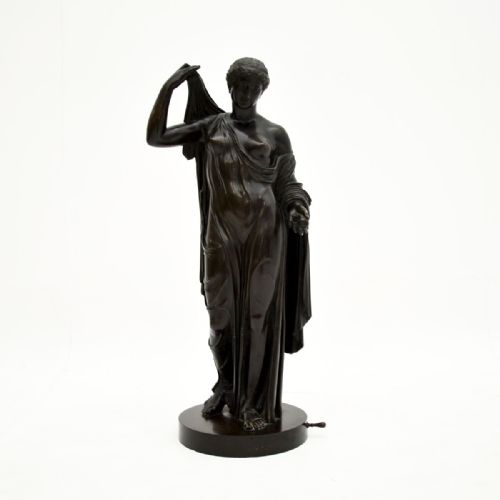
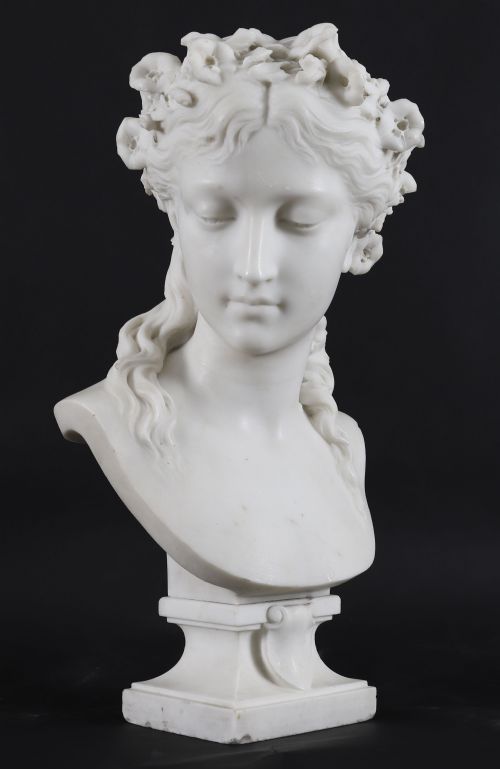


Neoclassical Lady Statue
A neoclassical lady statue brings classical drapery and timeless form into a room, capturing the enduring appeal of antiquity.
Neoclassical Lady Statue
A neoclassical lady statue embodies the classical ideals of ancient Greece and Rome, reimagined across the nineteenth century and into the mid-twentieth century. These figures appear as large garden statues, freestanding interior sculptures, portrait busts, and even functional bookends.
The versions most commonly met on this page range from nineteenth-century bronze robed figures and marble busts to mid-twentieth-century reconstituted stone garden pieces. Makers and sculptors drew heavily upon Regency and Victorian neoclassical vocabularies to create these draped and semi-nude ladies.
Whether executed in biscuit porcelain or heavy cast stone, each neoclassical lady statue reflects an ongoing fascination with antiquity. They serve equally well as commanding focal points in gardens or as refined decorative objects upon interior mantelpieces and plinths.
How they were made
Foundry-cast bronze and carved white or mixed marble represent the primary materials of the finer interior works, often requiring considerable sculptural skill to render the delicate folds of drapery. Parian ware and biscuit porcelain provided a smooth, matte finish well suited to smaller classical figures.
Exterior and larger garden pieces rely on robust media such as cast stone, reconstituted stone, and plaster. These heavier sculptural forms were frequently cast in moulds to achieve the substantial presence required for outdoor display on plinths.
Neoclassical Lady Statue Retail Price Guide 2026
Typical asking prices for neoclassical lady statue among the pieces listed under this phrase on Sellingantiques today, from the lower quarter to the upper quarter. They describe what is for sale here now, not the wider market.
Some nineteenth-century classical ladies double as bookends, keeping heavy volumes upright with an air of ancient dignity.
What varies in quality
Quality rests primarily in the crispness of the carving or the fidelity of the bronze casting, particularly in how convincingly the sculptor renders the fall of fabric over the human form. Finer works display meticulous attention to anatomical proportion and facial expression.
The choice of material heavily dictates the character of the piece, distinguishing high-grade Carrara marble and finished bronze from standard plaster or cast stone. Signed works by recognised sculptors elevate a piece above anonymous production.
Eugene Aizelin·Royal Worcester
The Neoclassical Lady Statue Glossary
- Neoclassical
- A style reviving the architectural and artistic forms of ancient Greece and Rome, prominent during the eighteenth and nineteenth centuries. It emphasises symmetry, restraint, and classical drapery.
- Parian ware
- A type of fine biscuit porcelain developed in the nineteenth century to imitate carved marble. It is frequently seen in Victorian figures and busts.
- Grand Tour
- A traditional trip of Europe undertaken by upper-class young men of means in the eighteenth and nineteenth centuries. Travellers often returned with small bronzes and marbles representing classical antiquities.
- Biscuit porcelain
- Unglazed ceramic porcelain fired once to produce a matte, tactile surface resembling marble. It was widely utilised for nineteenth-century decorative figures.
- Regency
- A British stylistic period spanning the early nineteenth century characterised by a heavy borrowing of Greco-Roman motifs. Furniture and decorative arts from this era display clean lines and classical ornamentation.
Neoclassical Lady Statue: Frequently Asked Questions
Where should I place a heavy stone statue?
Heavy stone and reconstituted stone statues suit outdoor garden settings best, especially when mounted securely on a matching plinth to withstand the elements.
For interior spaces, ensure the floor or furniture can bear the substantial weight of marble or bronze pieces before final placement.
How do I care for nineteenth-century bronze?
Nineteenth-century bronze requires only occasional dusting with a soft, dry cloth to protect its patinated surface from accumulating moisture and airborne grit.
Avoid applying modern polishes or abrasive cleaners, which can strip away the historical oxidation developed over decades.
What is the difference between marble and alabaster?
Marble is a hard, metamorphic rock capable of holding sharp sculptural details and withstanding both indoor and outdoor environments.
Alabaster is softer and more translucent, making it better suited for delicate indoor carvings that avoid direct exposure to moisture.
Are these figures solid bronze?
Most sculptural figures from the nineteenth century are cast using the lost-wax method, resulting in hollow metal forms rather than solid blocks of bronze.
This technique allowed makers to produce substantial decorative objects that remained manageable in weight and cost.