




Neoclassical French King Bed
A neoclassical french king bed brings monumental proportions and refined classical geometry straight into the master bedroom.
Neoclassical French King Bed
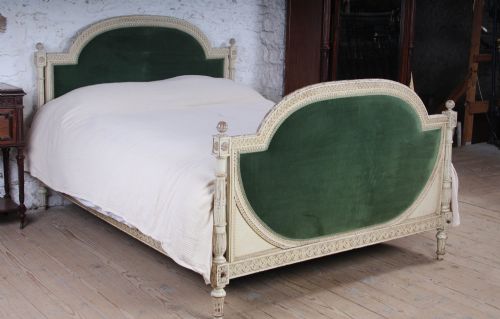
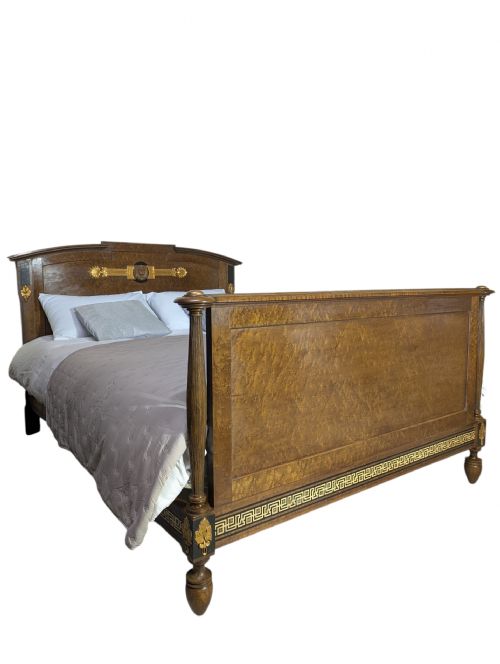
When you search for a neoclassical french king bed, you are looking at large sleeping frames drawing on Louis XVI, Empire, and French Chateau styles. These pieces range in date from the early nineteenth century through to the early twentieth century.
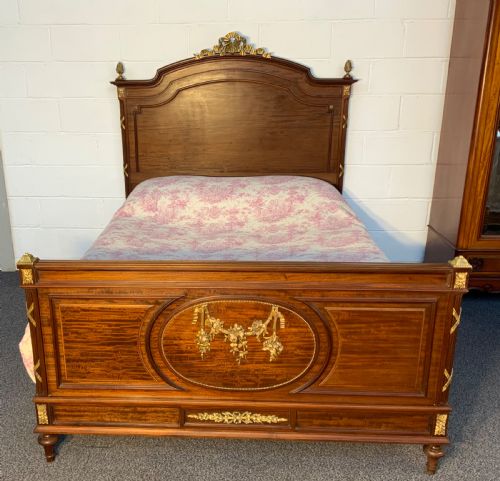
The most common versions met on this page date around nineteen hundred, taking the form of substantial mahogany, walnut, or painted wooden bedsteads. Many incorporate characteristic stylistic cues such as distinct brass detailing, carving, and caning.
These grand beds provide both practical scale and strong decorative presence. They serve as the focal point of a bedroom, combining historical design traditions with king-sized proportions.
How they were made
Makers constructed these frames using dense timbers like mahogany, walnut, and oak, alongside painted timber and giltwood. Structural soundness relied on traditional joinery applied to heavy woods.
Decorative enrichment was achieved through applied ormolu, brass detailing, and detailed carving directly into the wood. Surface finishes ranged from plain painted wood to gilded or polished timber.
Design influences recorded across these beds include French Empire, Louis XVI, and French Chateau styles.
What varies in quality
The distinction between ordinary and superior pieces rests largely on the crispness of the carving and the application of brass or ormolu mounts. Finer examples display meticulous attention to proportion and detail across the headboard and footboard.
Material selection also dictates the tier of the piece, with carefully figured mahogany or walnut sitting alongside simpler painted timber. The integration of specialty techniques such as caning or gilding elevates the overall refinement.
The Neoclassical French King Bed Glossary
- Ormolu
- Gilded bronze used for decorative mounts and accents on furniture. It provides a bright metallic contrast against dark woods.
- Caning
- Woven rattan material used for panel inserts in headboards and footboards. This technique offers a lighter visual texture.
- Giltwood
- Timber treated with gold leaf or gold paint to give a metallic finish. It highlights carved details on formal beds.
- Louis XVI
- A classical revival style characterised by straight lines, symmetry, and ancient Roman motifs. It forms the basis of many pieces here.
Neoclassical French King Bed: Frequently Asked Questions
How do I fit modern mattresses?
Many older French frames require custom mattress sizes or slight adjustments to standard modern dimensions. It is sensible to check internal rail measurements carefully before ordering a new mattress.
Supporting slats or a proper base may need to be added to ensure modern mattresses sit securely within the antique wooden rails.
Are these beds easy to dismantle?
Most antique wooden bedsteads utilise standard bolt-in rail systems that allow the headboard, footboard, and sides to separate. This makes moving and transporting the large frames much simpler.
Care should be taken with older metal fixings and wooden threads during reassembly to avoid stripping the original joints.
How do I clean carved wooden frames?
Dusting regularly with a soft, dry cloth prevents grime accumulation in the deep recesses of the carving. Avoid harsh chemical cleaners that can strip the original polish or painted surface.
Occasional application of appropriate wax helps nourish older timber surfaces without damaging delicate ormolu or gilded sections.
What defines the neoclassical style here?
Neoclassical design draws inspiration from classical antiquity, featuring restrained ornamentation, symmetry, and geometric balance. It avoids the heavy curves of earlier baroque styles in favour of architectural lines.
Details such as fluted columns, urn motifs, and crisp linear mouldings frequently appear on these pieces.