


Needlework Fire Screen
Needlework fire screens are decorative home furnishings that shield faces from hearth heat while displaying hand-stitched artistry.
Needlework Fire Screen
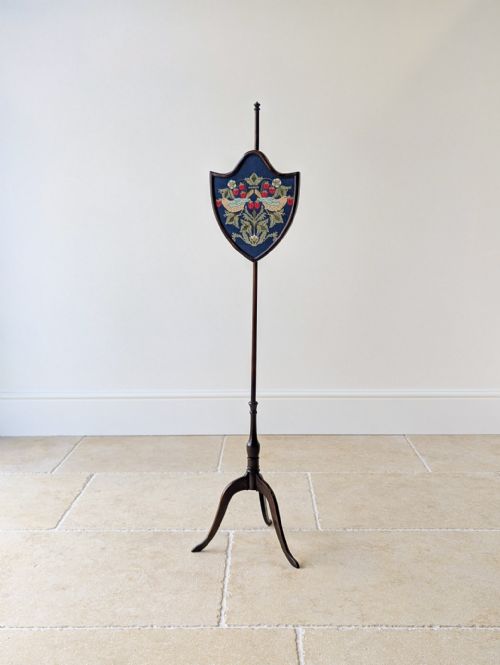
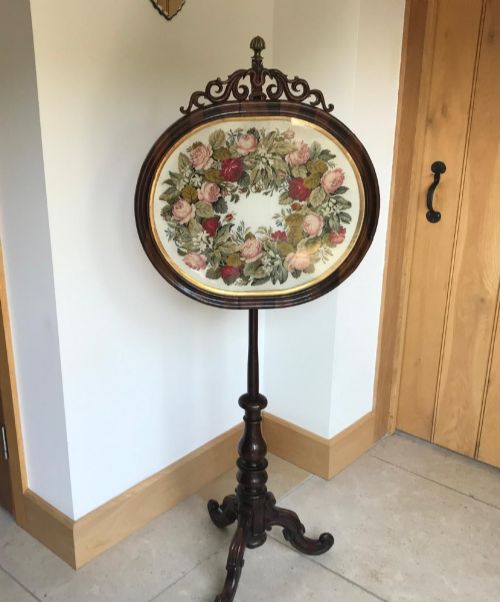
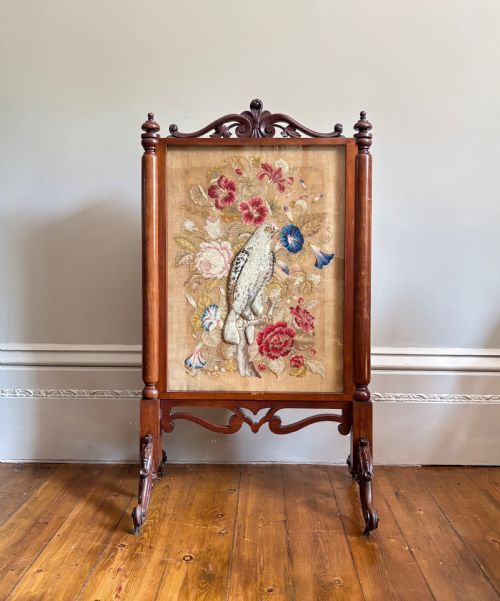
A needlework fire screen serves both a functional and decorative purpose in period interiors, designed originally to protect a person's face from the intense heat of an open fire. When searching this phrase, buyers encounter various forms ranging from adjustable pole screens to cheval and table screens.
The pieces appearing on this page span several centuries, with Victorian and Regency examples appearing alongside earlier Georgian designs. Most commonly, these items feature wooden frames housing embroidered panels executed in wool, silk, or canvas.
Makers utilised dense timbers such as mahogany, rosewood, and walnut to construct sturdy supports. The panels themselves display diverse decorative techniques, from Berlin work to framed silkwork and samplers.
Materials and construction
Carpenters shaped hardwoods like mahogany, rosewood, satinwood, and walnut into slender poles, carved tripod bases, or stable standing frames. Brass adjustments allowed pole screens to slide and lock at desired heights.
Needlework panels relied on robust canvas grounds stitched with wool, silk, or mixed textile threads. Artisans executed intricate tapestry, embroidery, and Berlin work to form pictorial or geometric centrepieces.
Needlework Fire Screen Retail Price Guide 2026
Typical asking prices for needlework fire screen among the pieces listed under this phrase on Sellingantiques today, from the lower quarter to the upper quarter. They describe what is for sale here now, not the wider market.
Victorian ladies painstakingly stitched elaborate wool dogs and floral wreaths just to keep their cheeks from roasting by the grate.
Judging the craftsmanship
Quality rests significantly on the intricacy and tightness of the needlework panel, alongside the crispness of the timber carving on the frame. Denser stitches and finer silk or wool threads indicate higher skill levels.
Construction methods also separate standard pieces from exceptional ones, particularly the stability of the turning, the smoothness of adjustable pole mechanisms, and the richness of figured woods like rosewood or mahogany.
Jas Scholbred
The Needlework Fire Screen Glossary
- Pole screen
- A type of fire screen featuring a vertical wooden shaft mounted on a base, holding an adjustable sliding panel. This design allowed the user to raise or lower the shield against the heat.
- Berlin work
- A popular form of needlepoint embroidery charted on squared paper using coloured wools. It dominated mid-nineteenth-century decorative textiles.
- Cheval screen
- A standing fire screen supported by two lateral feet rather than a central pole or tripod base. The term derives from the French word for horse.
- Sampler
- A piece of needlework produced as a demonstration or test of skill, often incorporating alphabets or pictorial motifs. These panels frequently found a second life mounted in screen frames.
Needlework Fire Screen: Frequently Asked Questions
How did people use a fire screen?
These screens were placed between a seated person and the fireplace to block the intense radiant heat of an open coal or wood fire. They protected delicate complexions and cosmetics from melting or flushing.
Users adjusted the height of pole screens to target the heat shield precisely where needed in the room.
Are needlework panels original to the frames?
Many screens retain their original nineteenth-century or eighteenth-century needlework, executed specifically for the frame it occupies. Needlepoint required considerable time and investment, making the textile an integral part of the piece.
Careful inspection of the mounting helps determine if a panel has lived its life within that specific surround.
How do I date a pole screen?
Stylistic clues in the woodwork offer the clearest date, following broader furniture history from Georgian tripod bases to Victorian rosewood turnings. Regency examples often feature bold goncalo alves or rosewood grains with brass mounts.
Needlework styles also shift from eighteenth-century classical motifs to vibrant mid-nineteenth-century Berlin work.
Where should I place a fire screen today?
Without an active hearth to guard against, these pieces function brilliantly as decorative wall art or subtle room dividers. They suit corners of sitting rooms where their embroidered panels add texture and historic colour.
Placing them away from direct, strong sunlight preserves the delicate silk and wool threads of the antique textile.