
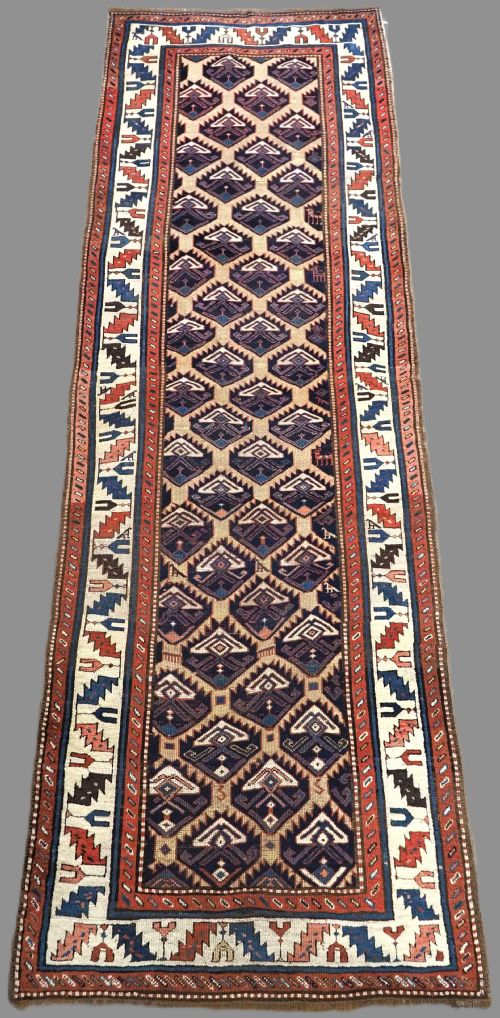



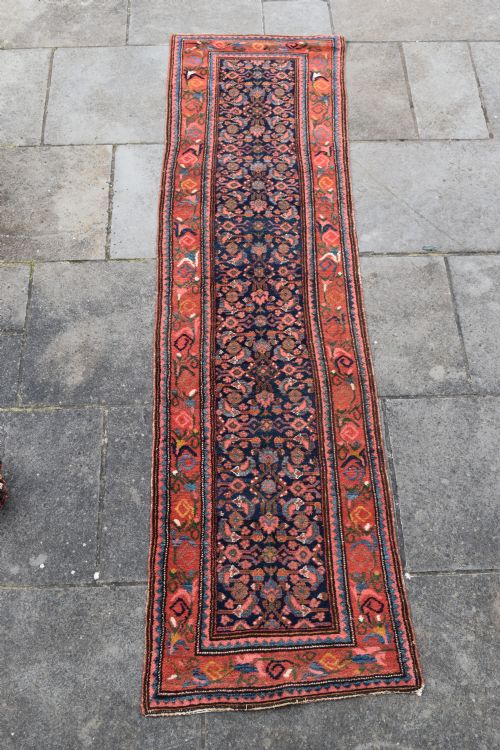


Navy Wool Hall Runner
A navy wool hall runner brings enduring warmth and deep indigo tones to narrow spaces, drawing upon centuries of nomadic and village weaving traditions.
Navy Wool Hall Runner
A navy wool hall runner spans several decades of craftsmanship, incorporating styles from Persian tribal origins to Caucasian workshops. These long floor coverings serve to anchor corridors and transitional spaces with robust formats designed for heavy foot traffic.
Most examples encountered here originate from the late nineteenth century through to the early decades of the twentieth century. They present elongated rectangular proportions well-suited to traditional hallways and narrow passages.
Weavers utilised durable animal fibres and natural dyes to create these pieces, resulting in varied geometric patterns, lattice designs, and stylised floral motifs. Each rug reflects the regional aesthetics of its maker, from Kurdish and Bakhtiari districts to Caucasian weaving centres.
Defining factors of quality
The distinction between standard examples and finer pieces rests upon knot density, precision of the geometric or floral layout, and the depth of the natural dye palette. Greater care in the hand-spinning of the wool yields a softer handle and superior resilience.
Compositional balance and the integrity of the border designs dictate the visual harmony of the runner in a hallway setting. Superior pieces maintain straight vertical edges and clear, unfaded motifs throughout their length.
Listings span production dates from 1880 to 1920, incorporating wool, cotton, hand-spun wool, and natural dyes.
The Navy Wool Hall Runner Glossary
- Runner
- A long, narrow carpet format specifically proportioned for corridors, hallways, and staircases.
- Hand-Spun Wool
- Yarn processed manually on a spindle, retaining natural lanolin and irregularities that absorb natural dyes unevenly for rich visual texture.
- Natural Dyes
- Colourants derived from plants, insects, and minerals rather than synthetic chemicals, known for ageing with harmonious patinas.
- Caucasian
- Pertaining to rugs woven in the Caucasus region, typically distinguished by bold geometric medallions and striking primary colours.
- Boteh
- A stylised teardrop or almond-shaped motif representing a floral spray or cypress tree, frequently found in Persian and Caucasian weaving.
Navy Wool Hall Runner: Frequently Asked Questions
How do I care for a wool runner?
Regular gentle vacuuming without a rotating brush roll helps remove grit from the wool pile. Professional cleaning by a specialist familiar with antique textiles preserves the natural dyes and fibres.
Positioning a quality underlay beneath the runner prevents slipping and reduces friction against the floorboards. Rotating the piece periodically ensures even wear across high-traffic areas.
Where should I place a long runner?
These narrow formats suit hallways, landings, and entrance passages where they soften footsteps and protect wooden flooring. They also function effectively in long kitchens or beside bedroom furniture.
Leaving a uniform border of exposed floor around the edges helps frame the runner within the space. Measure the corridor carefully to allow clearance for doors to open freely over the pile.
Are these runners made by hand?
The pieces recorded here are entirely handmade using traditional knotting techniques passed down through generations. Artisans worked on upright looms, tying individual knots of hand-spun wool onto cotton warps.
Slight irregularities in width and straightness confirm the manual production methods of village and tribal weavers. These subtle variations distinguish authentic antique textiles from modern machine-woven reproductions.
How do I identify regional rug styles?
Regional attribution relies on specific design vocabulary, colour combinations, and structural characteristics unique to particular weaving groups. For instance, Caucasian rugs often feature sharp geometric polygons, while Persian village pieces incorporate curvilinear floral elements or stylised lattice patterns.
Examining the selvedges, fringe construction, and knotting structure provides further clues to tribal or regional origin. Comparing these details against documented examples helps classify the heritage of each piece.