

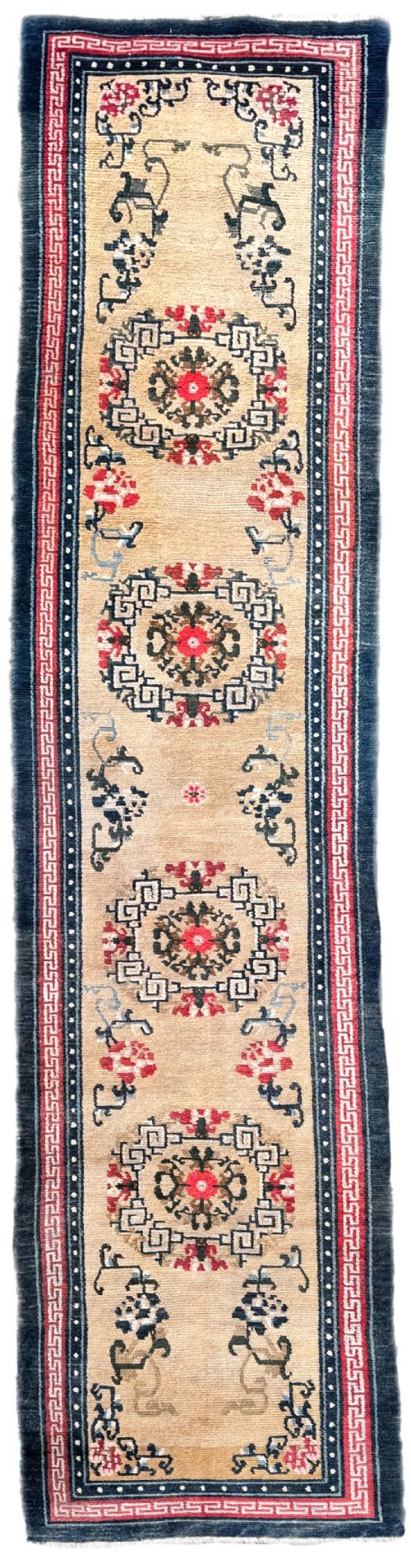

Antique Rug for Hallway
An antique rug for hallway use brings warmth and endurance to a long space through historic pattern and natural dye.
Antique Rug for Hallway
An antique rug for hallway placement typically takes the form of a long, narrow runner designed to handle foot traffic while anchoring a passage or landing. The examples collected here span the late nineteenth century through to the early decades of the twentieth century, originating from Persian, Turkish, Caucasian and Tibetan workshops.
Buyers encounter long formats such as Heriz, Ushak, Kurdish and Caucasian runners, often woven with geometric medallions, lattice designs or repeating tribal motifs. These pieces serve to soften wooden floorboards and bring proportion to narrow architectural layouts.
Materials and construction methods
The pieces listed here are built on foundations of hand-spun cotton or wool warp and weft threads, tied with dense wool pile knotted by hand. Natural dyes derived from plants and minerals provide the palette, yielding deep indigos, madder reds and olive greens that mellow gracefully over decades of use.
Weavers working in tribal and village settings employed sturdy vertical looms, beating down the rows of knots with heavy combs to create a firm, resilient textile capable of sustaining heavy daily passage.
Antique Rug for Hallway Retail Price Guide 2026
Typical asking prices for rug for hallway among the pieces listed under this phrase on Sellingantiques today, from the lower quarter to the upper quarter. They describe what is for sale here now, not the wider market.
The listings here include wool and cotton runners originating from Persian, Turkish, Caucasian, and Tibetan weaving traditions dating from 1860 to 1960.
Evaluating quality and execution
Quality rests in the precision of the knotting, the complexity of the design layout, and the clarity of the natural dyes. Denser knot counts allow for sharper geometric lines and intricate lattice work, whereas looser village or tribal pieces display a charmingly organic irregularity in their motifs.
The integrity of the foundation threads and the evenness of pile wear distinguish a robust survivor from one that has suffered structural strain. Pieces retaining their original side cordings and end finishes command greater attention from those seeking structural completeness.
The Antique Rug for Hallway Glossary
- Runner
- A long, narrow carpet format specifically proportioned for corridors, hallways, and staircases. This shape directs foot traffic and balances narrow spaces.
- Warp
- The vertical foundation threads stretched lengthwise on the loom before knotting begins. The fringe of a rug is typically formed from these exposed threads.
- Weft
- The horizontal threads passed back and forth across the warp threads between rows of knots to secure the pile. Together with the warp, it forms the structural grid of the textile.
- Pile
- The dense surface layer of upright wool loops or cut ends that forms the visible and tactile face of the rug. Tighter knotting creates a firmer pile.
- Natural dye
- Colourants sourced from plants, insects, and minerals rather than synthetic chemicals. These dyes produce complex, muted tones that age with a characteristic patina.
Antique Rug for Hallway: Frequently Asked Questions
How do I choose the right length?
Measure your corridor while leaving a uniform border of exposed floorboards around the perimeter of the rug. This frames the textile and prevents the passage from feeling visually crowded.
Account for doors that need to swing open over the floor covering, ensuring sufficient clearance so the door base does not catch on the pile.
Are these runners durable enough for daily use?
Traditional village and tribal carpets were constructed for heavy domestic wear using sturdy wool pile over firm foundations. Their dense knotting naturally resists compression from footsteps in busy corridors.
Using a quality underlay beneath the textile prevents slipping and cushions the fibres against hard subfloors, extending the working life of the piece.
How do I identify a Caucasian runner?
Caucasian pieces typically feature bold geometric medallions, stark hooked polygons, and crisp lattice patterns rendered in saturated primary colours. Their designs are generally more angular and graphic than flowing Persian florals.
The wool handling tends to feel slightly crisper, and the palette often incorporates distinct ivory, bright blue, and rust red tones.
What is a Mina Khani design?
The Mina Khani pattern is an repeating overall motif composed of daisy-like flower heads linked by curved vines in a continuous lattice grid. It appears frequently in traditional Persian and Kurdish village weaving.
This balanced layout creates a steady visual rhythm down the length of a narrow corridor without requiring a central medallion.