


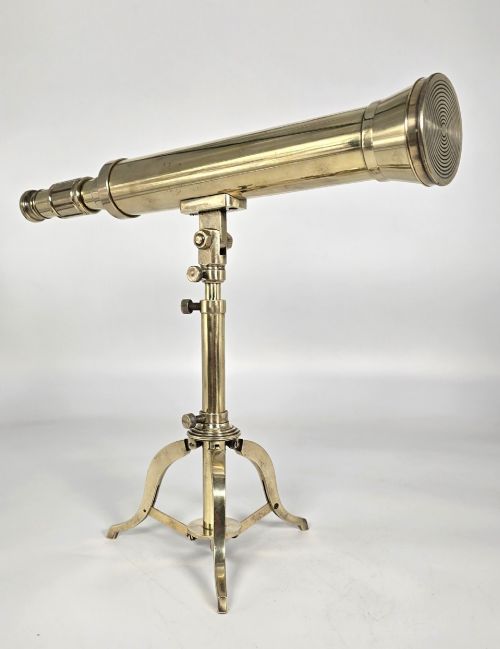


Nautical Brass Spyglass
Nautical brass spyglass instruments combine precision optics with maritime history, offering collectors tangible links to navigation and discovery at sea.
Nautical Brass Spyglass
A nautical brass spyglass is primarily a portable telescope designed for maritime use, utilising extending draws to focus on distant objects. The versions most commonly encountered on this page span the Georgian, Victorian, and Edwardian periods, reflecting Britain's seafaring heritage.
These instruments range from compact two-draw pocket versions to substantial four-draw marine telescopes and officer of the watch models. Many feature protective leather or wood casings, while others are mounted on folding brass tripods for stable tabletop viewing.
Makers often signed the brass barrel tubes, providing clear provenance linking the optics to historic workshops in London, Sheffield, and abroad. Such pieces served practical roles aboard naval and merchant vessels before transitioning into decorative and scientific library instruments.
Materials and construction
Makers constructed the primary barrels predominantly from brass, chosen for its durability and resistance to marine corrosion, often finishing surfaces with nickel plating or gilding. Optical systems combine glass lenses housed within these telescopic draws, requiring precise alignment to achieve clear magnification.
External grips frequently incorporate stitched leather dressings, mahogany, oak, walnut, or fruitwood to provide a secure hold in wet conditions. The sliding draw tubes fit tightly together to maintain focal length while allowing smooth extension and collapse.
Listings feature brass, glass, mahogany, oak, leather, and nickel materials across Georgian, Victorian, and Edwardian periods.
Assessing quality and optical integrity
Superior examples demonstrate precision engineering in the smoothness of the draw action and the clarity of the glass lenses. Maker signatures engraved onto the brass tubing typically indicate higher workshop standards and better optical performance.
The choice of secondary materials, such as finely grained mahogany or stitched leather grips, distinguishes standard instruments from superior pieces commissioned for naval officers. Well-preserved seals and original stands also elevate the standing of an instrument within its period.
Nairne & Blunt·Ross of London·Voigtländer & Sohn·Clarkson London·Steward of London·Newton & Co·Broadhurst Clarkson & Co·Cary London·L Casella London·Chadburn Brothers·John Gilbert
The Nautical Brass Spyglass Glossary
- Spyglass
- A small, handheld refracting telescope used primarily for terrestrial viewing. These instruments employ multiple extending draws to adjust focus.
- Draw
- Each sliding tubular section of a telescope that collapses into the main barrel. Multiple draws allow a long focal length to compress into a portable size.
- Achromatic
- An optical lens designed to reduce chromatic and spherical aberration. This engineering development provides sharper images with minimal colour distortion.
- Terrestrial telescope
- An optical instrument configured to produce an upright image for viewing land or sea objects. It uses an erecting lens system rather than the inverted image typical of astronomical devices.
- Officer of the watch telescope
- A specialised marine telescope utilised by naval officers for signaling and monitoring horizon traffic. These models prioritize robust construction and rapid deployment.
Nautical Brass Spyglass: Frequently Asked Questions
What is a nautical brass spyglass?
A nautical brass spyglass is an extending telescope historically used by mariners for navigation and sighting distant vessels.
Constructed with multiple sliding brass draws, these instruments balance portability with effective magnification.
How do you use a multi-draw telescope?
To operate the instrument, extend all the brass draws fully from the main barrel until locked into position.
Adjust the final smaller draw near the eyepiece slowly until the distant terrestrial object comes into sharp focus.
How are different periods identified?
Makers marked barrel tubes with signatures, addresses, and styles characteristic of Georgian, Victorian, or Edwardian manufacturing techniques.
Materials such as mahogany, fruitwood, and leather dressings also indicate the prevailing aesthetic and production era.
How were these spyglasses used at sea?
Naval officers and lookouts utilised day or night spyglasses to scan the horizon for land, hazards, or other ships.
Their compact nature allowed them to be stowed easily in pockets or mounted on brass tabletop stands inside cabins.