
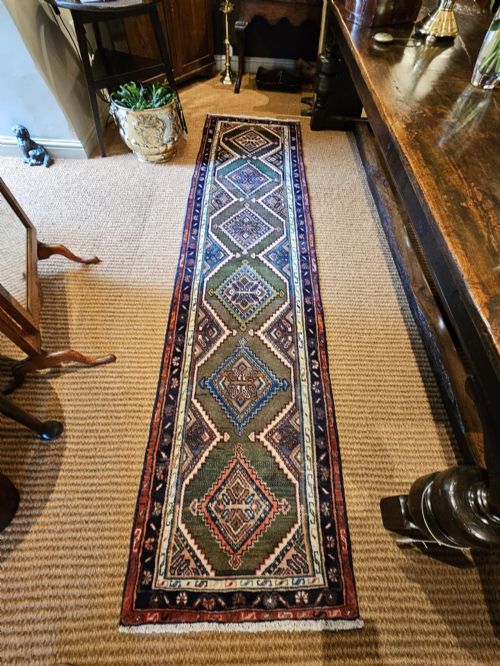
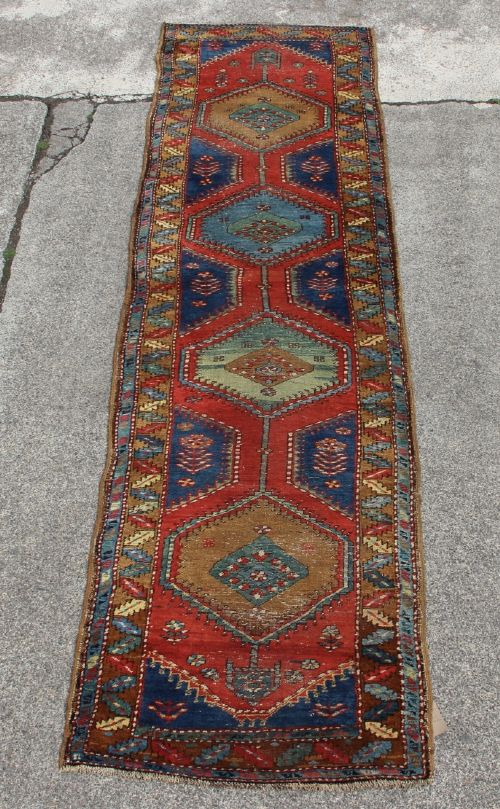
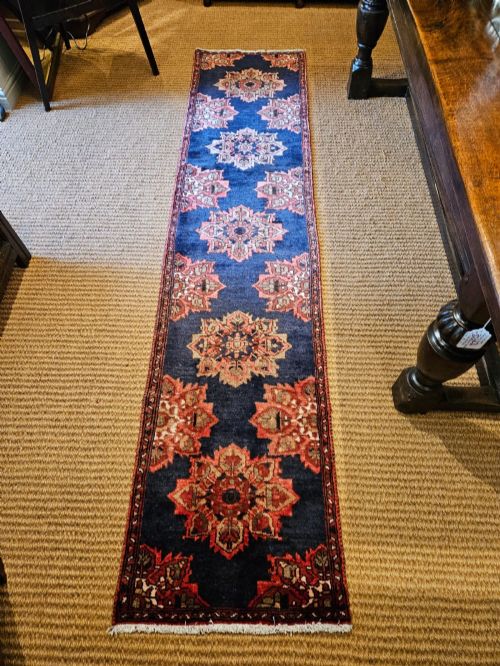
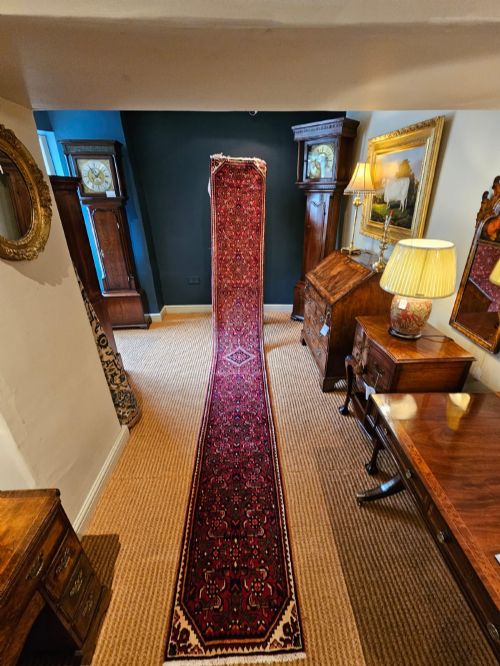
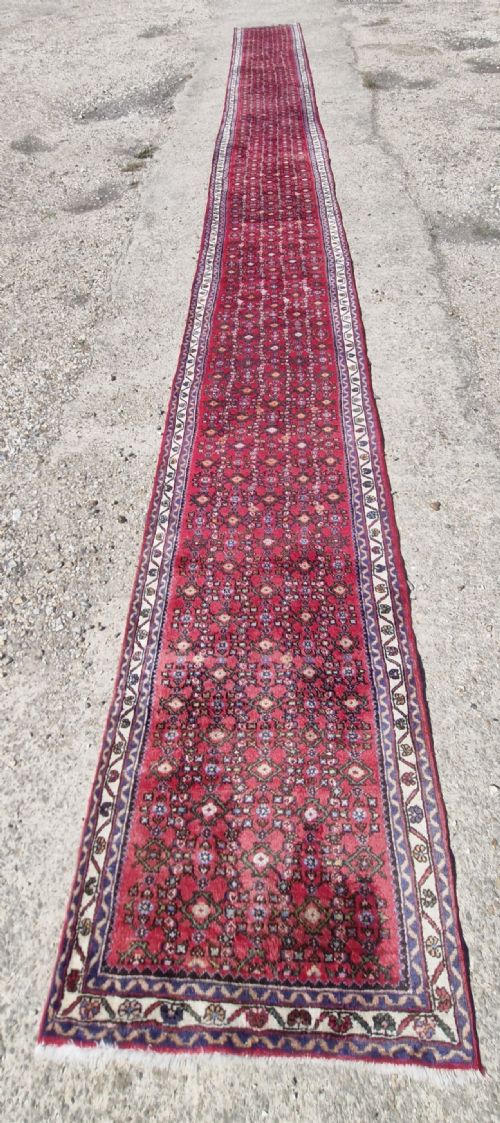
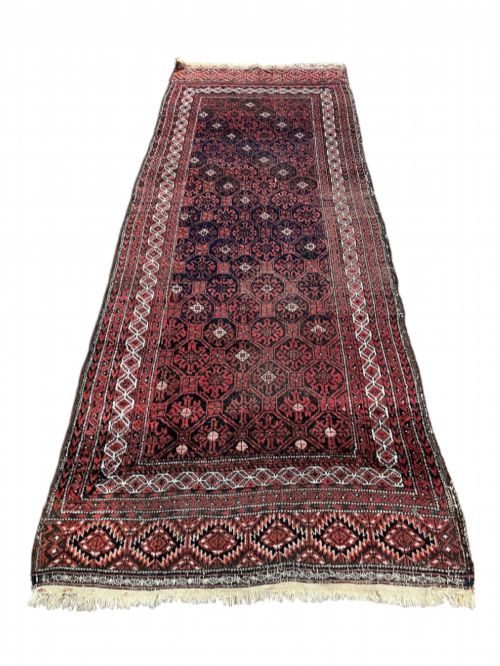
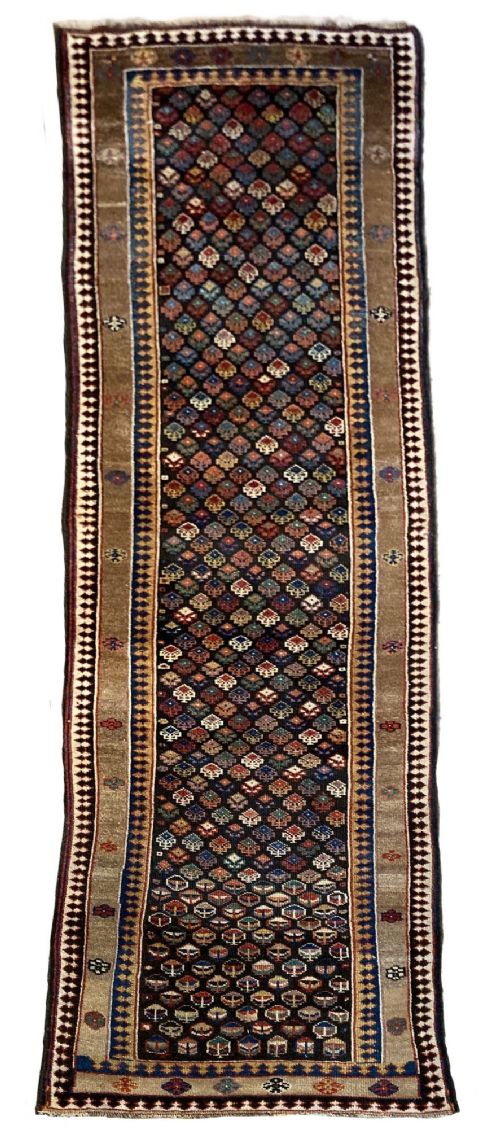


Narrow Long Persian Rug
A narrow long persian rug provides a practical solution for hallways and landings, bringing traditional patterns and deep colour into linear spaces.
Narrow Long Persian Rug
A narrow long persian rug functions primarily as a runner designed for corridors, stairs, and long hallways. These pieces originate from various regions and workshops across Persia, dating from the nineteenth and early twentieth centuries.
Village and tribal examples display geometric medallions, repeating boteh motifs, and stylized animal or tree designs. Town pieces such as Heriz and Sarouk frequently exhibit more structured central medallions and formal floral borders.
How They Were Made
Weavers constructed these runners using hand-spun wool pile knotted onto sturdy cotton or wool foundations. Selected pieces incorporate camel hair within the un-dyed portions to provide natural tone variations and enhanced durability.
Natural dye sources yielded deep reds, navy blues, and olive greens that mellow gracefully with age. Artisans tied symmetrical or asymmetrical knots by hand, securing the ends with woven selvedges to withstand high foot traffic.
A few antique Kurdish runners feature tiny birds perched patiently on stylized trees woven straight into the corridor field.
What Varies In Quality
Knot density and structural tightness dictate the crispness of the geometric and floral motifs. Finer village and town workshops achieved sharper pattern definition through precise hand-knotting.
The integrity of the foundation and the evenness of pile wear determine how well a runner maintains its straight lines over decades of use. Natural dye consistency across the field also separates standard village pieces from exceptional town specimens.
The Narrow Long Persian Rug Glossary
- Runner
- A long, narrow carpet format specifically proportioned for corridors, hallways, and staircases. These pieces measure significantly longer than their width.
- Heriz
- A style of Persian rug originating from the Azerbaijan region, known for bold geometric medallions and robust structural wool. They frequently employ large-scale angular motifs rather than delicate curves.
- Hamadan
- A broad designation for village and bazaar rugs produced in and around the West-Persian hub of Hamadan, often featuring repeated herati patterns or central pole medallions. These utilise sturdy foundation materials suited for daily domestic use.
- Serab
- A style originating from a village in northwestern Persia, celebrated for camel hair fields and subdued, natural earth tones. They typically present minimalist geometric formats.
- Boteh
- A Paisley-like almond or pine-cone motif representing a stylized floral spray or cypress tree. This ancient symbol appears frequently across Persian tribal and village weaving.
Narrow Long Persian Rug: Frequently Asked Questions
Where do I put a long runner?
These pieces suit narrow architectural spaces such as hallways, long landings, and entry corridors where floorboards require softening. They also function effectively alongside galley kitchens or beside bedroom furniture.
Because lengths vary from compact dimensions to over thirty feet, measuring the unobstructed floor area ensures the piece clears doorways and heating vents properly.
How do I care for antique wool runners?
Regular gentle vacuuming without a rotating brush head removes grit from the wool pile before it settles into the foundation. Professional cleaning by specialists in antique textiles preserves the natural lanolin and dye stability.
Using a quality underlay prevents slipping on hard floors and reduces friction between the cotton foundation and the subfloor during daily use.
What is a Heriz runner?
A Heriz runner comes from the northwest region of Persia and is distinguished by bold, geometric medallions and durable construction. These pieces utilise heavy wool knotting designed to endure generations of heavy foot traffic.
Their distinct corner spandrels and large-scale angular designs make them visually striking in long, linear corridors.
Are these rugs made with natural dyes?
Many pieces from the nineteenth and early twentieth centuries rely on traditional natural dye materials derived from plants, roots, and minerals. These colorants produce rich tones that mellow and harmonize gracefully over time.
Subtle shifts in hue, known as abrash, often occur naturally across the field when dyepots change during the weaving process.
How do I identify a Kurdish runner?
Kurdish runners from northwest Persia typically display expressive geometric patterns, tribal motifs, and occasional depictions of birds or trees perched on branches. They often use heavier, saturated wool with robust dark grounds.
Their village production methods result in charming irregularities that reflect the weaver's individual creative choices rather than strict commercial cartoons.