


Muted Coastal Watercolour Painting
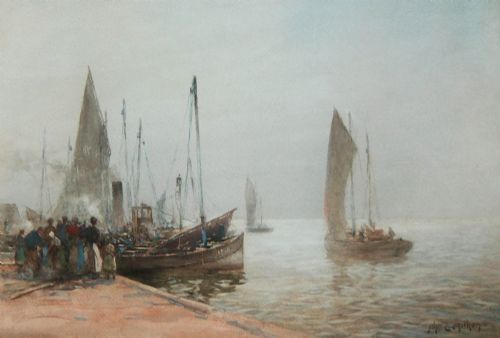
A muted coastal watercolour painting captures harbour walls, sandy shores and fishing fleets through a restrained palette of subdued pigments.
Muted Coastal Watercolour Painting
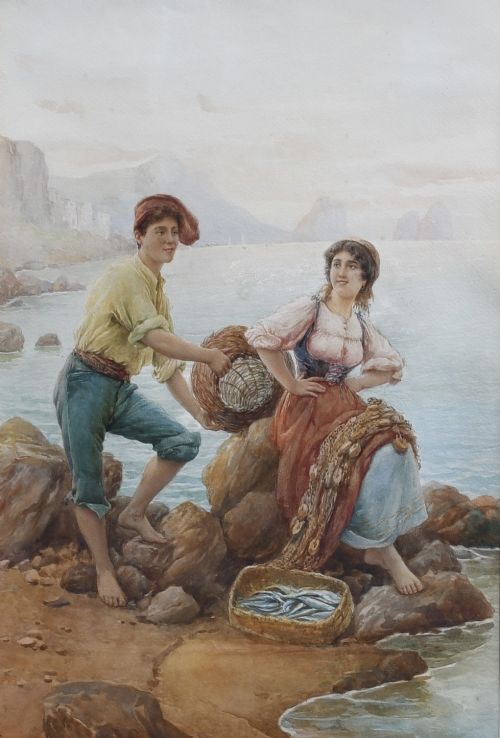
A muted coastal watercolour painting brings nineteenth-century and early twentieth-century marine scenes into domestic spaces through delicate washes on paper. These works document British and European shores, from Yorkshire harbours and Norfolk cliffs to Welsh estuaries and Mediterranean fishing ports.
The pieces on this page span the Victorian era, Edwardian period and the early decades of the twentieth century. They range from small topographical records to larger framed maritime views produced by regional artists and Royal Academy exhibitors alike.
Buyers look for these watercolours to introduce soft, weathered tones and historic maritime atmosphere to a room. Subjects frequently feature local fisherfolk, moored boats at low tide and quiet coastal towns rendered with subtle atmospheric depth.
Materials and Technique
These works rely on water-soluble pigment applied directly to paper support, utilising the reflective white of the sheet to generate luminosity. Artists built up transparent washes for sea and sky while reserving opaque bodycolour for highlights on sails, foam and stone.
Framed beneath protective glass, the surviving sheets demonstrate traditional watercolour techniques handed down through generations of British landscape painters. Wood frames typically house the paper, preserving the delicate pigments from atmospheric moisture and handling.
The current selection spans multiple periods, featuring works dated from 1870 through the 1940s, executed primarily in watercolour on paper.
Evaluating Quality
Quality rests upon the artist's handling of light, atmospheric perspective and spatial depth within the coastal landscape. Superior examples display confident brushwork and controlled tonal gradations that suggest sea mist and overcast skies without overworking the paper surface.
The strength of the composition and the specific topographical interest also distinguish finer watercolours from standard topographical sketches. Works by established marine specialists or exhibited members of regional art societies generally command greater artistic authority through their assured draftsmanship.
James E Aitken·Carlo Ferranti·Alfred George Morgan·Sir Thomas Newenham Dean·Tom Clough·James Watson·Frederick William Hattersley·John Mitchell·Kate E Booth·Ernest F Hill·Stephen John Batchelder·Rowland Henry Hill·Hirst Walker·William Lee Hankey·Walter Emsley·William Collins·Clarence Woodburn·Thomas Swift Hutton·Fred Lawson·Harry Wanless·GM de L'Aubiniere·Carleton Grant·John J Hamer·Cuthbert Crossley·Fred Stead
The Muted Coastal Watercolour Painting Glossary
- Watercolour
- A painting method where paint is made of pigments suspended in a water-based solution. The medium relies on translucent washes applied to paper.
- Bodycolour
- Watercolour paint mixed with a white pigment to make it opaque. Artists use this technique to add highlights and solid details to a predominantly transparent wash painting.
- Marine watercolour
- A painting focused primarily on the sea, ships, harbours and coastal life. These works record maritime activity and coastal weather conditions.
- Provenance
- The chronological ownership history of a work of art. Documented origin helps verify the authenticity and attribution of nineteenth-century watercolours.
- Monogram
- A motif made by overlapping or combining letters to form a single symbol. Painters often used these initials to sign their works rather than spelling out their full names.
Muted Coastal Watercolour Painting: Frequently Asked Questions
How should I hang a antique watercolour?
Position the piece away from direct sunlight to prevent the watercolour pigments from fading over time. Consistent indoor temperatures help protect the fragile paper support and wooden frame.
Ensure the hanging wall remains free from dampness. Professional framing with acid-free backing boards secures the paper and preserves the longevity of the artwork.
What subjects appear in these coastal paintings?
Artists recorded busy fishing dockyards, quiet harbour walls and wide sandy bays along the British coastline. Common motifs include moored sailing vessels, returning fishing fleets and figures sorting nets on the shore.
Many scenes capture specific locations such as Whitby, St Ives, Scarborough and various Welsh and Scottish estuaries. These topographical details offer a glimpse into nineteenth-century and early twentieth-century maritime life.
How do I identify the period of a watercolour?
Examine the paper type, framing style and the artist's signature or monogram for clues regarding the date of creation. Victorian and Edwardian works often feature specific framing methods and handwritten titles on the reverse.
Stylistic elements also point to specific decades, such as the characteristic brushwork of late nineteenth-century British Impressionism or the calmer palette of early twentieth-century marine painting.
Are these watercolours original paintings?
Every piece featured here is a hand-painted original work executed on paper by an artist, rather than a mechanical reproduction or print. Brush strokes, pigment texture and pencil guidelines under the wash confirm the unique nature of each sheet.
Artists painted these scenes directly on location or in their studios using watercolour pigments, resulting in distinct variations even among works by the same painter.