



Cornish Harbour Art
Cornish harbour art captures maritime life along the coast, offering buyers a direct window into nineteenth and twentieth century fishing ports.
Cornish Harbour Art
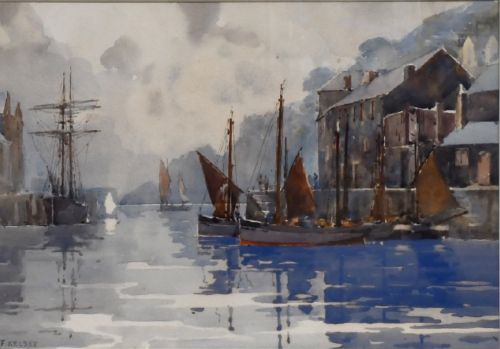
Cornish harbour art encompasses paintings and works on paper depicting coastal scenes, fishing vessels, and village life across Cornwall. These works document historic ports such as St Ives, Mevagissey, Polperro, and Mousehole during periods of artistic growth.
The selection on this page consists primarily of framed watercolours and oil paintings created by British and international artists working between the late nineteenth century and the mid twentieth century. Buyers encounter coastal views ranging from Victorian marine watercolours to later twentieth century impressionist interpretations.
Many of these works align with established regional movements like the Newlyn School and British Impressionism. They record local vessels, trawling luggers, and harbour architecture before modern tourism transformed the coastline.
Materials and technique
Artists relied primarily on watercolour on paper or oil paint applied to canvas and wood panels to capture the changing coastal light. Watercolours allowed for rapid, translucent studies of sea and sky, while oil paint provided rich texture and depth for heavier seas and harbour walls.
Framed works frequently utilise traditional wood mouldings and glass protection for paper pieces, preserving delicate watercolours and pastels from moisture and fading. Canvases are stretched over wooden frames, occasionally retaining original artist annotations or gallery labels on the reverse.
Listings span the nineteenth and twentieth centuries, incorporating oils, watercolours, and pastels centred on Cornish coastal towns.
Judging quality and execution
Quality rests on the artist's command of light, atmosphere, and maritime perspective rather than the mere subject matter. Superior examples demonstrate confident brushwork and accurate draughtsmanship in rendering rigging, hulls, and tidal movement.
Condition plays a central role, distinguishing works with vibrant, unfaded pigments and original stable framing from those compromised by heavy foxing, damp staining, or clumsy restoration.
William Banks Fortescue·Frank Kelsey·George F Pennington·Edward Matthew Elliott·Richard Harry Carter·Gyrth Russell·George Turland Goosey·Ernest F Hill·Frederick Stuart Richardson·William Lambert Bell·Ralph Todd·Jack R Mould·William Lee Hankey·Walter Sweet·Hendrik Yan Wolter·S J Lamorna Birch·William Edward Webb
The Cornish Harbour Art Glossary
- Newlyn School
- An art colony based in West Cornwall during the late nineteenth and early twentieth centuries. Painters associated with this group focused on plein air realism, capturing local fishermen and coastal communities.
- Watercolour
- A painting method where fine pigment is suspended in a water-based solution on paper. It yields transparent washes that capture coastal light and atmosphere.
- Oil on canvas
- Pigment mixed with drying oil applied to a woven fabric stretched across a wooden frame. This medium allows for thick impasto and deep tonal range.
- Lugger
- A traditional two-masted fishing boat with standing lug sails frequently seen in West Country maritime paintings. These vessels dominated the Cornish fishing fleet in the Victorian era.
- Impressionism
- A style emphasising accurate depiction of light and its shifting qualities. In Cornish art, this approach translates to broken brushstrokes and luminous harbour scenes.
Cornish Harbour Art: Frequently Asked Questions
What is Cornish harbour art?
Cornish harbour art comprises paintings, watercolours, and drawings depicting the fishing ports, boats, and coastal topography of Cornwall. These works date primarily from the late nineteenth century through the mid twentieth century.
Artists were drawn to settlements like St Ives and Polperro by the unique light, dramatic tides, and active maritime industries. The pieces serve as both historical records and decorative works reflecting regional artistic movements.
How do I date a Cornish painting?
Dating relies on stylistic clues, artist signatures, framing methods, and stretcher construction. Many Victorian and Edwardian works carry dates or inscriptions verso from the artist.
Clothing styles of figures depicted, vessel types like trawling luggers, and the evolution from Victorian academic realism to twentieth century impressionism also help establish a reliable timeframe.
What is the Newlyn School?
The Newlyn School was a community of artists based in the Cornish fishing village of Newlyn from the 1880s onwards. They painted en plein air to capture natural light and everyday life.
Works from this circle focus heavily on local fisherfolk, harbour activities, and coastal landscapes, forming a cornerstone of British regional art history.
How should I care for antique watercolours?
Antique watercolours on paper require protection from direct sunlight to prevent fading of pigments and yellowing of the paper support. Framing should include acid-free mounts and UV-filtering glass.
Keep pieces away from high humidity and fluctuating temperatures to avoid foxing spots and mould growth on the paper.