
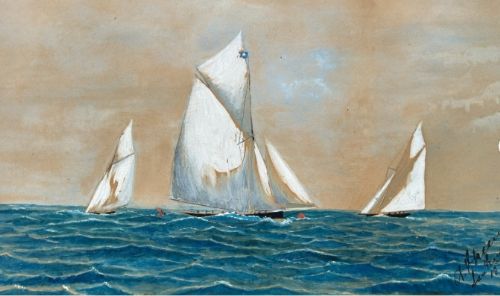


Vintage Sailboat Watercolour
A vintage sailboat watercolour brings the movement of coastal tides and nineteenth-century harbours directly onto the wall.
Vintage Sailboat Watercolour
When you search for a vintage sailboat watercolour, you encounter maritime scenes spanning from the late nineteenth century through to the mid-twentieth century. The selection comprises original paintings on paper, capturing racing yachts, trawling luggers, and beached fishing boats in British and American coastal settings. Most examples arrive framed, often behind glass in wood or gilt frames that complement the maritime subject matter.
The periods represented stretch across Victorian, Edwardian, and mid-century movements, showcasing British Impressionism and regional maritime traditions. You will find works bearing specific artist attributions alongside signed compositions from provincial harbours like Whitby, Cornwall, and Norfolk. These paintings record working vessels and coastal craft with direct observation rather than romantic abstraction.
Materials and technique
Artists executed these works using watercolour pigment and ink applied to paper supports, occasionally incorporating gouache for opaque highlights on sails and cresting waves. The transparent washes render the atmospheric light of sea and sky, while fine ink lines delineate rigging and hull structures.
Framing materials typically involve wood and gilt wood moulding enclosing protective glass. This traditional housing preserves the delicate paper surface from atmospheric moisture and handling damage over the decades.
Listings feature works spanning the nineteenth century through the 1950s, executed on paper using watercolour pigment, ink, and occasionally gouache.
What separates the examples
Quality rests in the handling of light and atmospheric depth, where confident brushwork conveys the movement of water and wind against canvas sails. Weaker pieces rely on stiff delineation and flat washes, whereas superior works capture the shifting coastal atmosphere with precision.
Condition of the paper and pigment stability also define the upper tier. Works that retain their original colour intensity without excessive fading or foxing demonstrate careful preservation through successive decades.
Richard Harry Carter·William Tuck·Samuel Owen·Charles Harmony Harrison·Ernest F Hill·Stanley Orchart·John McDougal·Harry Wanless·Thomas Bush Hardy·Henry Scott Tuke·Henry Bright
The Vintage Sailboat Watercolour Glossary
- Watercolour painting
- A work executed with water-soluble pigments on paper. The medium relies on transparent washes to build luminosity.
- Gouache
- An opaque water-based paint often used alongside watercolour to add solid highlights and dense areas of colour.
- Lugger
- A traditional two-masted fishing vessel rigged with lug sails. These boats appear frequently in West Country maritime art.
- Foxing
- Small brownish spots caused by chemical reactions in the paper over time. It occurs commonly in nineteenth-century works on paper.
- Gilt wood
- Wood framing finished with a thin layer of gold leaf or metallic paint. It provides traditional embellishment for period artwork.
Vintage Sailboat Watercolour: Frequently Asked Questions
How do I care for a watercolour painting?
Keep the artwork away from direct sunlight to prevent the pigments from fading over time. Ensure it hangs in a stable environment away from excess moisture that might damage the paper support.
Check that the framing remains sealed against dust and insects. Professional conservation framing preserves the paper integrity for future decades.
How can I tell the age of a marine watercolour?
Examine the style of the vessels depicted, the clothing of figures on the shore, and the framing materials. Victorian and Edwardian works often feature specific rigging details of historic vessels.
Look for artist signatures, dates inscribed on the margin, and paper watermarks where visible. Archivists and dealers use these stylistic markers to narrow down the decade of creation.
Are these paintings original works?
Each listed item is an original hand-painted work on paper rather than a modern reproduction or print. Artists applied pigment directly by hand to capture the coastal scenes.
Brushstrokes, paper texture, and variations in pigment density confirm the hand-painted nature of these maritime artworks.
What subjects appear most frequently in these watercolours?
Harbour scenes, fishing boats, racing yachts, and coastal lighthouses dominate the subjects. Artists frequently recorded working vessels in British ports such as Cornwall, Whitby, and Norfolk.
Open sea encounters involving tall ships and naval vessels also feature among nineteenth-century and Edwardian compositions.