
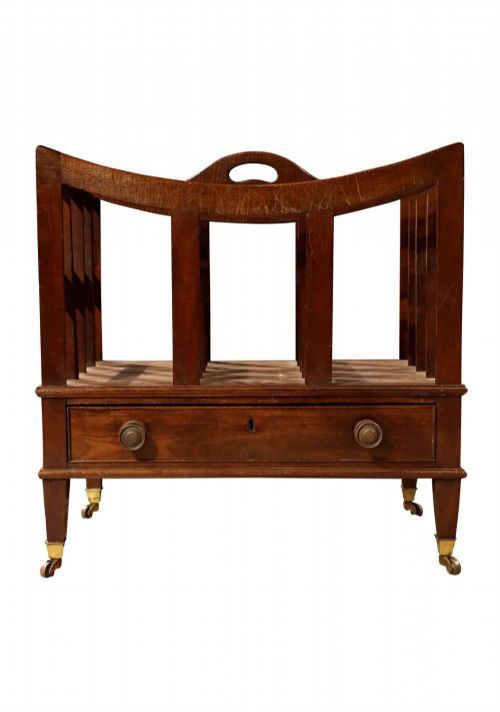


Music Stand on Castors
A music stand on castors organises sheets and folios within reach, moving easily across the floor on its wheels.
Music Stand on Castors
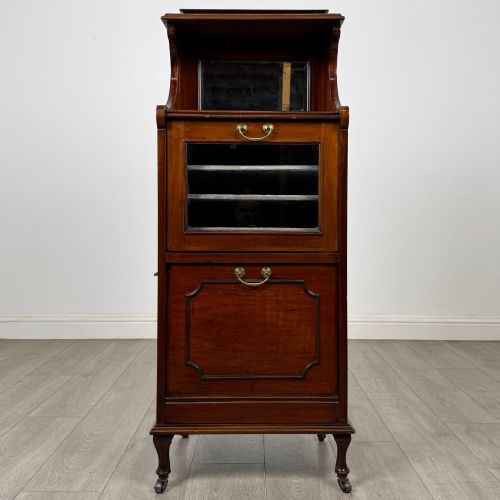
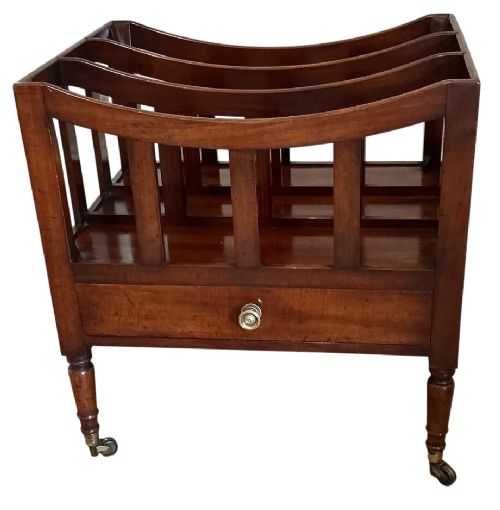
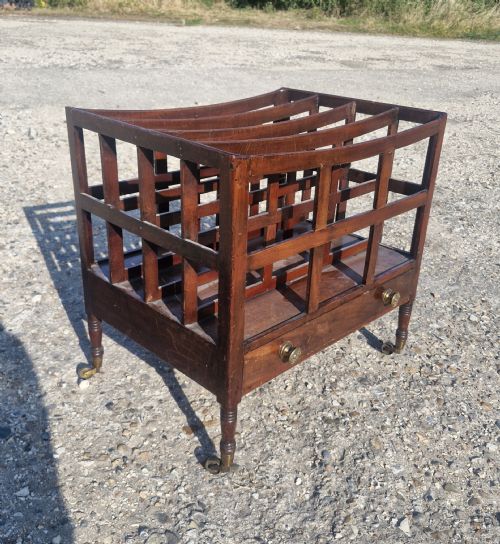
A music stand on castors typically takes the form of a Canterbury or music cabinet designed to hold folios, sheets and periodicals. The selections on this page span the Georgian, Regency, William IV, Victorian and Edwardian periods, stretching from around 1800 into the early twentieth century.
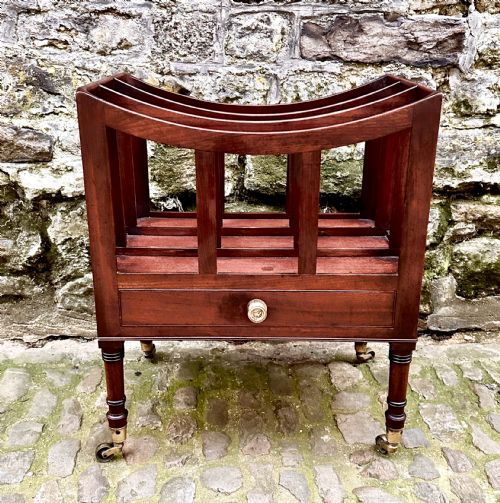
Most pieces appear in mahogany or rosewood, adopting boat shapes, four-division racks or multi-tier shelving with drawers beneath. Makers often mounted these stands upon turned legs fitted with castors to allow smooth repositioning around a room.
The inventory demonstrates how cabinetmakers adapted the form from elegant Regency newspaper racks to substantial Victorian ebonised what-nots and Edwardian music cabinets. Buyers encounter both open-slotted folio stands and enclosed cabinetry designed to keep scores protected.
Distinctions in craftsmanship and design
The distinction between standard items and exceptional examples lies in the refinement of the timber and the sophistication of the joinery. Figured grain, such as burr walnut or richly grained rosewood, elevates the visual presence of a piece.
Proportion and detail dictate the hierarchy of quality, from simple four-division racks to oversized country house folio stands with integrated drawers. Original castors and crisp carving, such as wreath motifs, mark out the superior output.
Listings feature pieces spanning from the Georgian period through Regency, William IV and Victorian eras to Edwardian designs.
Gillows of Lancaster·J.C.Loudon
The Music Stand on Castors Glossary
- Canterbury
- A low stand fitted with divisions for holding sheet music, newspapers or magazines, usually mounted on castors. Originating in the late eighteenth century, the form quickly became a staple of the refined parlour.
- Folio stand
- A large rack designed to hold oversized loose sheets, maps or prints upright. These pieces often feature substantial proportions suitable for country house libraries.
- What-not
- An open set of multi-tiered shelves used for displaying or storing books and music. They frequently incorporate lower cabinets or drawers.
- Boat shaped
- A distinct curving outline given to the compartment dividers of certain Regency racks. This profile tapers gracefully toward the ends.
- Ebonised
- Wood treated with a dark finish to imitate ebony. This technique was favoured by Victorian cabinetmakers for decorative contrast.
Music Stand on Castors: Frequently Asked Questions
What is a music stand on castors?
A music stand on castors is a movable piece of furniture designed to store sheet music, folios and periodicals within a room. These stands combine upright partitions or shelves with small wheels.
They emerged strongly during the Georgian and Regency eras, evolving through the Victorian period into cabinets and multi-tiered what-nots.
How were these stands used historically?
Musicians and households placed them beside pianos and music desks to keep scores organised and close at hand. The wheels allowed servants or musicians to reposition the rack easily across parquet or carpeted floors.
Larger country house versions also held oversized newspapers, folios and maps for daily reading in the library.
Which woods are most common?
Mahogany and rosewood dominate the earlier Georgian and Regency pieces, offering dense structures and deep natural tones. Burr walnut and oak appear more frequently in Victorian and Edwardian examples.
Cabinetmakers also utilised ebonised finishes and decorative inlay to match changing domestic fashions.
Can these hold modern magazines?
The slatted divisions and drawer spaces accommodate contemporary periodicals, books and large format prints comfortably. Their original purpose for sheet music translates directly to modern storage needs.
Buyers simply need to check the width of the individual divisions against their intended items.