
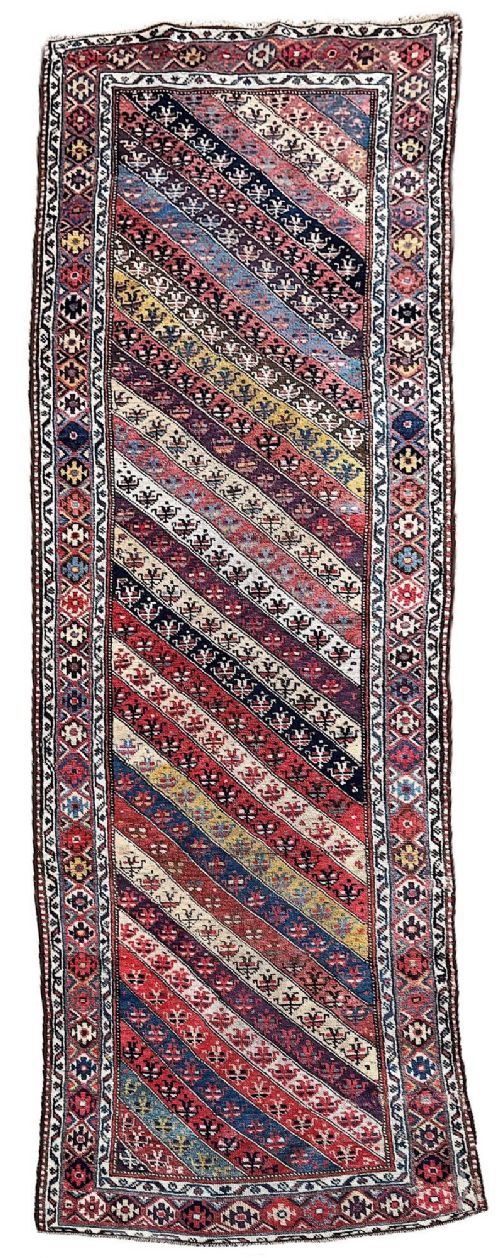


Multicoloured Wool Tribal Carpet
A multicoloured wool tribal carpet brings expressive geometry and rich dyes from nomadic and village weaving traditions directly into your interior.
Multicoloured Wool Tribal Carpet
A multicoloured wool tribal carpet encompasses hand-knotted rugs, flat-woven kilims, and long runners originating from regions such as the Caucasus, Persia, Anatolia, and North Africa. These pieces range from small pile rugs to room-sized carpets and narrow hallway runners produced by nomadic and village weavers. The selection on this page centres primarily on late nineteenth and early twentieth-century examples, spanning from the 1870s up to the 1930s.
Makers include specific regional groups and tribes such as the Qashqai, Yalameh, Lesghi, Gendje, Kazak, Uzbek Lakai, Talysh, Moghan, Esme, Karakecili, Konya, Shirvan, Yuruk, Shekarlu, Shassavan, and Malatya. Forms vary from corridor rugs and village prayer kilims to wall hangings and large kelim formats. The visual vocabulary relies on traditional motifs such as boteh, Memling guls, cloud bands, and striped or banded arrangements.
How They Were Made
The construction of these textiles typically involves wool, hand-spun wool, and cotton foundations, with occasional touches of silk. Weavers utilised natural materials and traditional hand-knotting or flat-weaving techniques to build durable structures suited for nomadic and village daily life. Dyes derived from natural sources provide the varied palette seen across these rugs and kilims.
Structural methods differ between pile carpets, which utilise vertical knotting on warps, and flat-woven kilims, which interlace warp and weft threads without a pile. Many pieces, such as specific Turkish kilims, were woven in two separate parts and joined together to achieve larger room sizes. The combination of hand-spun wool and sturdy cotton or wool foundations ensures physical longevity.
Listings feature periods spanning from the 1870s to the 1930s, utilising wool, hand-spun wool, cotton, and silk materials.
What Varies in Quality
Quality rests upon the fineness of the weave, the integrity of the structural materials, and the sophistication of the design execution. Tighter knot counts or precise flat-weave construction indicate greater technical skill by the weaver. The vibrancy, depth, and harmony of the natural dye palette also distinguish superior examples.
Condition plays a role, with intact borders, original selvedges, and minimal wear commanding attention from collectors. The clarity of traditional tribal motifs, such as guls and boteh designs, reflects the cultural authenticity and care taken during production. Superior pieces maintain structural soundness alongside expressive artistic merit.
The Multicoloured Wool Tribal Carpet Glossary
- Kilim
- A flat-woven carpet or rug produced without a pile by tightly interweaving warp and weft strands. These textiles often feature sharp geometric patterns.
- Boteh
- A traditional teardrop or almond-shaped motif with a curved upper end, frequently seen in Persian and Caucasian textile designs. This symbol represents a floral spray or cypress tree.
- Gul
- A medallion or repeating octagonal motif used extensively in Central Asian and Caucasian carpet designs. Each tribal group utilised distinct gul variations for identification.
- Runner
- A long, narrow carpet format specifically designed for hallways, corridors, or staircases. These pieces balance length with a restrained width.
- Warp
- The vertical foundation threads stretched tightly on a loom before weaving begins. Weft threads are subsequently passed across and through these stationary strands.
- Selvedge
- The finished reinforcing edge of a carpet that runs parallel to the warp threads. Proper binding prevents the sides from fraying or unravelling over time.
Multicoloured Wool Tribal Carpet: Frequently Asked Questions
How do I clean a wool tribal carpet?
Regular gentle vacuuming without a beater bar removes surface dust and loose debris safely.
Professional specialist cleaning is necessary for deeper maintenance to protect natural wool fibres and traditional dyes.
Where were these carpets originally woven?
Nomadic tribes and village communities produced these textiles across the Caucasus, Persia, Anatolia, Central Asia, and Morocco.
Weavers worked within distinct regional traditions that dictated specific colour palettes, materials, and geometric vocabularies.
Are these carpets suitable for heavy hallway traffic?
Many sturdy wool pile runners and flat-weaves handle moderate hallway footfall effectively.
Placing a quality underlay beneath the rug prevents slipping and reduces fibre compression during daily use.
How can I tell a kilim from a pile rug?
A kilim is flat-woven without pile, resulting in a thin, tapestry-like fabric with a smooth surface on both sides.
Pile rugs feature cut wool yarn knotting that creates a dense, plush surface texture on the upper face.