


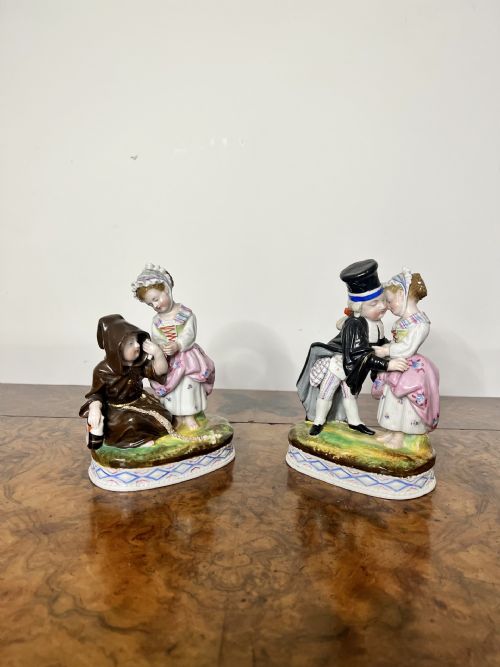

Multicoloured Ceramic Statuettes
These multicoloured ceramic statuettes bring character to a room, ranging from Staffordshire earthenware to Meissen porcelain.
Multicoloured Ceramic Statuettes
Multicoloured ceramic statuettes encompass figures, figurines, and pottery groups originating across the eighteenth, nineteenth, and early twentieth centuries. A buyer searching this phrase looks for figurative ceramic works, most commonly meeting Victorian Staffordshire figures and continental porcelain pieces on this page.
How they were made
Makers shaped these statuettes from porcelain, earthenware, and bisque ceramic, applying enamel, ceramic glaze, and enamel paint to build the multicoloured surfaces. Some works incorporate gold leaf details to highlight garments or accessories.
Workshops utilised moulds for mass production or hand-modelled individual figures, followed by high-temperature firing to set the body and subsequent lower firings to fix the painted polychrome enamels and glazes.
Listings feature porcelain, earthenware, and bisque ceramic materials across Victorian, Edwardian, Georgian, and Art Deco periods.
What varies in quality
The reputation of the manufactory, from Meissen and Royal Copenhagen to regional English potteries, also influences the standing of the work. Superior examples maintain crisp glaze surfaces and well-defined forms without blurring in the painted decoration.
Triebner Ens And Eckert·Gotthelf Greiner·Royal Copenhagen·Royal Doulton
The Multicoloured Ceramic Statuettes Glossary
- Bisque
- Unglazed ceramic fired once, leaving a matte, porous white surface that resembles marble. It was frequently used for nineteenth-century portrait busts and sentimental figure groups.
- Earthenware
- Porous pottery fired at lower temperatures, commonly used for robust nineteenth-century Staffordshire figures. It requires an opaque glaze or enamel coating to hold water and colour.
- Enamel
- Glassy pigment applied over a fired glaze and fused in a second kiln firing. This technique provides the vibrant, durable colours seen on porcelain figures.
- Porcelain
- A hard, vitreous ceramic made from kaolin and petuntse, fired at high temperatures until translucent. It forms the crisp, refined body of eighteenth and nineteenth-century continental and English statuettes.
- Staffordshire
- Pottery produced in the English region of Staffordshire, known for popular earthenware figures depicting contemporary events, literary characters, and animals.
Multicoloured Ceramic Statuettes: Frequently Asked Questions
How should I clean my ceramic statuettes?
Dust figures gently with a soft, dry brush to prevent accumulation in crevices and painted details.
Avoid using water or liquid cleaners, particularly on antique enamel surfaces where moisture can lift or damage old pigments.
Where were most of these figures made?
The selection includes works from English potteries in Staffordshire as well as continental European porcelain factories in Germany, France, and Denmark.
Each region employed distinct ceramic bodies and local glazing traditions that distinguish their output.
Are these figures fragile?
Ceramic and porcelain statuettes are delicate and prone to chipping or breakage if dropped or knocked against hard surfaces.
Display them on stable, level shelves away from heavy foot traffic or busy household activity.
How do I tell an 18th century figure from a 19th century one?
Eighteenth-century porcelain figures often feature softer paste bodies, Rococo scroll bases, and hand-modelled foliate details.
Nineteenth-century pieces tend to use harder porcelain or earthenware, frequently with more rigid moulding and brighter industrial enamel palettes.