



Mother of Pearl Writing Slope
A mother of pearl writing slope is a portable writing desk that brings iridescent shell inlay and fitted compartments to nineteenth century correspondence.
Mother of Pearl Writing Slope
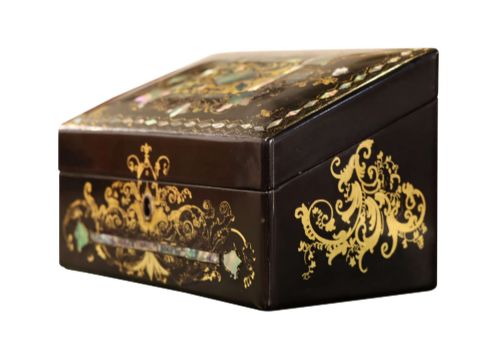
A mother of pearl writing slope is a hinged desk box designed for travel and domestic correspondence during the nineteenth century. These pieces open to reveal a slanted writing surface lined with leather or velvet, alongside inkwells, pen trays and secret compartments. Buyers looking at this page will encounter portable writing boxes and larger stationery cabinets from the Victorian, William IV and Regency periods.
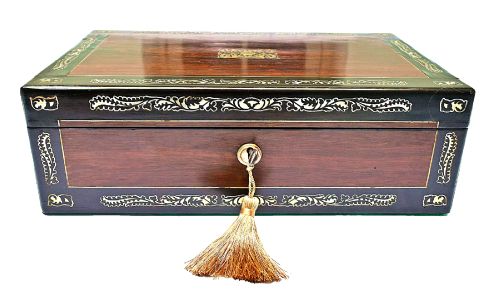
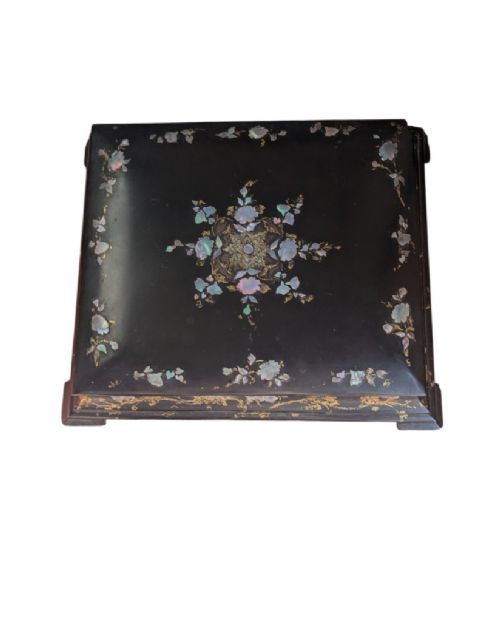
The most common version met here pairs a dark timber carcase with intricate shell escutcheons and floral motifs. Rosewood and coromandel dominate the current and past inventory, often contrasted with shimmering abalone and mother-of-pearl inlay. While many examples function as personal lap desks, variants include tabletop boxes, stationery cabinets and combined sewing cases.
What separates the finest examples
Quality rests upon the precision of the shell inlay and the integrity of the timber carcase. The top of the range exhibits tightly fitted mother-of-pearl and abalone that sits level with the surrounding wood, free from shrinkage cracks or missing pieces. Elaborate floral arrangements, intricate marquetry and substantial coromandel foundations distinguish superior pieces from simpler rosewood boxes.
Internal completeness and maker attribution elevate certain slopes above standard production. Surviving original leather skivers, matching glass inkwells and functional secret drawers indicate a well-preserved piece. Signed examples from documented makers such as George Austin of Dublin or Lund of London carry additional distinction.
Mother of Pearl Writing Slope Retail Price Guide 2026
Typical asking prices for mother of pearl writing slope among the pieces listed under this phrase on Sellingantiques today, from the lower quarter to the upper quarter. They describe what is for sale here now, not the wider market.
The inventory spans the nineteenth century, with pieces recorded from the Regency, William IV and Victorian eras.
George Austin, Dublin·Lund of London
The Mother of Pearl Writing Slope Glossary
- Mother-of-pearl
- An iridescent inner nacre layer of pearl oyster and freshwater pearl mussel shells. Craftsmen cut this material into thin pieces for decorative inlay on nineteenth century boxes.
- Abalone
- A marine mollusc shell known for deep green, blue and purple iridescence. It appears alongside mother-of-pearl to add colour variation to floral and geometric box inlays.
- Coromandel wood
- A heavy, dense tropical timber featuring dark brown stripes over a yellow-brown ground. It serves as a luxury carcase material for high-end Victorian writing slopes.
- Escutcheon
- A flat plate surrounding a keyhole to protect the surrounding wood from wear. On these pieces, escutcheons are frequently fashioned from brass or engraved mother-of-pearl.
- Tunbridge Ware
- Small woodware decorated with mosaic patterns created from thousands of tiny coloured wood blocks. This technique appears on specific nineteenth century domed writing slopes.
Mother of Pearl Writing Slope: Frequently Asked Questions
What is inside a mother of pearl writing slope?
Lifting the lid reveals a folding writing slope lined with leather or velvet, divided by partitions for stationery, pens and wax seals. Glass inkwells, nib trays and hidden secret drawers sit beneath or behind the main writing flap.
Many interiors retain original velvet surfaces and compartments designed to hold letters and postage items securely during travel.
How do I date a writing slope?
Dating relies on timber choice, inlay style and construction marks associated with Victorian, William IV and Regency periods. Rosewood and coromandel boxes featuring dense floral pearl inlay typically point to the mid-nineteenth century.
Papier-mâché examples and specific cabinet styles help narrow the decade between eighteen-fifty and nineteen-hundred.
Are these boxes portable?
Nineteenth century writing slopes were engineered for travel, featuring compact rectangular forms, brass carrying handles and secure locks. Owners carried them on journeys to write letters away from home.
Larger stationery boxes and desk cabinets remained stationary on library tables, while lap desks travelled in carriages and trunks.
How do I care for the mother of pearl?
Maintain the shell and timber by dusting gently with a dry, soft cloth and avoiding harsh chemical cleaning agents. Keep the wood away from direct sunlight and extreme humidity to prevent timber movement.
Conditioning the hardwood surfaces occasionally with appropriate furniture wax preserves the polish without harming the flush shell inlay.