


Miniature French Furniture
Miniature French furniture offers scale models and salesmen samples crafted in mahogany, kingwood, and ormolu.
Miniature French Furniture
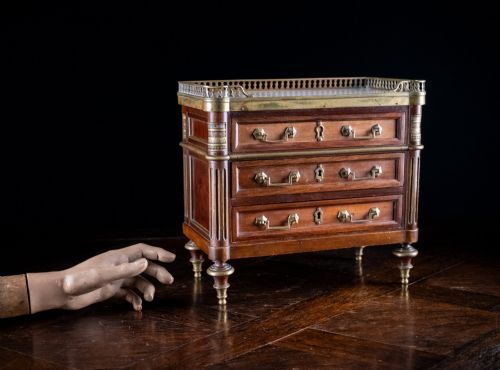
Miniature french furniture comprises small-scale items and apprentice pieces created across the nineteenth century, including commodes, credenzas, and seating. These objects reproduce full-scale styles such as Louis XVI, French Empire, and Rococo Revival in reduced dimensions.
How they were made
Cabinetmakers utilised dense timbers like mahogany and kingwood, often applying tulipwood veneers and ebonising to achieve rich surface textures. Boulle marquetry and French polishing demonstrate the skilled joinery required for reduced scales.
Decorative detailing relies on cast ormolu, gilt bronze, and carved bone mounts, paired with inset marble slabs on commodes and cane work in miniature chairs.
Some miniature chairs were built small enough for a child's favourite doll to sit properly.
What varies in quality
The refinement of the bronze and ormolu mounts distinguishes superior examples from simpler ones, showing crisp chasing and secure fixing. Timber selection also matters, with finely figured kingwood veneers and detailed marquetry commanding greater attention than plain hardwoods.
Proportion and structural fidelity to full-scale pieces indicate the maker's hand, particularly in complex forms like bureau bookcases and commodes where miniature drawers must operate smoothly.
The Miniature French Furniture Glossary
- Ormolu
- Gilded bronze used for decorative mounts and accents on furniture. It provides a bright golden finish that contrasts with dark hardwoods.
- Kingwood
- A dense, richly figured timber imported from Brazil, prized for its distinctive grain patterns in nineteenth-century veneering.
- Boulle
- A form of marquetry using brass and tortoiseshell inlaid into furniture surfaces, named after the French cabinetmaker.
- Bergere
- An enclosed upholstered armchair with wooden framing, seen in miniature child and doll scales with cane or fabric seats.
Miniature French Furniture: Frequently Asked Questions
What is miniature french furniture?
These items are small-scale representations of full-size cabinetry, created as apprentice pieces, salesmen samples, or furnishings for children.
They mirror the major design periods of the nineteenth century, utilising fine woods and metal mounts.
How were apprentice pieces used?
Apprentice pieces served as proof of skill for woodworkers seeking admission to a guild or demonstrating mastery of their trade.
They replicate every structural detail of a standard commode or bureau on a reduced scale.
What woods appear most often?
Makers relied on durable hardwoods such as mahogany and exotic veneers like kingwood and tulipwood.
Ebonised finishes and gilt bronze accents frequently accompany these primary timbers.
How do I date these items?
Dating relies on stylistic markers from periods like Louis XVI, French Empire, and Napoleon III alongside construction methods.
Nineteenth-century examples show specific veneer thicknesses and mount casting techniques characteristic of the era.