
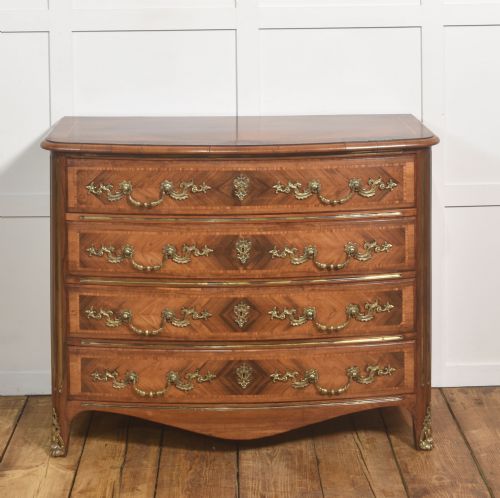
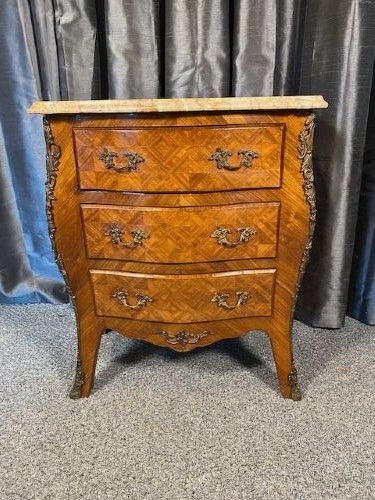
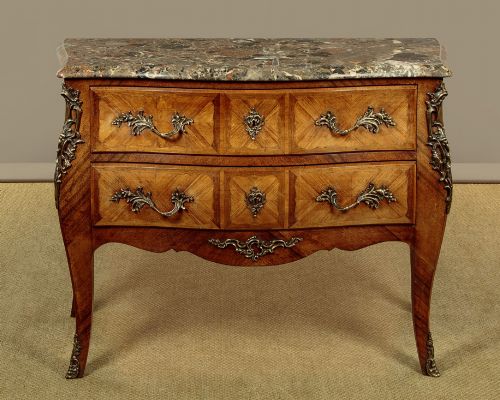
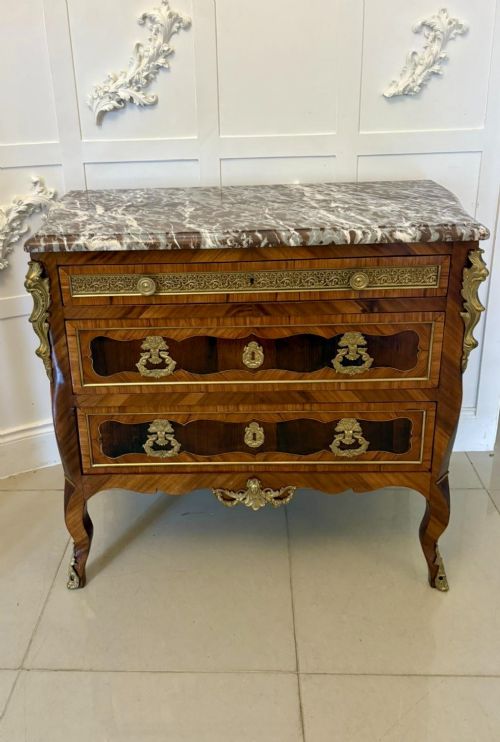


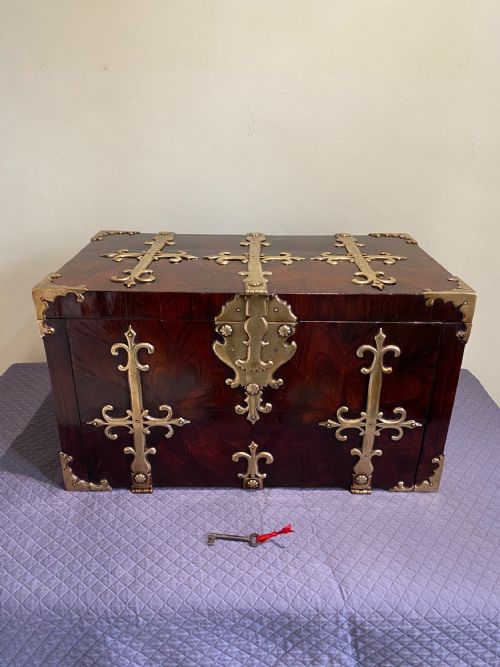


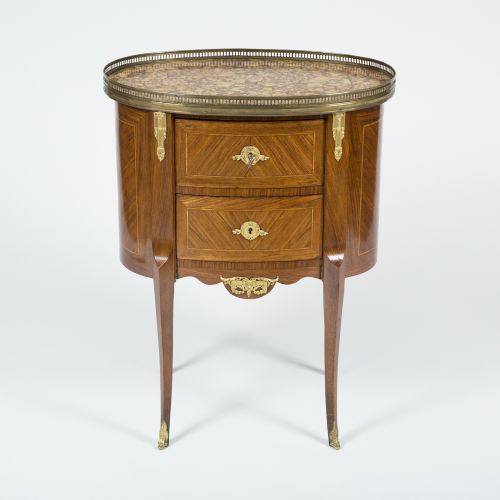
Brass Mounted Kingwood Chest
A brass mounted kingwood chest brings warmth and rich grain to a room through dark exotic timber framed by metal mounts.
Brass Mounted Kingwood Chest
A brass mounted kingwood chest displays the dense, figured grain of exotic timber paired with gleaming metal mounts. These pieces span centuries of cabinetmaking, featuring forms from grand commodes to compact bedside tables and strongboxes.
The selections range from serpentine chests of drawers to marble-topped commodes and miniature apprentice chests. French influences dominate, particularly Louis XV and Louis XVI styles, alongside earlier parquetry and oyster-venweed strongboxes.
Distinguishing quality in construction
The refinement of the surface decoration sets the finest examples apart, seen in the precision of the parquetry and marquetry layouts. Crisp casting and chasing on the brass mounts indicate superior craftsmanship.
The structural integration of the marble tops and the fluidity of serpentine or bombe forms determine the overall execution. Subtle details such as oyster veneering depth reflect the ambition of the original workshop.
Listings feature kingwood, walnut, rosewood, and ormolu across periods spanning the seventeenth century to the 1930s.
The Brass Mounted Kingwood Chest Glossary
- Kingwood
- A dense, richly figured South American timber prized for dark brown and violet colouring.
- Ormolu
- Gilded bronze used for decorative mounts and accents on fine cabinetry.
- Parquetry
- Geometric patterns formed by fitted wood veneer pieces laid onto a carcase.
- Serpentine
- A curved furniture front curving outward in the centre and inward at the ends.
- Commode
- A low chest of drawers, often featuring a marble top in French designs.
Brass Mounted Kingwood Chest: Frequently Asked Questions
What is a kingwood coffre fort?
A kingwood coffre fort is a heavy strongbox or small cabinet designed for securing valuables, constructed with thick timber and reinforced with metal mountings.
These pieces date back to earlier centuries and often feature intricate parquetry or oyster veneer work across the exterior surfaces.
How do I care for a marble top?
Marble tops require gentle cleaning with a damp cloth and mild soap, avoiding acidic substances that can etch the polished stone surface.
Using coasters and mats protects the stone from stains while preserving the original finish of the marble.
Where were these chests made?
The majority of these pieces follow French design traditions, spanning the Louis styles through to later 19th-century revivals.
Craftsmen across various European workshops produced them using exotic imported timbers and cast metal mounts.