
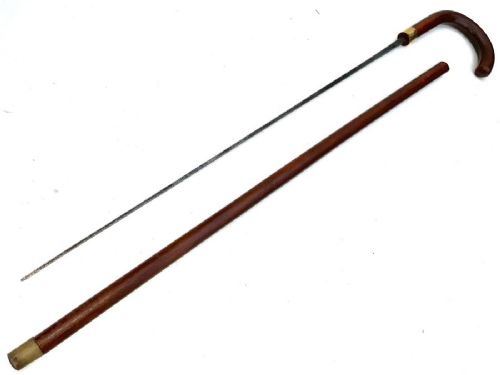
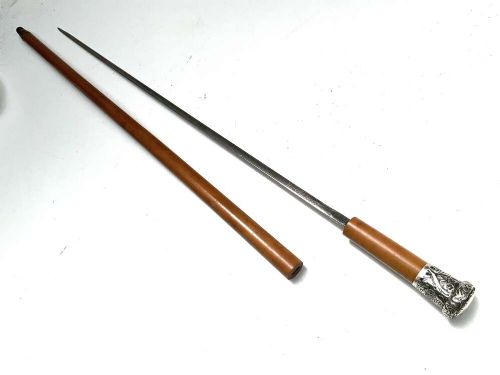


Military Swagger Stick
A military swagger stick is a short, commanding cane carried by officers, bringing undeniable regimental history straight to your hallway stand.
Understanding the military swagger stick
A military swagger stick is a traditional officer accessory designed for carry rather than physical support, acting as a mark of authority. You encounter specimens originating from the nineteenth century through the Edwardian period, often tied to specific regiments or colonial service.
The forms span from standard short canes to combination pieces incorporating concealed blades, alongside specialised examples bearing unit insignia. Anglo-Indian provenance and imperial German or British infantry connections appear frequently among these pieces.
Victorian militaria and Edwardian military items dominate the available selections, showing how officers marked their rank off-duty. These objects range from plain working tools to ornate presentation pieces with precious metal mounts.
Materials and construction
Makers utilised dense timbers, carved wood, and various metals to build these durable batons, often pairing polished shafts with robust terminals. Wood and metal construction ensured the stick could withstand daily handling while maintaining a smart appearance.
Metal components include brass and steel, frequently shaped into decorative caps, ferrules, or secret blade housings. Silver collars provide a distinct contrast to the darker timber shafts, sometimes bearing engraved regimental details or presentation inscriptions.
Retail Price Guide 2026
Typical UK retail prices for military swagger stick, calculated from the Sellingantiques database of over a million retail prices indexed since 2003. This retail price guide relies exclusively on Sellingantiques data; no external sources or auction records are used, so the figures do not describe the wider market.
Recorded styles include Victorian militaria, Edwardian military, and Anglo-Indian variations linked to specific regiments.
Judging quality and craftsmanship
Quality rests in the precision of the metal mounts and the finish of the timber shaft, distinguishing mass-produced items from bespoke officer commissions. Superior examples display crisp engraving on silver collars and seamless integration of concealed sword blades.
The presence of documented regimental associations, such as specific battalion markings, elevates a piece from a generic accessory to a historical artefact. Finer specimens exhibit balanced proportions and substantial weight, reflecting the status of the original owner.
The Military Swagger Stick Glossary
- Swagger stick
- A short cane carried by military officers as a symbol of authority rather than an aid for walking.
- Collar
- A metal band, frequently silver, fitted around the upper portion of the stick often bearing inscriptions or hallmarks.
- Ferrule
- The protective metal cap fitted to the bottom of the stick to prevent splitting and wear during use.
- Sword stick
- A walking stick or swagger stick containing a concealed hidden blade within the wooden shaft.
- Militaria
- Antiques and collectibles relating to military history, uniforms, and weaponry.
Frequently Asked Questions
What is a military swagger stick?
A military swagger stick is a short cane traditionally carried by officers as an insignia of rank and authority.
Unlike standard walking sticks, these pieces were meant for parade or off-duty carry rather than physical support.
Did swagger sticks contain blades?
Certain military swagger sticks incorporated concealed sword blades within their wooden shafts for personal defence.
These combination pieces functioned both as a symbol of rank and as a discreet weapon.
How do I identify the period?
Dating relies on examining the style of the metal mounts, timber types, and any engraved regimental markings.
Victorian and Edwardian examples often feature distinct silver hallmarks or specific battalion details that help narrow down the date of manufacture.
Where were these sticks used?
Officers carried them across domestic British postings and throughout colonial service in regions like India.
Colonial pieces often reflect local carving traditions combined with standard British military forms.