






Middle Eastern Scene Painting
Middle Eastern scene painting captures foreign landscapes and figures, offering buyers a window into nineteenth and twentieth-century travels.
Middle Eastern Scene Painting
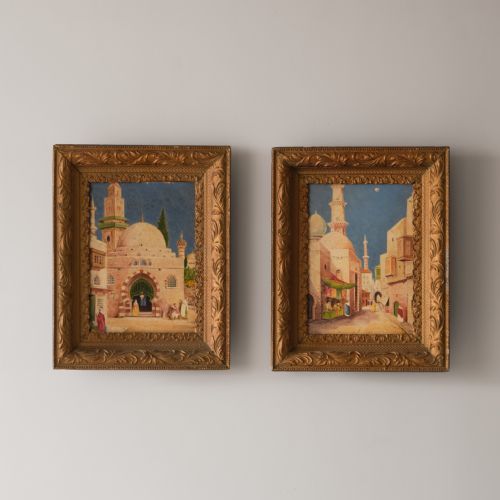
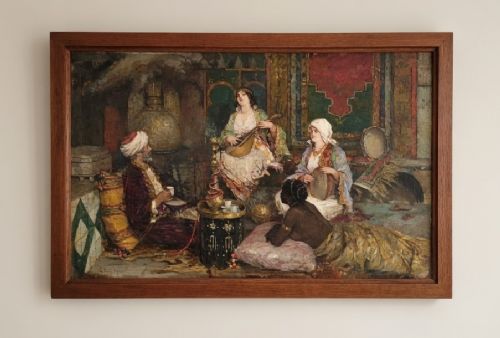
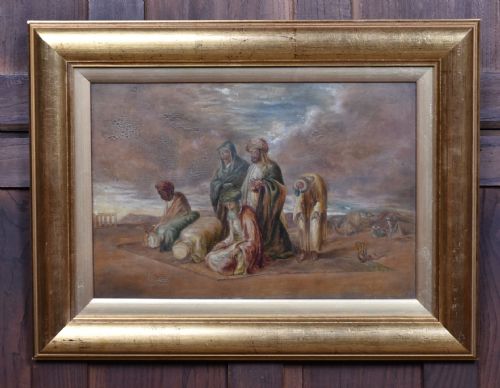
Middle Eastern scene painting encompasses works executed across the nineteenth and twentieth centuries, capturing subjects from Arab lands and Persia. These pieces range from naive depictions of old Bagdad to detailed landscape watercolours and village scenes.
Buyers will encounter various formats on this page, including framed watercolours, oil paintings on canvas and board, and painted textiles. The selection spans distinct artistic movements such as Victorian Orientalism, naive art, and mid-century impressionism.
Origins vary widely across the inventory, reflecting both European artists travelling abroad and regional creators. Works stretch from eighteenth-century oil paintings to mid-century vintage pieces, showing diverse interpretations of eastern architecture, waterways, and local inhabitants.
Materials and methods
Works in this category rely primarily on traditional supports such as paper, wood, and canvas. Artists applied media including watercolour, gouache, and oil paint to create these textured depictions.
Framing forms an integral part of the presentation, utilising wood, gilt wood, gilded wood, and ebonised frames. Additionally, block printing and painting appear on textile supports from Persia.
Middle Eastern Scene Painting Retail Price Guide 2026
Typical asking prices for middle eastern scene painting among the pieces listed under this phrase on Sellingantiques today, from the lower quarter to the upper quarter. They describe what is for sale here now, not the wider market.
The inventory includes textile pieces alongside traditional framed paintings on board and canvas.
Assessing quality
Quality rests upon the skill of the brushwork and the accuracy of composition, distinguishing hurried sketches from fully realised oils and watercolours. The handling of light and atmospheric depth marks the division between standard decorative works and accomplished artistic achievements.
The choice of materials and the preservation of the original support influence the standing of each piece. Intact period frames and stable paint layers support the overall integrity of the artwork.
Edwin Lord Weeks·Gabriel Puig Roda·William James Muller·V. Zirakian·Hugo Vogel·Richard Wilson
The Middle Eastern Scene Painting Glossary
- Watercolour
- A painting method where paints are made of pigments suspended in a water-based solution. It provides transparent washes of colour on paper supports.
- Gouache
- A water-based paint consisting of pigment and other inert materials designed to be opaque. It offers heavier coverage than traditional watercolour.
- Orientalism
- An artistic style depicting scenes and people of the Middle East and North Africa. It was particularly prevalent among European artists during the nineteenth century.
- Qajar
- Pertaining to the Iranian dynasty ruling from the late eighteenth to the early twentieth century. It is associated with distinct artistic traditions in painting and textiles.
- Ebonised
- Wood finished to resemble ebony through staining or painting. This dark treatment was common in nineteenth and early twentieth-century picture frames.
Middle Eastern Scene Painting: Frequently Asked Questions
What periods do these paintings cover?
The works span from the eighteenth century through to the mid-twentieth century.
They reflect shifting artistic movements and traveller perspectives across multiple decades.
Are these paintings usually framed?
Many examples retain their period surrounds, including wood, gilt, and ebonised frames.
Original framing helps preserve the context and presentation of the artwork.
What subjects appear in these scenes?
Common subjects include landscapes, waterways such as the Suez Canal, and village architecture.
Artists also recorded local inhabitants, Bedouin tribesmen, and farmers with animals.
How should I display these paintings?
Keep them away from direct sunlight to protect watercolours and oils from fading.
Ensure stable indoor humidity to preserve wooden frames and paper supports.