
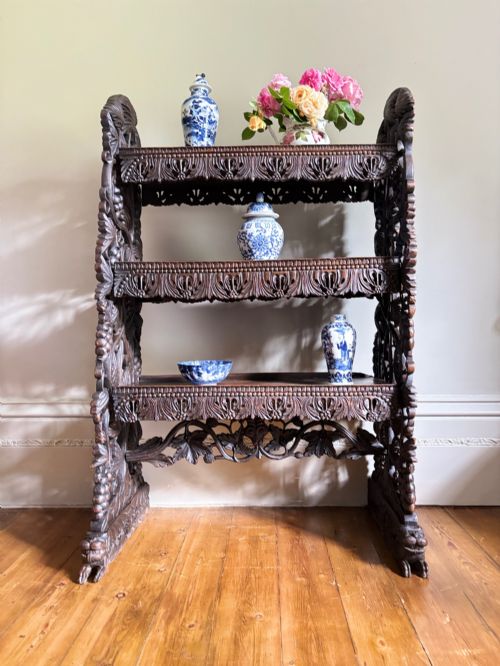
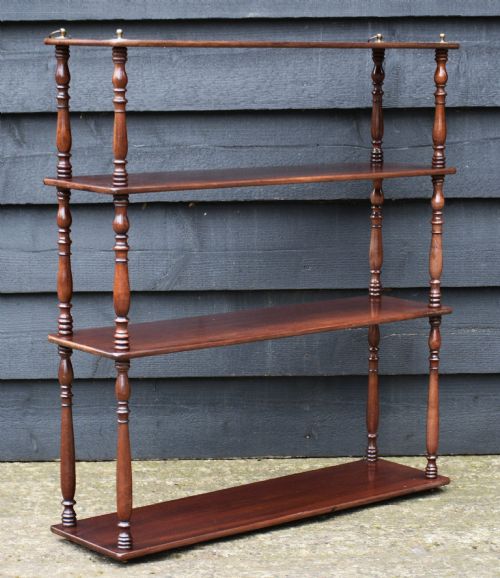
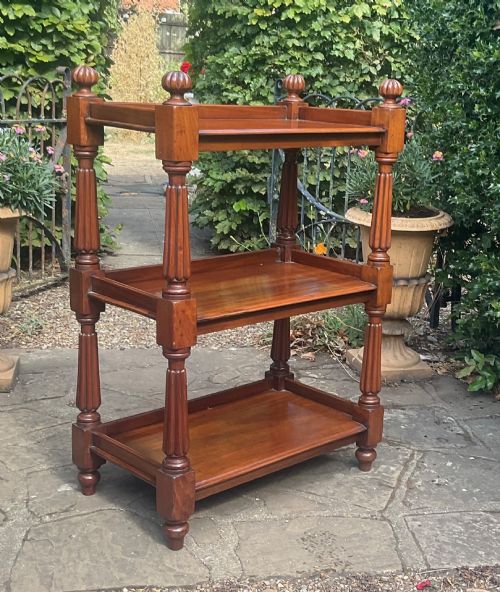

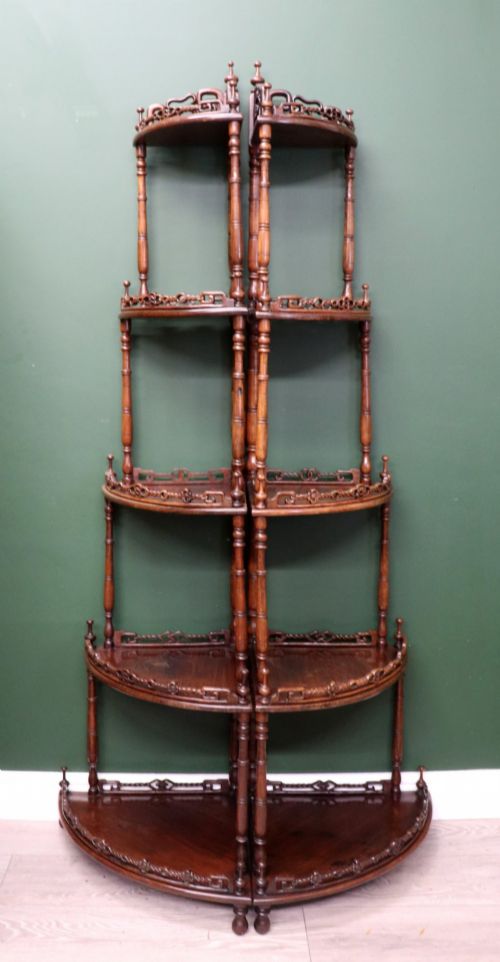
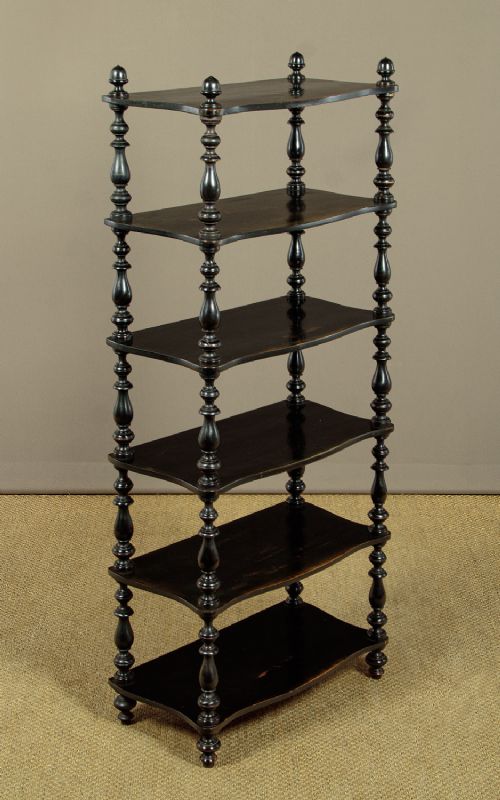


Mid Victorian Etagere
A mid victorian etagere brings tiered display and architectural order to a room, offering open shelving for books and ornaments.
Mid Victorian Etagere
A mid victorian etagere functions primarily as an open shelving unit or display stand, designed to hold decorative objects and books across multiple tiers. You will regularly encounter mahogany, rosewood, and walnut examples on this page, taking forms from corner shelves to wall-hanging units and central standing buffets.
The objects span the nineteenth century, specifically emerging from the decades around eighteen fifty to eighteen seventy. Makers constructed these tiered pieces to stand freely in a room or to mount securely against a wall, sometimes incorporating lower cabinets or single drawers beneath the open shelves.
How they were made
Craftsmen utilised dense hardwoods including mahogany, rosewood, walnut, and padauk, often selecting rich veneers and marquetry to cover the foundational surfaces. Ebonised wood also appears among these tiered structures, providing a dark and uniform finish that mimics more costly exotic materials.
Metalwork played a structural and decorative role, with brass mountings securing the tiers or framing the edges in the French manner. Cabinetmakers turned supports and shaped vertical uprights to bear the weight of multiple levels without losing stability.
The documented object types span wall shelves, corner units, dumb waiters, and central standing buffet cabinets.
What varies in quality
The distinction between standard pieces and exceptional ones rests upon the choice of timber and the complexity of the internal construction. Finer examples display carefully figured rosewood or burr walnut veneers, paired with crisp turning on the uprights and robust joinery that keeps the multiple tiers rigid.
Proportion and decorative detail further separate the tiers, ranging from simple utility shelves to grander designs with brass mounts, marquetry inlay, and integrated drawers or cupboards. The presence of specialised woods like padauk or documented workshop attribution elevates the architectural ambition of the piece.
Holland and Sons
The Mid Victorian Etagere Glossary
- Etagere
- A piece of furniture consisting of a set of open shelves for displaying small ornaments. This form became particularly popular during the Victorian period for parlor and drawing room display.
- Whatnot
- An alternative term for a multi-tiered set of open shelves used for holding books, ornaments, or bric-a-brac. The name reflects its catch-all utility in nineteenth-century interiors.
- Marquetry
- The art and craft of applying pieces of veneer to a structure to form decorative designs and patterns. Cabinetmakers used contrasting woods to create pictorial or geometric surface decoration.
- Padauk
- A heavy tropical hardwood known for its deep reddish-brown colour and durability. Anglo-Indian pieces frequently utilised this timber for its rich tone and density.
Mid Victorian Etagere: Frequently Asked Questions
What is an etagere?
An etagere is a standing piece of furniture featuring multiple open tiers designed for displaying decorative objects, porcelain, or books.
Originating in France, the form was widely adopted by British cabinetmakers during the nineteenth century to suit the Victorian desire for layered interior display.
How were these shelves used?
These tiered stands served primarily as display furniture in drawing rooms and parlors, holding small sculptures, framed photographs, and ceramics.
Some variations included enclosed lower cabinets or single drawers, allowing them to function simultaneously as small sideboards or buffets for storing table linens and papers.
Where should I place an etagere?
An etagere suits corners, flat walls, or central positions in a room depending on whether the piece is designed for wall hanging or freestanding support.
Freestanding models provide access from multiple sides, while corner shelves utilise awkward angles to add vertical display space without crowding floor area.
How do I care for rosewood furniture?
Rosewood requires stable humidity levels and protection from direct sunlight to prevent the timber and its underlying veneers from drying out or fading.
Dust the tiers regularly with a soft, dry cloth and avoid applying modern silicone polishes that can damage the historical finish over time.