


Mid Century Brass Clock
A mid century brass clock brings mechanical weight and sharp metal finish to a desk or mantel.
Mid Century Brass Clock
When you search for a mid century brass clock, you look at items spanning desk clocks, mantel pieces and heavy perpetual motion designs produced across the middle decades of the twentieth century. These pieces combine metallic yellow cases with functional dials, often driven by complex mechanical movements or specialised movements such as the Atmos system.
The versions most common on this page date from the nineteen-fifties and nineteen-sixties, reflecting mid-century design alongside earlier nineteenth-century brass examples. Forms range from portable carriage clocks and round dial desk pieces to skeleton movements and novelty lamp post shapes.
Makers such as Jaeger-LeCoultre, Imhof and Kienzle dominate the mid-century selection, providing distinct housing styles that include gilt brass, glass panels and contrasting enamel faces. Alongside these, earlier nineteenth-century French and British pieces appear, demonstrating that brass housings span multiple decorative eras.
Materials and construction
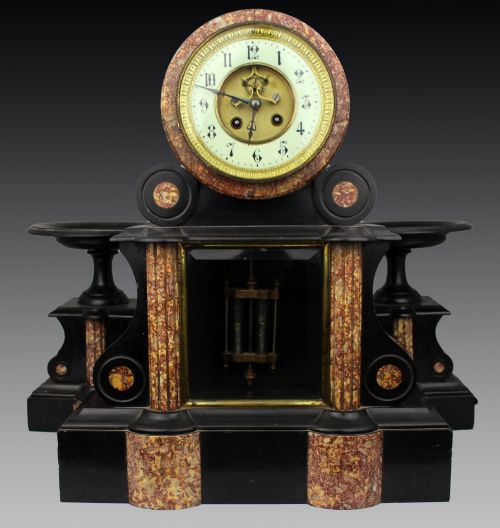
Makers constructed these timepieces primarily using brass, gilt brass and gilt bronze, often pairing metallic housings with clear glass panels to expose the internal gears. Enamel and metal dials provide the face for numeric displays, while specialised models incorporate wood cases like burr walnut or marble bases.
Movements rely on traditional mechanical wind mechanisms, eight-day springs, or complex fifteen-jewel escapements that require precise calibration. The mid-century era also introduced electro-mechanical systems and perpetual motion mechanics driven by atmospheric temperature changes.
The listings combine mid-century pieces from the nineteen-fifties and sixties with nineteenth-century French and Georgian designs in brass and glass.
Assessing quality and finish
Quality in these timepieces rests upon the precision of the mechanical movement, the weight of the metal housing and the clarity of the dial work. Substantial gilt brass cases and jewelled escapements demonstrate superior construction compared to lighter commercial alternatives.
The presence of original packaging, signed maker dials and documented service histories elevates certain pieces above standard production models. Furthermore, the integrity of the glass panels and the crispness of the engraved or printed dial numerals separate standard items from top-tier examples.
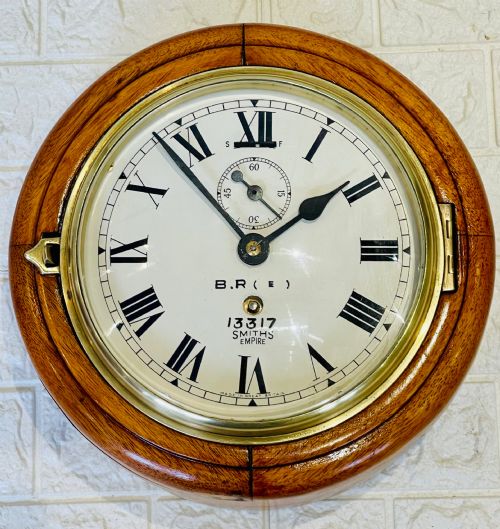
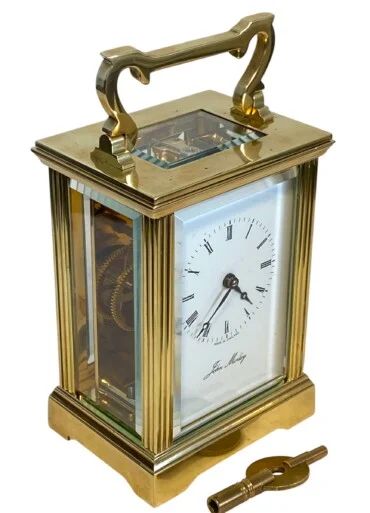
Japy Freres·Windmills and Wightman·John Morley·L Epee·Imhof·Smiths·Jaeger LeCoultre·Elliott of London·Luxor·Pearson and Price·Kienzle
The Mid Century Brass Clock Glossary
- Atmos clock
- A mechanical timepiece created by Jaeger-LeCoultre that runs using changes in atmospheric temperature and pressure without manual winding.
- Carriage clock
- A small, portable spring-driven timepiece equipped with a carrying handle, originally designed for travel during the nineteenth century.
- Escapement
- The mechanical linkage that transfers energy to the pendulum or balance wheel while regulating the rotation of the gear train.
- Gilt brass
- Brass coated with a thin layer of gold or gold-coloured wash to give a bright, reflective metallic finish.
- Skeleton clock
- A timepiece designed with open plates and bridges to reveal the internal movement and gear trains from the exterior.
Mid Century Brass Clock: Frequently Asked Questions
How do Atmos clocks work?
These clocks operate via a sealed capsule containing a gas and liquid mixture that expands and contracts with temperature shifts. This movement winds the mainspring continuously without human intervention.
Because they require no batteries or manual winding, they need a stable, vibration-free surface to maintain accurate timekeeping over long periods.
How do I wind a mechanical desk clock?
You insert a small matching key into the winding arbor on the dial or backplate and turn it gently until you feel resistance. Care must be taken not to overwind the mainspring.
Most mechanical pieces on this page require winding every eight days to maintain continuous operation.
Where should I place a brass mantel clock?
These pieces suit flat, stable surfaces such as mantelpieces, heavy sideboards, or executive desks where their metallic finish catches light. They function best away from direct heat sources and damp areas.
Ensure the surface is level so the escapement beats evenly without stalling the movement.
How do I identify a mid-century piece?
Mid-century pieces typically feature clean circular or square dials, minimalist numerals, and heavy gilt brass or polished metal housings. They reflect design trends from the nineteen-fifties and sixties.
Earlier nineteenth-century examples often display ornate cast bronze, marble bases, or traditional French carriage case designs.