
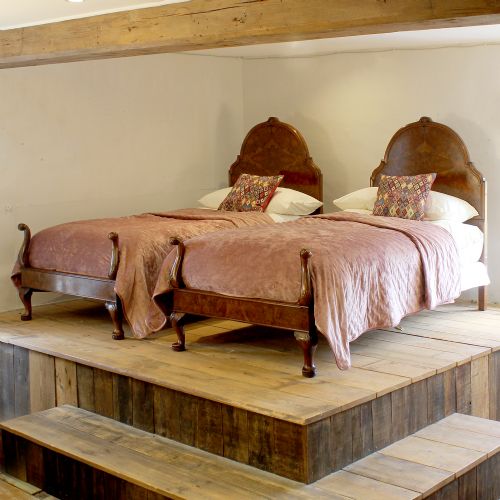
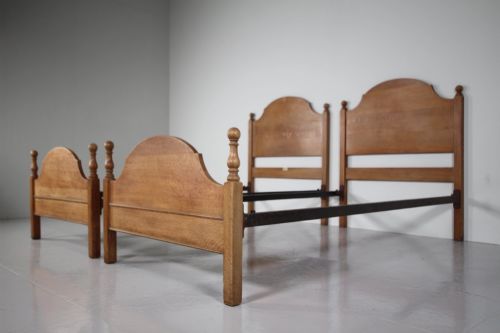


Matching Twin Beds
Matching twin beds are pairs of coordinated sleeping quarters that solve the problem of furnishing a guest room with symmetry and period character.
Matching Twin Beds
Matching twin beds appear across several distinct historical periods, ranging from nineteenth century iron frames to twentieth century walnut designs. When searching for matching twin beds, buyers frequently encounter Edwardian walnut bedsteads alongside Victorian iron and brass variations.
The inventory on this page spans simple oak single bed frames by Heal & Son to elaborate French chateau and Art Deco satinwood pieces. These listings unite pairs of single beds designed to match one another for coordinated bedroom schemes.
Materials and construction methods
Cabinet makers utilised solid woods like oak, mahogany, and walnut, often applying burr walnut veneers or delicate inlay to the headboards and footboards. Carved walnut and satinwood surfaces demonstrate the traditional woodworking techniques of the Edwardian and Art Deco periods.
Metal frames combine cast iron with brass decoration or painted finishes such as cream and black. These pieces rely on durable metal casting methods common in Victorian manufacturing.
One Edwardian walnut pairing comes with an unexpected bonus: a matching bedroom chair to complete the morning dressing routine.
Distinguishing quality in pairs
Quality rests on the consistency of the match between the two frames and the integrity of the timber or metalwork. Heals pieces demonstrate superior workshop execution through labelled authenticity and refined proportions.
Fine carving, crisp inlay work, and retained original maker labels separate standard production pieces from higher tier examples. The cohesion of auxiliary items like ensuite bedside cabinets or matching chairs further elevates a matched set.
Heal & Son·Heals
The Matching Twin Beds Glossary
- Bedstead
- The framework of a bed supporting the mattress, consisting of headboard, footboard, and side rails. Wooden bedsteads often feature panelled or carved construction.
- Platform bed
- A low frame designed to support a mattress directly without traditional bedsprings. These appear in Victorian and Art Deco variations.
- Inlay
- A decorative technique where contrasting woods or materials are inserted into recesses in the primary wood surface. Edwardian mahogany pieces frequently employ this method.
- Chinoiserie
- European decorative style reflecting Chinese artistic motifs. Edwardian walnut bedsteads occasionally display this painted or lacquered aesthetic.
Matching Twin Beds: Frequently Asked Questions
How do I style matching twin beds?
Pair the two single frames with coordinated bedding and position them with a shared bedside cabinet between them. This maintains symmetry while keeping the floor plan balanced.
Matching Edwardian or Art Deco pieces work well when echoed by period appropriate chairs or ensuite storage units listed alongside the beds.
What periods do these beds come from?
The listings encompass nineteenth century designs, Victorian cast iron models, and Edwardian walnut frames. Twentieth century Art Deco pieces in satinwood also feature.
Each period brings distinct materials, from heavy iron and brass to polished walnut and mahogany.
Are matching twin beds comfortable for daily use?
These historical frames accommodate standard modern single mattress sizes depending on the specific platform or base dimensions. Buyers should check the internal dimensions of the bedstead.
Some Art Deco and Victorian platforms include modern bed bases to assist with mattress support.
How do I identify an Edwardian twin bed?
Edwardian examples often feature walnut or inlaid mahogany panels, sometimes bearing labels from makers such as Heal & Son. Stylistic cues include lighter wood tones and subtle decorative carving.
Chinoiserie motifs and Queen Anne style influences also help date these Edwardian frames.