


Marquetry Vanity Desk
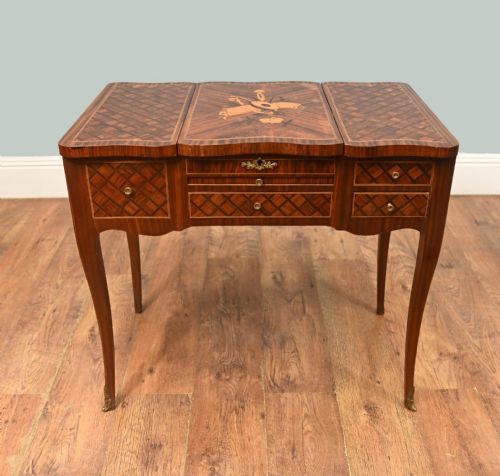
A marquetry vanity desk brings intricate floral and geometric wood veneers together with a practical surface for morning grooming or private correspondence.
Marquetry Vanity Desk
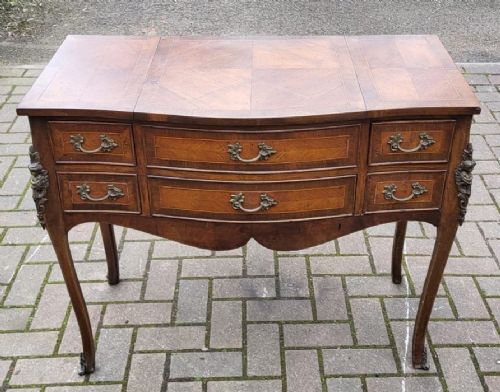
A marquetry vanity desk serves as a dedicated space for personal grooming and writing, combining drawers, compartments, and a finished writing surface. These pieces often take the form of a poudreuse, bonheur du jour, or inlaid dressing table.
The selections span the eighteenth, nineteenth, and early twentieth centuries, drawing heavily on Victorian and French revival styles. Makers utilise classic silhouettes alongside detailed decorative veneers.
Originating largely from English and continental workshops, these items range from compact kidney desks to elaborate tables featuring rising compartments and integrated mirrors.

Materials and construction
Cabinet makers built the carcases from foundational timbers like mahogany, oak, and walnut, applying decorative veneers of satinwood, kingwood, rosewood, and tulipwood over the surfaces.
Intricate marquetry patterns are formed by meticulously cutting and fitting contrasting pieces of wood veneer together. Craftsmen then added cast brass or ormolu mounts to edge the tops, drawers, and cabriole legs.
The inventory records pieces from the Georgian, Victorian, and Edwardian eras, incorporating English and continental workshop traditions.
Evaluating the craftsmanship
Quality rests heavily on the precision of the veneer work and the choice of timbers, where tightly fitted exotic woods demonstrate superior workshop skill. The crispness of the brass or ormolu mounts and the smoothness of drawer operation further distinguish finer examples.
The integrity of the original carcase construction, alongside the subtlety of the floral or geometric inlay, separates standard production from exceptional cabinet work.
Edwards and Roberts·Gillows·Hepplewhite
The Marquetry Vanity Desk Glossary
- Marquetry
- The art of applying decorative pieces of veneer to a structural carcase to form detailed pictures or geometric patterns. This technique transforms a plain wooden surface into a canvas of contrasting tones and grains.
- Poudreuse
- A French dressing table featuring folding lids that open to reveal a mirror and hidden compartments for cosmetics and toilet accessories. It serves as a dual-purpose piece for grooming and writing.
- Bonheur du jour
- A small, light ladies writing desk featuring a raised back with small drawers, pigeonholes, or cupboards above the main writing surface. The phrase translates from French as day's good fortune.
- Ormolu
- Gilded bronze mounts and decorative trimmings applied to furniture. This finish adds a bright, metallic contrast to dark or figured timber surfaces.
Marquetry Vanity Desk: Frequently Asked Questions
What is a poudreuse?
A poudreuse is a specific type of French dressing table fitted with folding top panels that conceal a central mirror and storage wells. It was designed in the eighteenth and nineteenth centuries for morning ablutions and powdering.
The clever design allows the surface to remain completely flat when closed, transforming the piece into a small side table or desk when not in use for grooming.
How do I care for marquetry wood?
Marquetry surfaces require gentle treatment to protect the delicate veneer and the glue beneath it. Keep these pieces away from direct sunlight and sudden temperature changes to prevent the wood from warping or shrinking.
Apply a traditional beeswax polish occasionally and buff with a soft cloth to maintain the natural lustre without building up heavy chemical residues.
Where were these desks placed?
Historically, ladies placed these desks in private boudoirs, dressing rooms, or withdrawing rooms where they could write letters, manage correspondence, or attend to morning routines in private.
In a modern home, their compact footprints make them well suited as striking writing desks in studies, living rooms, or bedrooms.
How do I date a vanity desk?
Dating relies on examining the secondary timbers used inside the drawers, the style of the hardware, and the overarching design aesthetic. Cabinet construction methods often shift noticeably between the eighteenth, nineteenth, and early twentieth centuries.
Matching the stylistic markers, such as Sheraton revival lines or French Louis XV influences, provides a reliable framework for determining age.