
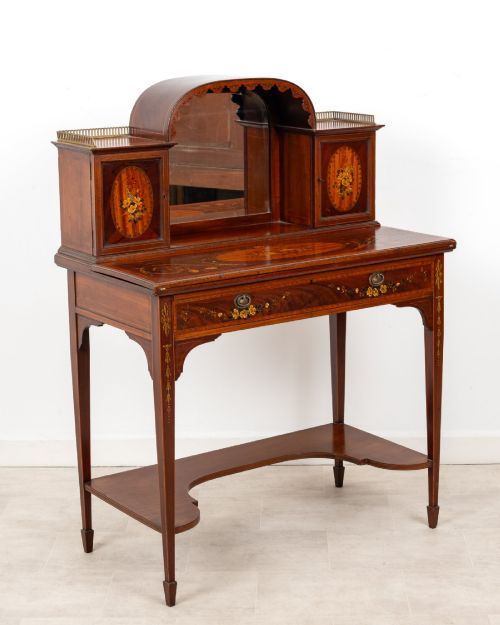


Ladies Inlaid Vanity Table
A ladies inlaid vanity table brings refined personal grooming and correspondence spaces into the home, combining delicate woodwork with practical compartments.

Ladies Inlaid Vanity Table
When you search for a ladies inlaid vanity table, you encounter a selection of sophisticated small-scale desks, dressing tables, and writing furniture designed primarily for female use. These forms encompass Edwardian and Victorian pieces, alongside earlier George III examples and French Revival creations.
Origins span English cabinet makers to French workshops, reflecting the shifting tastes of the eighteenth, nineteenth, and early twentieth centuries. Each version serves the dual purpose of a writing surface and a dressing or vanity space.
How they were made
Cabinet makers utilised dense hardwoods such as mahogany, walnut, and kingwood as foundational structures, often applying veneers of satinwood or rosewood to outer surfaces. Intricate marquetry and brass mounts completed the decorative scheme.
Interior elements frequently incorporated hidden compartments, sliding trays, and fitted glass or leather writing surfaces. Joinery relied on traditional techniques to ensure stability within these delicate proportions.
The listings span multiple eras, encompassing Edwardian, Victorian, and George III periods alongside French Revival and Sheraton Revival styles.
What varies in quality
The distinction between tiers rests upon the precision of the marquetry and the choice of timber veneers. Master workshops employed finer grain matching and more complex pictorial inlay than standard provincial makers.
Hardware selection and the integration of secondary elements, such as fitted leather panels or original brass galleries, define the upper tier of execution. The complexity of internal mechanisms also elevates certain pieces above simpler counterparts.
Edwards & Roberts
The Ladies Inlaid Vanity Table Glossary
- Marquetry
- Decorative veneer work arranged in pictorial or geometric patterns using various coloured woods. It requires considerable skill to cut and fit each piece precisely.
- Bonheur du jour
- A small, light ladies writing desk featuring a tiered superstructure with shelves or drawers above the main work surface. This French form gained popularity during the eighteenth and nineteenth centuries.
- Satinwood
- A pale, lustrous timber native to India and Ceylon, prized for its golden sheen and smooth texture. Cabinet makers used it extensively for banding and decorative veneers during the Georgian and Edwardian periods.
- Ormolu
- Gilded bronze applied as decorative mounts, feet, or handles on fine furniture. It adds a metallic contrast to dark or figured timber surfaces.
- Kidney-shaped
- A curved desk or table profile resembling a bean, designed to wrap partially around the user. This shape appears frequently in late Victorian and Edwardian writing furniture.
Ladies Inlaid Vanity Table: Frequently Asked Questions
What is a ladies inlaid vanity table?
These items are compact nineteenth and early twentieth-century desks and dressing pieces designed for personal writing and grooming.
They combine decorative veneers like satinwood and mahogany with practical compartments tailored for daily correspondence.
How were these tables used?
Owners used them in private boudoirs or drawing rooms for writing letters, applying cosmetics, and storing small personal items.
Secret compartments and rising trays provided secure spaces for jewellery and private papers.
How do I identify the period?
Edwardian examples often feature painted satinwood and lighter frames, whereas Victorian pieces tend to use darker burr walnut or rosewood.
Earlier George III and Sheraton Revival versions display precise marquetry and classical proportions.
Where should I place one?
Their modest proportions allow them to fit well as freestanding pieces in bedrooms, studies, or living rooms.
They function effectively as small writing desks or display surfaces rather than primary work stations.