



Antique French Makeup Table
An antique french makeup table brings refined Continental elegance to a bedroom, offering both a practical surface and a decorative focal point.

Antique French Makeup Table
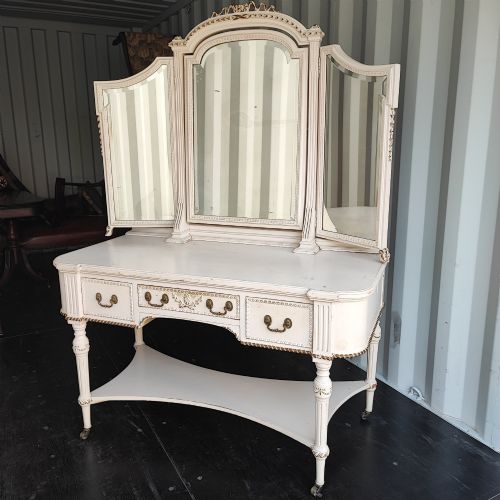
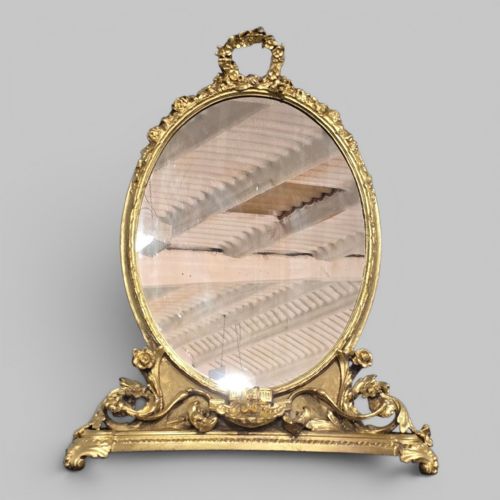
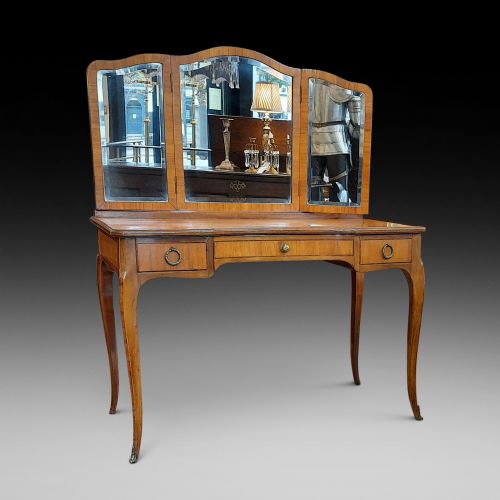
When you search for an antique french makeup table, you encounter a range of forms designed for personal grooming and dressing. The selection on this page includes larger dressing tables alongside smaller dressing table mirrors, vanity mirrors, and matching boudoir stools.
Originating predominantly from the nineteenth and early twentieth centuries, these pieces draw upon historical design idioms such as French Empire, Louis XVI Revival, and Rococo Revival. Makers embraced both freestanding tables with integrated mirrors and tabletop glass mounted on pivoting brass or bronze supports.
The materials span rich timbers like mahogany, kingwood, tulipwood, and rosewood, often complemented by painted wood surfaces and ornate metal mounts. Surviving examples reflect the shifting domestic fashions of their eras, from grand marquetry-inlaid pieces to simple marble-topped variants.
Materials and construction
Cabinet makers utilised dense hardwoods including mahogany, kingwood, and tulipwood as the structural foundation, frequently applying delicate crossbanding and marquetry inlay to create visual depth on flat surfaces. Painted wood finishes also appear, showing the decorative versatility favoured across different decades.
Metal ornamentation played a central role in the decoration of these pieces, incorporating cast and chased ormolu, gilt bronze, and gilt metal mounts that accentuate the structural lines. Brass and bronze hardware frequently supports adjustable pedestal mirrors and securing mechanisms.
Fitted interiors often incorporate bevelled glass mirrors and occasionally porcelain plaques, as seen in Sevres-mounted specimens. Construction techniques rely on traditional joinery suited to housing delicate drawers and supporting heavy marble tops.
Listings feature items spanning the nineteenth and early twentieth centuries, including Victorian, Edwardian, and Art Deco periods.
Judging the execution
The distinction between standard and exceptional pieces rests upon the precision of the timber work and the crispness of the applied metal mounts. Finer examples display meticulous marquetry inlay and tightly fitted crossbanding using superior hardwoods.
The quality of the cast bronze or ormolu mounts dictates much of the visual character, where sharply defined chasing elevates the piece beyond mass production. Original glass and well-preserved painted surfaces further distinguish the upper tier of survivals.
The Antique French Makeup Table Glossary
- Ormolu
- Gilded bronze used for decorative mounts and hardware on fine furniture. It provides a bright metallic contrast against dark hardwoods.
- Marquetry
- Decorative patterns formed by small pieces of wood veneer fitted into a wooden background. This technique creates elaborate floral or geometric designs on tabletops.
- Kingwood
- A dense, heavily figured timber prized for its rich brown colour and dark grain markings. It was widely utilised by cabinet makers for high-status veneered furniture.
- Poudreuse
- A French dressing table or powdering desk featuring compartments for cosmetics and mirrors. These multi-functional pieces often include folding lids.
- Crossbanding
- A border of veneer laid around the perimeter of a tabletop with the grain running perpendicular to the central panel. This frames the main decorative surface.
Antique French Makeup Table: Frequently Asked Questions
How were antique french makeup tables used?
These tables served as private stations for morning grooming, hair styling, and the application of cosmetics. Owners stored powders, perfumes, and hairpins within fitted drawers and compartments.
Many incorporated adjustable mirrors so the user could direct light efficiently. They were housed primarily in bedrooms and dressing rooms of affluent homes.
How do I identify a Louis XVI style piece?
Louis XVI style furniture is characterised by straight fluted legs, neoclassical symmetry, and restrained geometric proportions. Decoration draws on classical motifs rather than the exuberant curves found in earlier Rococo designs.
Ormolu mounts on these pieces often feature ribbons, urns, and acanthus leaves. The overall aesthetic feels architectural and orderly.
Are these tables suitable for daily use?
Most antique dressing tables function well for everyday placement in modern bedrooms, provided they are treated with care. Polished wood surfaces benefit from coasters and gentle cleaning products to protect historical finishes.
Care should be taken with antique marble tops to avoid staining from liquids or cosmetics. The structural integrity of nineteenth-century joinery generally remains robust for modern use.
What is the difference between a poudreuse and a dressing table?
A poudreuse is a specific type of French dressing table featuring a compartmented interior beneath a hinged top, designed originally for powdering wigs and cosmetics. Standard dressing tables often rely on an upright mirror fixed to the surface or placed independently on top.
Poudreuses tend to have a more enclosed, compact silhouette when closed. Both forms belong to the broader category of vanity furniture.