
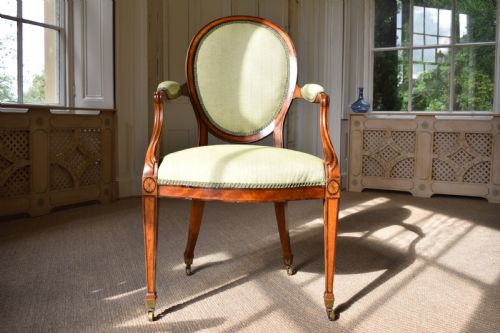


Marquetry Open Armchair
These marquetry open armchair pieces bring intricate floral and geometric wood inlay to classic seating forms.
Marquetry Open Armchair
The assortment on this page spans from 17th Century Scottish oak masters chairs and George III satinwood pieces up to Art Nouveau and Sheraton Revival salon seating. Desk chairs and occasional elbow chairs also appear amongst the standard armchairs.
Makers and workshops across these periods utilised contrasting timbers to create floral, scrollwork, or geometric motifs set into the primary wood body. These seats functioned as principal furnishings in parlours, studies, and drawing rooms.
Materials and construction
Cabinetmakers built the foundational frames of these chairs using solid hardwoods such as mahogany, oak, walnut, and satinwood. Joinery relied on traditional mortise and tenon joints to ensure structural rigidity in the arms and backrests.
The distinctive surface ornamentation involved recessing thin veneers of boxwood, fruitwoods, or darker timbers into the primary wood ground. Craftsmen then secured these precision-cut inlays with animal glue before smoothing and polishing the finished panel.
Petal-back chairs bring botanical geometry straight to your sitting room.
Assessing quality and execution
Quality rests upon the precision of the wood inlay work and the crispness of the surrounding joinery. Sharply defined botanical or geometric patterns with tight veneer joints distinguish superior examples from simpler production.
The choice of primary timber and secondary stringing also dictates the grade of the piece. Dense, well-figured mahogany or satinwood paired with varied contrasting inlays demonstrates higher workshop ambition than plain domestic woods.
The Marquetry Open Armchair Glossary
- Marquetry
- Decorative veneer work forming pictures or patterns on a wooden surface. Craftsmen cut contrasting pieces of wood, bone, or shell to fit precisely into a prepared background.
- Satinwood
- A yellowish hardwood prized for its natural lustre and smooth grain. It served as a favoured ground for detailed inlay in late eighteenth and nineteenth-century seating.
- Sheraton Revival
- A late nineteenth-century design movement inspired by the lightness and classical motifs of George Thomas Sheraton. Pieces from this revival often incorporate delicate inlay and tapered legs.
- Elbow chair
- An armchair featuring lower arms designed to support the elbows while sitting upright. These chairs frequently served writing desks or dining tables.
- Boxwood
- A dense, pale yellow wood frequently utilised for fine stringing and contrasting inlay details. Its tight grain allows for sharp, precise cutting.
Marquetry Open Armchair: Frequently Asked Questions
How were these armchairs used historically?
These seating pieces served primary functions in studies, libraries, and formal reception rooms. They provided comfortable seating for reading, writing at a desk, or receiving guests.
Over successive centuries, lighter salon and occasional versions emerged for drawing rooms. Their open arm design permitted voluminous skirts and dresses to fit comfortably between the supports.
How do I distinguish Edwardian from Victorian examples?
Edwardian pieces often display lighter proportions, satinwood highlights, and Sheraton Revival influences with delicate floral marquetry. Victorian versions tend to utilise heavier mahogany frames with deeper, more robust carving and darker finishes.
Looking closely at the framing timber and the boldness of the inlay helps separate the lighter Edwardian aesthetic from the sturdier Victorian output.
What is the difference between marquetry and wood inlay?
Wood inlay generally refers to pieces of contrasting material set into a recessed cavity within a solid wood base. Marquetry covers the entire surface with a composed veneer picture made from multiple wood types.
Marquetry creates complex pictorial or geometric expanses across the backrests and crest rails of these chairs.
How should I care for a marquetry chair?
Maintain these chairs by keeping them away from direct sunlight and sudden temperature shifts that can dry out old veneers. Gentle dusting with a dry, soft cloth preserves the polished surface without harming the delicate inlays.
Avoid placing damp items on the wooden arms and periodically apply appropriate furniture wax to nourish the antique timbers.