
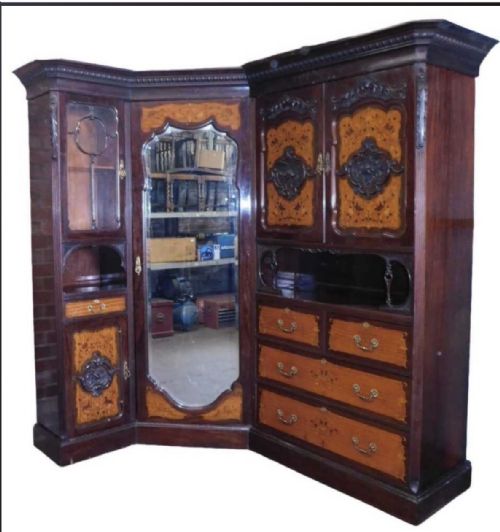


Marquetry Mahogany Wardrobe
A marquetry mahogany wardrobe brings deep timber grain and intricate floral or architectural wood-inlay straight into a bedroom.
Marquetry Mahogany Wardrobe
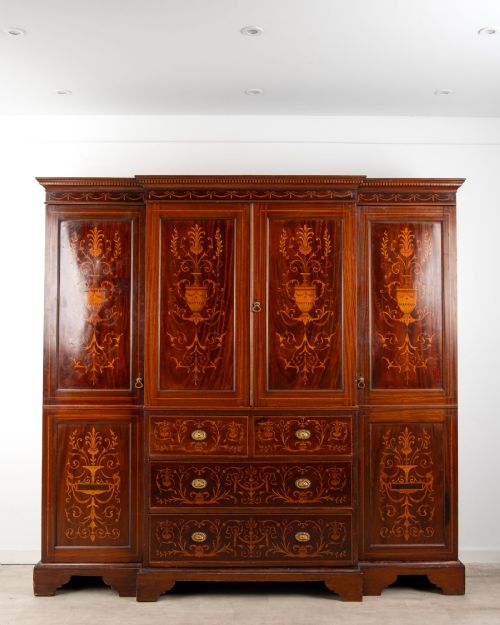
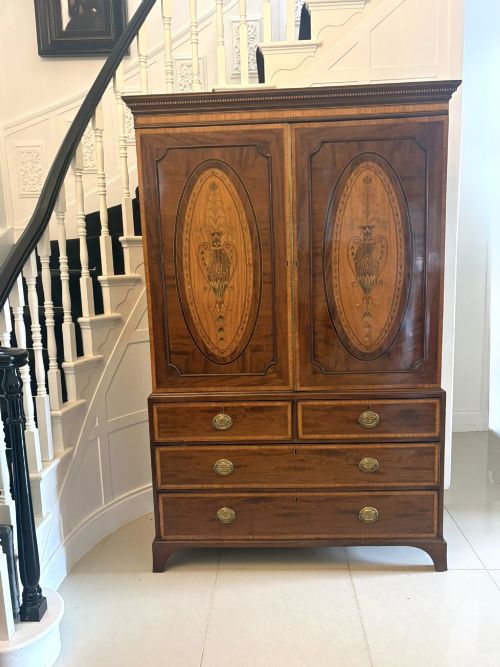
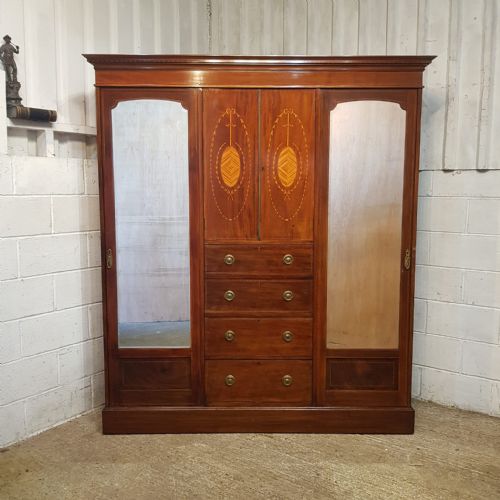
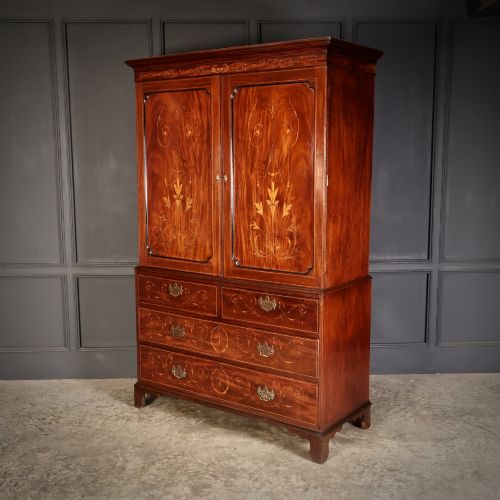
A marquetry mahogany wardrobe stands as a substantial bedroom storage piece, encompassing multi-door compactums, tall linen presses, and fitted architectural designs. The examples found here span the Georgian, Victorian, and Edwardian eras, reflecting changing domestic requirements for hanging space and linen storage over two centuries.
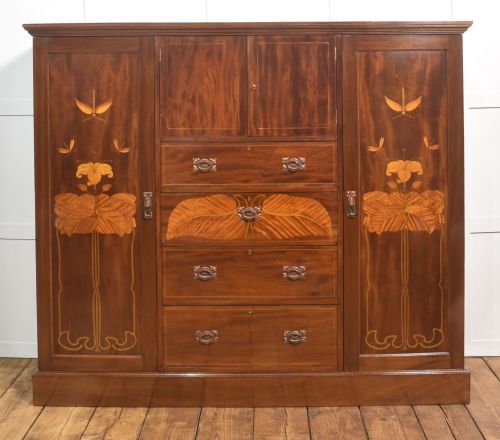
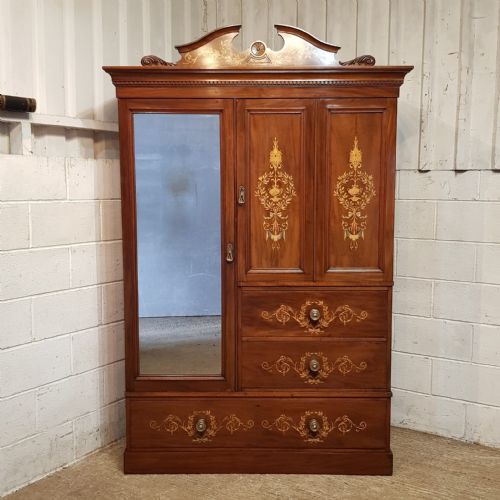
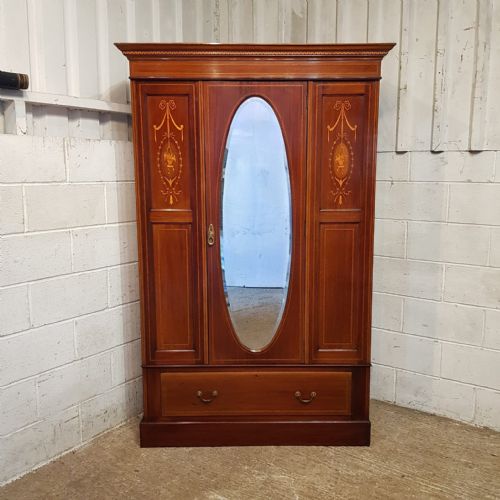
Buyers most frequently encounter Edwardian and late Victorian iterations, often featuring symmetrical door arrangements or breakfront profiles. These later pieces balance traditional craftsmanship with the lighter aesthetic of the Sheraton Revival, frequently incorporating mirrors alongside detailed wood-inlays.
How they were made
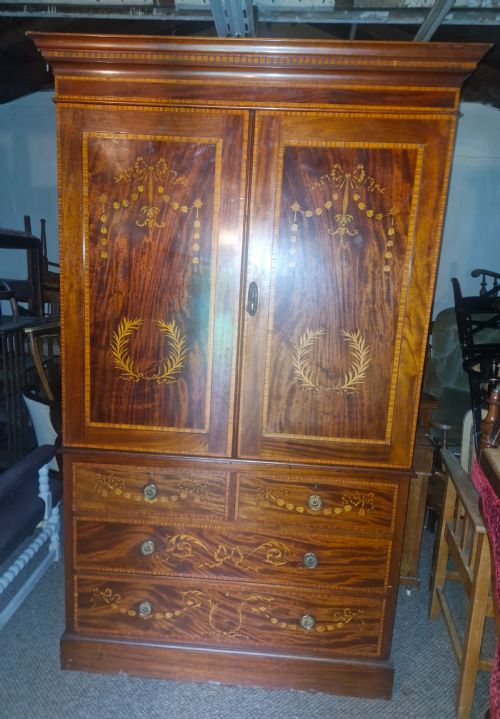
Cabinet makers utilised solid mahogany and mahogany veneers as the primary structural and visual base, providing a rich, dark grounding for the exterior surfaces. Workshops then applied contrasting timbers such as satinwood, boxwood, and walnut to create decorative panels and borders.
The defining decorative technique relies on marquetry inlay, where fine veneers are hand-cut and fitted together to form pictorial, floral, or geometric motifs. Brass hardware, glass doors, and carved details occasionally supplement the woodwork to complete the structure.
Marquetry Mahogany Wardrobe Retail Price Guide 2026
Typical asking prices for marquetry mahogany wardrobe among the pieces listed under this phrase on Sellingantiques today, from the lower quarter to the upper quarter. They describe what is for sale here now, not the wider market.
Several wardrobes retain their original hanging hooks, quietly waiting to hold garments after more than a century of domestic service.
What varies in quality
Quality rests significantly on the precision and complexity of the marquetry work, distinguishing simple geometric stringing from elaborate pictorial floral displays. Finer pieces demonstrate seamless veneer matching and tightly fitted joints across large breakfront or compactum facades.
The pedigree of the maker and the interior configuration also dictate distinction, with fully fitted internal drawers, sliding trays, and branded maker stamps elevating the piece. Heavier architectural proportions and well-figured mahogany timber indicate higher workshop standards.
Druce & Co.·Edwards & Roberts·Maples & Co
The Marquetry Mahogany Wardrobe Glossary
- Marquetry inlay
- An elaborate decorative technique where contrasting wood veneers are assembled to form pictures or patterns on a surface. It differs from simple inlay by covering the entire background with a mosaic of timber.
- Compactum wardrobe
- A multi-functional wardrobe designed to provide comprehensive storage including hanging space, drawers, and linen shelves within a single unit. These pieces often feature a central tower of drawers flanked by hanging compartments.
- Linen press
- A tall piece of furniture traditionally used for storing folded clothes and linens, featuring sliding trays enclosed by upper doors above a chest of drawers. Georgian and Victorian examples frequently incorporate wardrobe hanging sections.
- Breakfront
- A cabinet design where the central section projects forward from the flanking wings, creating visual depth and architectural presence. This form is common in larger Victorian and Edwardian wardrobe construction.
- Sheraton Revival
- A late nineteenth and early twentieth-century design style inspired by eighteenth-century neoclassical furniture. It typically employs light mahogany, delicate satinwood inlay, and refined proportions.
Marquetry Mahogany Wardrobe: Frequently Asked Questions
What is a compactum wardrobe?
A compactum is a multi-functional storage unit combining hanging space, shelving, and internal drawers within one unified architectural carcass. These pieces were designed to maximise bedroom storage without requiring separate chests of drawers.
They often feature a central column of drawers flanked by two full-length wardrobe doors. Edwardian and Victorian makers favoured this format for larger bedrooms.
How do I date a mahogany wardrobe?
Dating relies on observing structural proportions, timber selection, and decorative styles such as Georgian neoclassical lines or Edwardian Sheraton Revival motifs. Cabinet construction methods and the presence of mirror doors also provide clear chronological markers.
Earlier eighteenth-century pieces display heavier cornices and solid timber carcases, whereas later Victorian and Edwardian examples often utilise extensive veneering and machine-assisted moulding.
Where were linen presses used?
Linen presses originated in grand Georgian houses as housekeepers' cupboards for storing freshly laundered household textiles and linens. By the Victorian era, many houses adapted these presses into general wardrobe use by converting sliding trays into hanging rails.
The upper section houses shallow trays or shelves behind large doors, while the lower base contains functional storage drawers.
How do I care for antique mahogany?
Maintain antique mahogany by keeping the timber away from direct sunlight and sudden temperature changes that cause wood to dry and split. Regular dusting with a soft cloth preserves the polished surface without the need for heavy chemical polishes.
Applying a light, natural wax periodically helps nourish the mahogany and protects the delicate satinwood and boxwood marquetry details.