

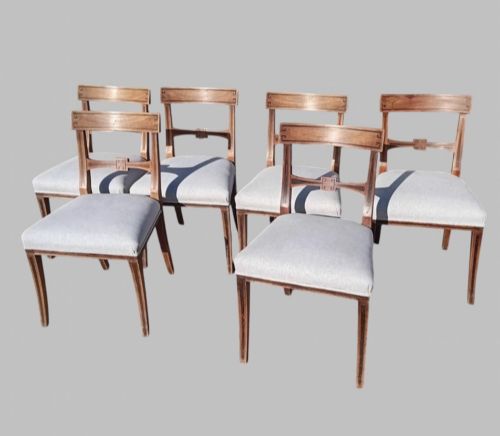
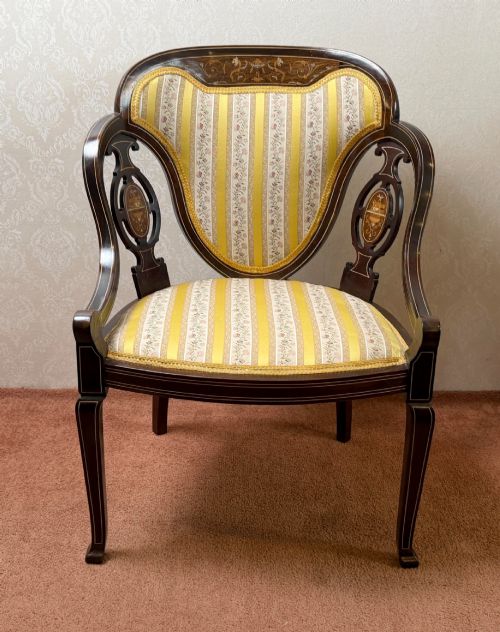

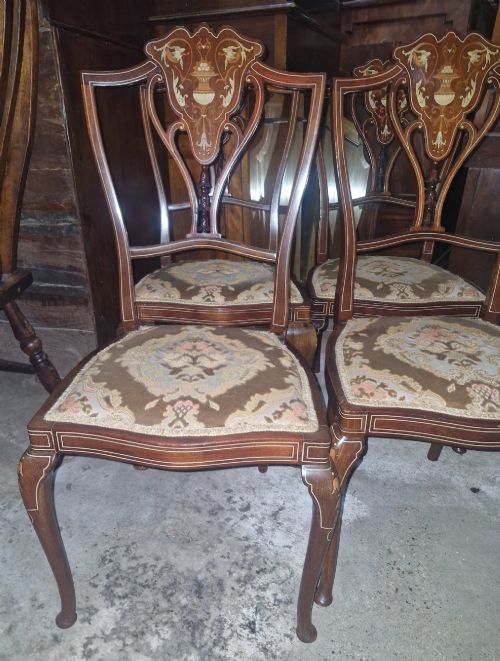
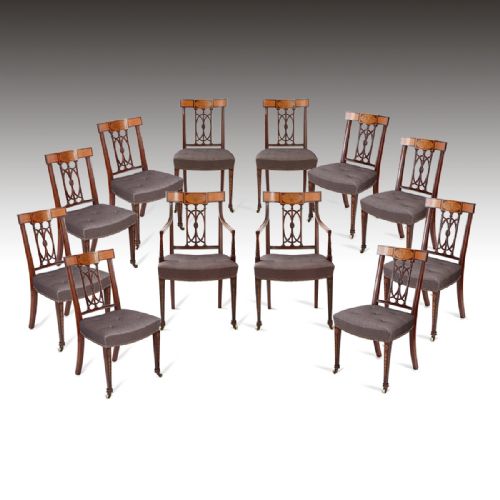
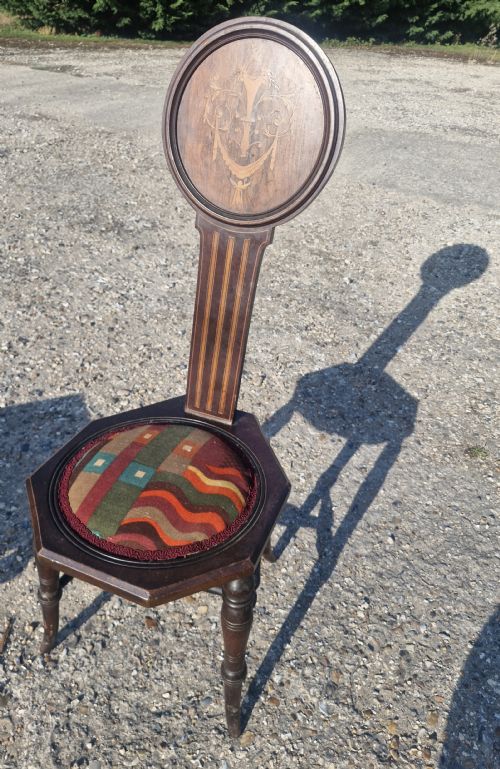
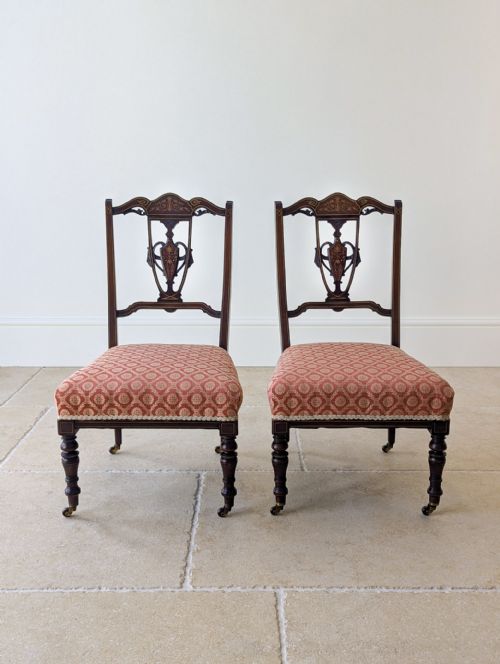
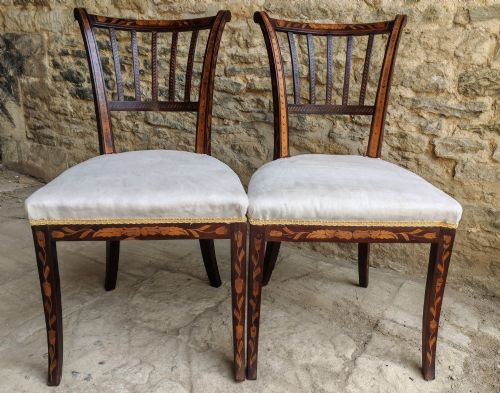

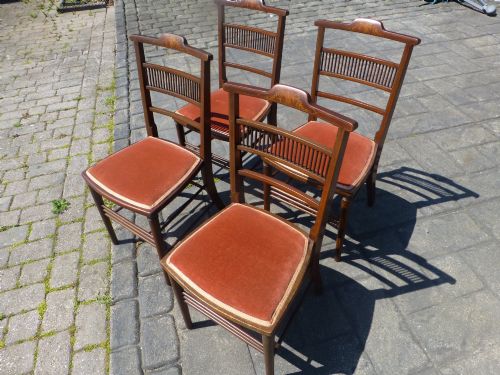


Marquetry Mahogany Side Chair
A marquetry mahogany side chair brings timber figure and pictorial detail to a room, drawing the eye with contrasting botanical and geometric veneers.
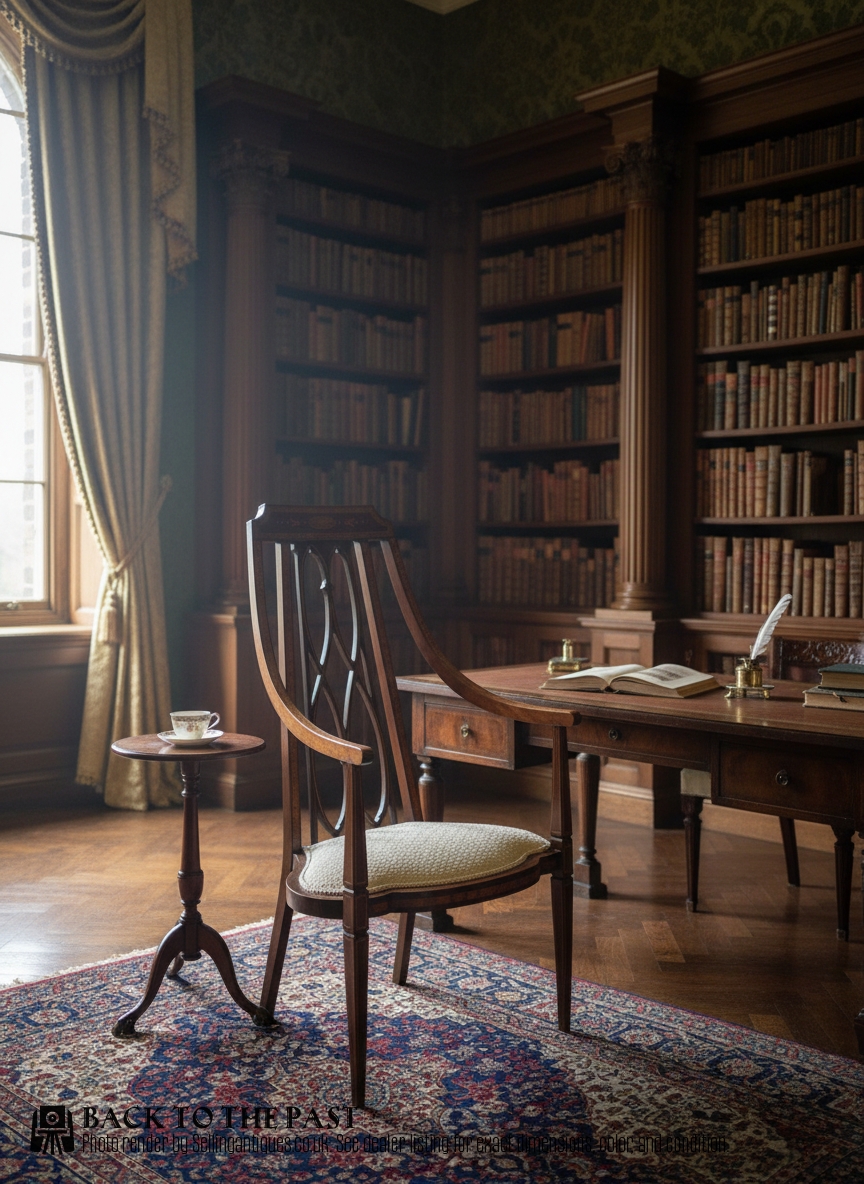
Marquetry Mahogany Side Chair
A marquetry mahogany side chair combines structural timber with decorative veneer work, taking its place around dining tables, in parlours, or against bedroom walls. These seating pieces appear across multiple historical periods, with Edwardian examples and nineteenth-century pieces dominating the current selection alongside earlier Georgian and Regency specimens.
Makers shaped these forms in various styles ranging from Edwardian Sheraton Revival and Hepplewhite proportions to Art Nouveau curves and late Victorian interpretations. While armchairs, salon chairs, and dining sets also populate the inventory, the single side chair remains a distinct form designed to sit neatly against a wall when not in use.
Judging the work
Quality rests upon the crispness of the timber carving and the precision of the veneer work, where tight joints between contrasting woods reveal the maker's skill. Finer examples display intricate floral or scroll marquetry that flows naturally across the mahogany ground without lifting edges or clumsy filler.
The integrity of the underlying mahogany frame and the choice of secondary timbers further separate standard production from superior pieces. Well-executed chairs maintain structural rigidity through balanced proportions, while lesser items exhibit heavier, less refined turning and coarser veneer matching.
Marquetry Mahogany Side Chair Retail Price Guide 2026
Typical asking prices for marquetry mahogany side chair among the pieces listed under this phrase on Sellingantiques today, from the lower quarter to the upper quarter. They describe what is for sale here now, not the wider market.
The selection spans diverse forms including salon suites, library desk chairs, nursing chairs, and dining sets.
Shoolbred
The Marquetry Mahogany Side Chair Glossary
- Marquetry inlay
- The art of applying small pieces of veneer to a structural panel to form decorative pictorial designs. This technique relies on contrasting woods to create depth and pattern.
- Mahogany
- A durable tropical hardwood prized for its reddish-brown colour and stable grain. It serves as the principal structural wood for these chairs.
- Satinwood
- A luminous, fine-grained timber with a yellowish sheen used for contrasting highlights in inlay work. Cabinet makers employed it to catch the light against darker mahogany fields.
- Side chair
- A small, lightweight chair built without arms for use at a dining table or against a wall. These pieces form the core of the available selection.
Marquetry Mahogany Side Chair: Frequently Asked Questions
Where did these chairs stand originally?
These chairs served multiple domestic functions in period homes, appearing primarily as dining seats, bedroom furnishings, or occasional seating in formal reception rooms. Their light construction allowed servants or residents to move them easily between rooms as social gatherings required.
In larger houses, matching sets populated the dining room, while single side chairs or pairs found places in hallways, libraries, and dressing rooms. Their decorative marquetry made them suitable for spaces where guests gathered.
How do I date a marquetry chair?
Dating relies on stylistic clues, timber characteristics, and the nature of the inlay work. Edwardian pieces often show lighter, revivalist motifs, while nineteenth-century and Georgian examples display heavier proportions or distinct Regency brass details.
The evolution of veneer cutting techniques also aids dating, as machine-sawn veneers appeared later in the nineteenth century, whereas earlier pieces relied on hand-sawn methods that left subtle irregularities.
Can I use them every day?
These chairs tolerate normal daily use provided the timber joints remain sound and the underframe is secure. Many examples retain sufficient structural integrity for regular seating at a desk or dressing table.
Owners should inspect the glue blocks and frame joints periodically, as historic hide glue can dry out over generations. Careful placement away from direct heat sources protects both the mahogany timber and the delicate veneer inlay.
What is the difference between marquetry and inlay?
Inlay generally involves inserting pieces of contrasting material into a recessed cavity carved directly into the solid wood base of the furniture. The design sits flush with the surrounding surface.
Marquetry is a specialised form of inlay where an entire pictorial or geometric veneer picture is assembled first on a backing sheet before being glued down as a complete layer onto the mahogany carcass.