
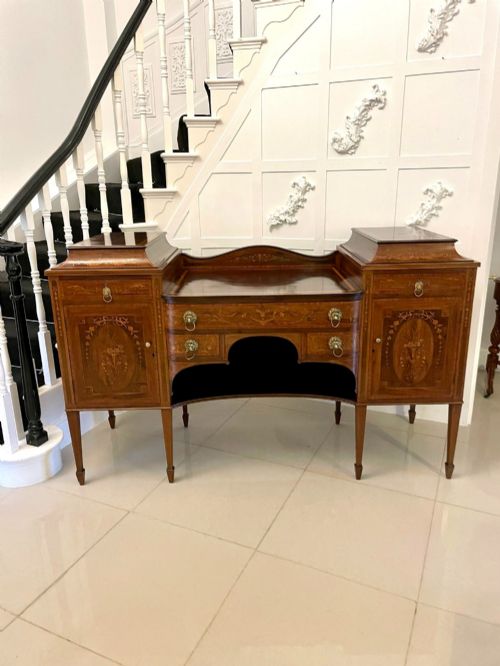
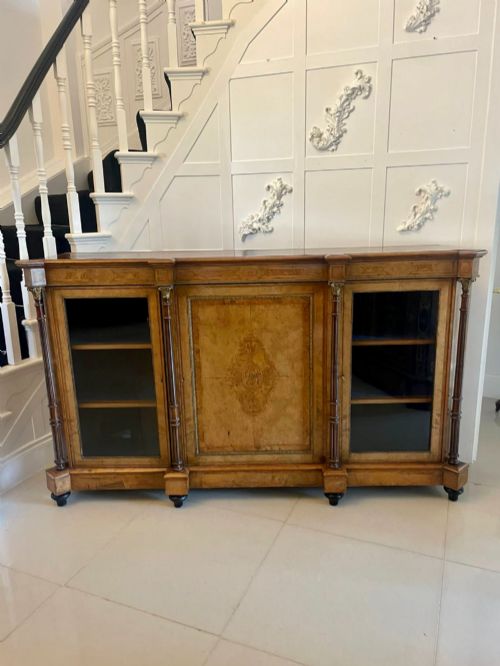
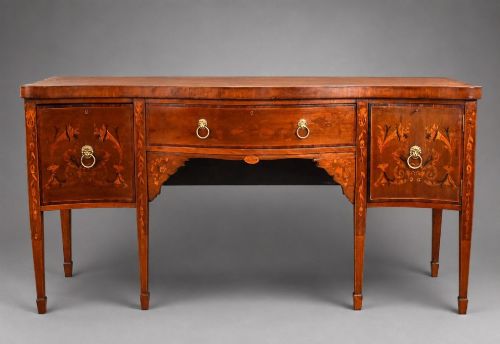
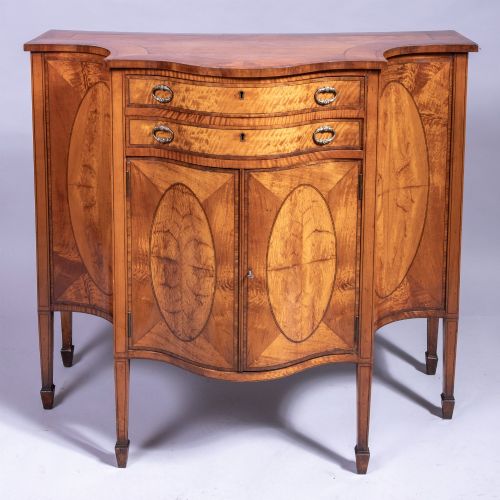



Marquetry Dining Buffet
A marquetry dining buffet brings patterned wood veneers and generous storage to the dining room, offering both surface display and practical interior capacity.
Marquetry Dining Buffet
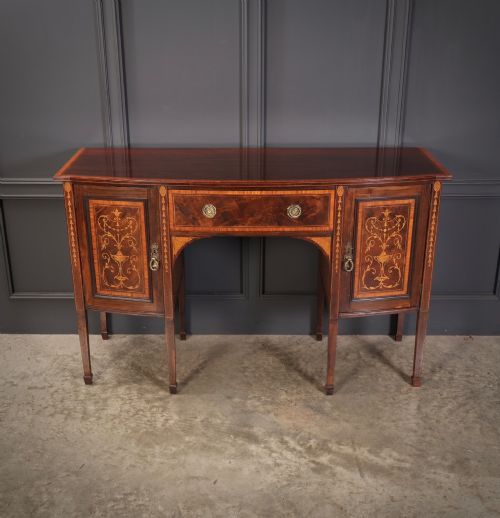
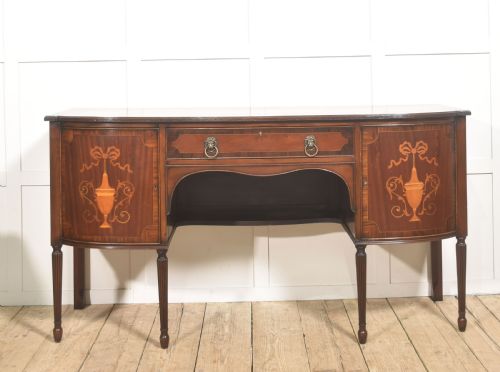
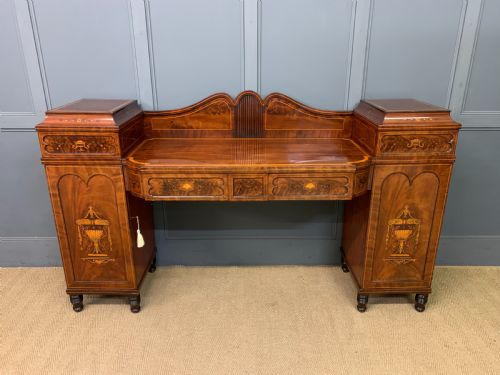
A marquetry dining buffet encompasses large timber storage furniture intended for dining rooms, appearing primarily as sideboards, credenzas, and side cabinets across this selection. These pieces date from the eighteenth century through to the art deco period, drawing on georgian proportions and revival movements.
The most frequent examples seen on this page date from the nineteenth and early twentieth centuries, particularly in victorian, edwardian, and sheraton revival idioms. Buyers meet both serpentine forms and rectilinear carcass shapes, often combining cupboard doors with drawer space.
Makers and workshops constructed these items using substantial timbers as a base, applying contrasting veneers to create pictorial or geometric surface patterns. The results serve the traditional function of holding dining silver and linen while providing a decorative focal point.
Materials and Techniques
Cabinet makers utilised dense primary woods such as mahogany, walnut, and rosewood for the structural carcasses, mounting figured veneers across the exterior surfaces. Satinwood, burr walnut, and maple provided lighter contrasting tones for detailed panel work.
Craftsmen applied contrasting timbers in precise veneer patterns known as marquetry, often enhanced by boxwood lines and brass mounts or handles. Certain pieces incorporate marble tops and glass elements to complete the specification.
Listings feature mahogany, satinwood, burr walnut, and rosewood across georgian, victorian, and edwardian periods.
Judging Quality
Quality rests in the precision of the timber matching and the complexity of the inlaid motifs across the drawer fronts and doors. Superior examples display crisp botanical or geometric veneer work integrated seamlessly into the primary wood.
The choice of cabinet timber and the refinement of secondary woods inside the drawers distinguish standard production from exceptional pieces. Heavier gauge brass hardware and well-figured burr walnut or satinwood indicate higher workshop standards.
Hewetsons London·Edwards and Roberts·Howard And Sons
The Marquetry Dining Buffet Glossary
- Marquetry
- Decorative veneer work formed by fitting together small pieces of coloured wood, shell, or ivory to create pictorial or geometric designs on furniture surfaces.
- Credenza
- A low dining cabinet or sideboard, frequently featuring mirrored backs or glass panels in nineteenth-century interpretations.
- Serpentine
- A furniture front curved in a gentle wave, with a convex centre flanked by concave ends.
- Satinwood
- A lustrous, hard timber of yellowish colour used extensively for decorative veneers and stringing during the eighteenth and revival periods.
- Breakfront
- A cabinet or sideboard whose central section projects forward from the flanking outer sections.
Marquetry Dining Buffet: Frequently Asked Questions
What is a marquetry dining buffet?
A marquetry dining buffet is a large storage cabinet for the dining room decorated with fitted wood veneers. These pieces function as sideboards or credenzas to hold dining accessories.
They combine practical cupboard and drawer space with decorative wood patterns across the front panels.
How do I tell a georgian piece from a revival?
Georgian pieces date from the eighteenth century and rely on native timber construction with restrained inlay. Revival pieces date from the late nineteenth or early twentieth century and often feature brighter satinwood veneers.
Examine the secondary woods inside the drawers and the style of the hardware for clues to the exact period of manufacture.
Where should I place a buffet in my dining room?
A buffet is traditionally positioned against the main dining room wall to anchor the space and provide a surface for serving food. Ensure there is enough clearance for doors and drawers to open fully.
Pieces with mirrored backs look particularly effective against a wall opposite a light source to brighten the room.
What woods were used to make these buffets?
Mahogany and walnut served as the primary structural timbers for most nineteenth-century dining furniture. Cabinet makers used lighter woods like satinwood, maple, and boxwood for contrasting inlay and veneer details.
Some examples also incorporate burr walnut and rosewood to create striking grain patterns across the doors.