


Marquetry Column Clock
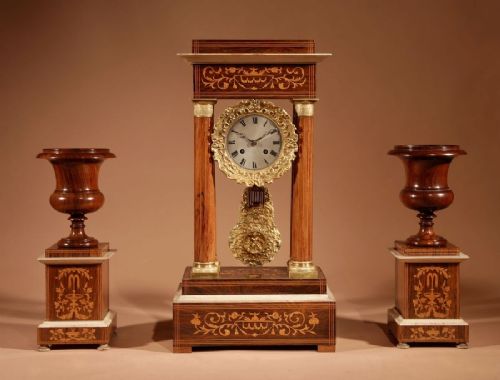
These marquetry column clocks are striking architectural timepieces, bringing classic French portico forms and rich inlaid woods into your room.
Marquetry Column Clock
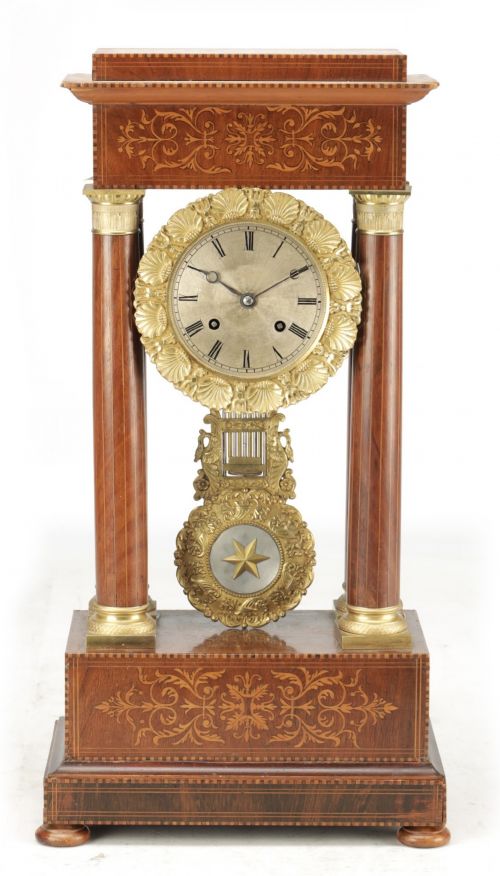
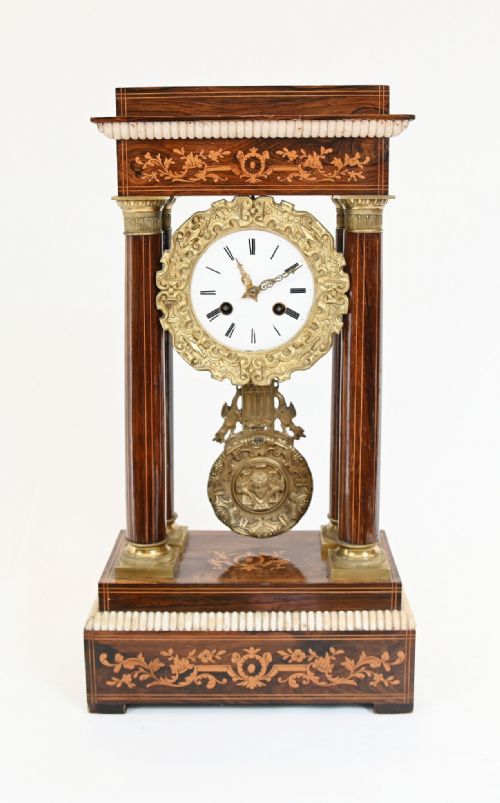
When you search for a marquetry column clock, you look at architectural French portico clocks and mantel clocks built around twin upright columns. These pieces stand out for their vertical geometry and balanced facades, framing the central pendulum movement.
The versions you meet most often on this page belong to the nineteenth century, spanning periods from Charles X and Louis Philippe through to the Victorian era and Edwardian times. Rosewood, mahogany, and satinwood form the primary bodies, often enriched with detailed inlay work and boxwood or lemon wood stringing.
Makers housed movements within circular bezels, frequently featuring enamel dials, while ormolu and gilt bronze mounts accent the capitals and bases of the columns. Dome top variants also appear alongside traditional architectural pediments, offering a variety of silhouettes for the collector.
How they were made
Cabinetmakers constructed the main carcass from dense timbers like rosewood and mahogany, applying fine veneers and marquetry inlay across the flat surfaces. Artisans cut contrasting woods such as lemon wood and satinwood to create geometric or floral patterns within the veneer.
Foundry workers cast brass, ormolu, and gilt bronze elements to embellish the column terminals, bezels, and pendulum bobs. Enamel specialists fired white dials with black numerals, mounting them behind protective glass doors within the architectural framework.
Materials recorded across these architectural timepieces include brass, ormolu, gilt bronze, boxwood, and enamel.
What varies in quality
Quality rests in the crispness of the marquetry cutting and the choice of contrasting woods used for the inlay. Finer examples display meticulous attention to grain alignment and precise botanical or geometric motifs across the rosewood and satinwood surfaces.
The weight and finish of the ormolu or gilt bronze mounts distinguish superior pieces from standard production. Well-cast mounts with sharp chasing and deep gilding elevate the architectural presence of the portico frame.
The Marquetry Column Clock Glossary
- Portico clock
- An architectural mantel clock supported by four or two vertical columns resembling a classical porch. This form gained popularity in France during the early nineteenth century.
- Marquetry
- The art of applying decorative pieces of veneer to a structure to form intricate patterns or pictures. Craftsmen select different coloured woods to create contrast without using paint.
- Ormolu
- Gilt bronze mounts applied to furniture and clocks for decorative accent. The technique involves coating metal with a mercury and gold amalgam.
- Bezel
- The metal ring that holds the glass protecting the clock face. It often hinges open to allow access for winding and hand-setting.
- Pediment
- The triangular or rounded upper architectural member above the columns. It crowns the portico structure.
Marquetry Column Clock: Frequently Asked Questions
What is a portico clock?
A portico clock is an architectural timepiece featuring vertical columns that support an upper entablature. The pendulum typically hangs visibly between these columns inside the central void.
originating largely in nineteenth-century France, these pieces draw inspiration from classical architecture and often incorporate rich wood veneers.
How do I wind the clock?
Winding requires a dedicated key inserted into the winding holes on the enamel dial. Turning the key tensions the mainspring that powers the eight-day movement.
Care must be taken not to overwind the mechanism, stopping as soon as resistance is felt.
Where should I place it?
These clocks suit sturdy mantelpieces, console tables, or flat surfaces where their vertical proportions can be admired. A stable location ensures the pendulum swings evenly without catching.
Keeping the clock away from direct sunlight and drafts preserves the rosewood veneer and internal mechanics.
How do I identify the period?
Period identification relies on the combination of timber choice, mount style, and dial design. Charles X and Louis Philippe examples often feature lighter stringing and refined ormolu, while later Victorian pieces show different proportions.
Examining the movement construction and timber preparation provides further clues to the decade of manufacture.