
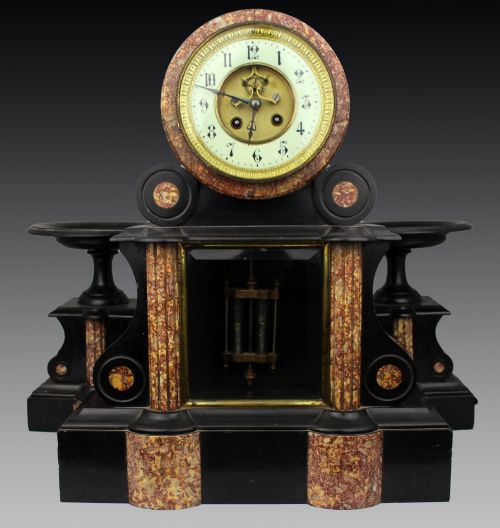
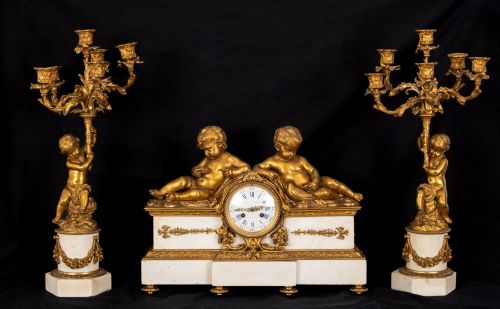
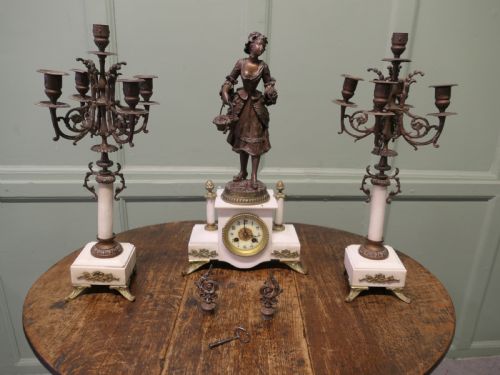
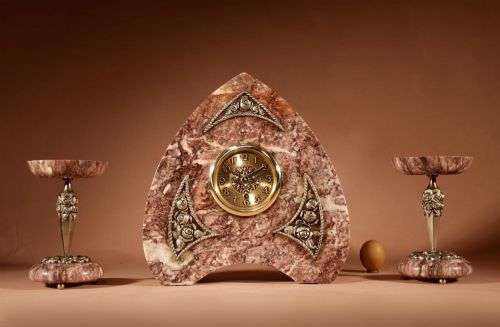

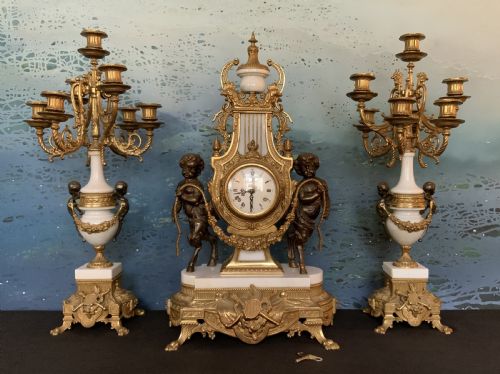


Marble Clock Garniture
A marble clock garniture brings symmetry and striking presence to a mantelpiece, pairing a central timepiece with matching side vases or figures.
What a marble clock garniture is
A marble clock garniture comprises a central mantel clock accompanied by matching side ornaments, designed to create a unified decorative scheme across a chimneypiece. When searching for a marble clock garniture, buyers encounter substantial multi-piece sets that combine functional horology with sculptural metalwork.
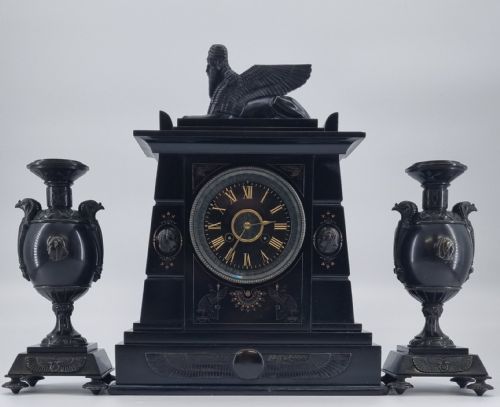
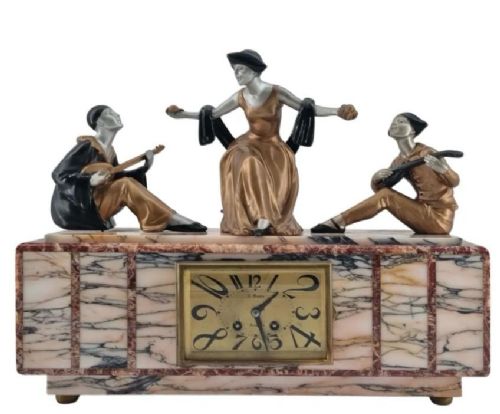
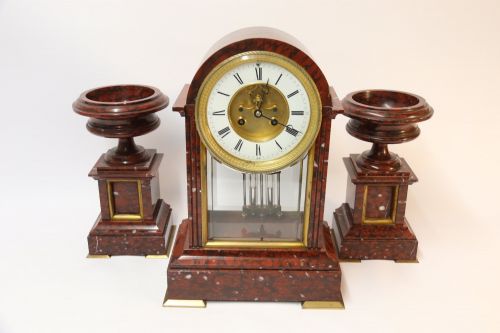
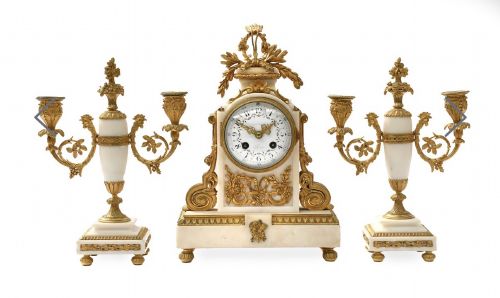
The pieces appearing on this page span Victorian, Napoleon III, Charles X, and Art Deco periods, originating primarily from French workshops. Forms range from classical portico designs and architectural white or pink marble bodies to geometric Art Deco compositions paired with bronze or chrome elements.
How they were made
Maker-craftsmen shaped natural stones including pink marble, sienna marble, white marble, slate, and onyx into architectural cases and matching side garnitures. These stone bodies were frequently mounted with cast brass, gilt bronze, ormolu, and metal components.
Figural elements cast in bronze, spelter, or gilt metal, such as cherubs, dancing girls, or animals by sculptors like Michel Decoux, were integrated into the design. Dials often combined enamel with brass bezels and protective glass covers to complete the working timepieces.
Listings feature French origins across the Victorian, Charles X, Napoleon III, and Art Deco periods, incorporating marble, bronze, ormolu, and glass.
What varies in quality
Quality rests in the harmony of the matched set and the crispness of the cast metal mounts, where finely chased ormolu and detailed bronze sculptures elevate a piece above standard production. The selection of the marble itself, from uniform white or veined varieties to rich sienna and bleu turquin, dictates the visual weight and ambition of the garniture.
The inclusion of named makers such as Samuel Marti or H & F Paris, alongside signed bronze sculptures, marks the distinction between standard commercial sets and exceptional horological works of art.
Michel Decoux·Samuel Marti of Paris·H & F Paris
The Marble Clock Garniture Glossary
- Garniture
- A set of matching decorative ornaments designed to be displayed together, typically consisting of a central clock flanked by two matching vases, urns, or figural pieces.
- Ormolu
- Finely ground high-carat gold applied to a bronze base using a mercury amalgamation technique, creating a rich golden surface finish on antique mounts.
- Portico clock
- A mantel clock featuring an architectural frame supported by four or more columns, often housing a suspended pendulum visible within the central opening.
- Spelter
- An alloy of zinc and lead used as a cost-effective alternative to bronze for casting sculptural figures and mounts, typically painted or electroplated to resemble bronze.
Frequently Asked Questions
What is a marble clock garniture?
A marble clock garniture is a matching three-piece set consisting of a central mantel clock and two symmetrical side ornaments, such as vases or sculptural figures. They are designed to sit together on a mantelpiece or sideboard to create a balanced decorative display.
The stone body of the clock is paired with matching materials on the side pieces, utilising elements like ormolu, bronze, and enamel dials. These sets function both as accurate timekeepers and as prominent interior focal points.
How do I style a clock garniture?
To style a marble clock garniture effectively, place the central clock in the exact middle of a mantelpiece, shelf, or console table. Position the two matching side pieces symmetrically on either side to maintain the intended visual balance.
Ensure the surface is sturdy enough to support the considerable weight of the marble and metal components. Keep the surrounding decor minimal so the unified set remains the primary focus of the room.
How do I tell Victorian pieces from Art Deco?
Victorian and Napoleon III garnitures rely on classical architectural forms, ornate ormolu mounts, cherubs, and rich materials like sienna marble, slate, or bleu turquin. They lean heavily towards traditional ornamentation and historical revival styles.
Art Deco garnitures, dating around the 1920s and 1930s, feature clean geometric lines, streamlined marble bodies, and modern sculptural elements such as chrome or stylized animal figures. The ornamentation is sparser, focusing on sleek materials and modernist silhouettes.
Are garniture clocks difficult to maintain?
Maintaining a marble clock garniture involves regular dusting of the stone and gentle cleaning of the metal mounts with a soft, dry cloth. Avoid harsh chemical cleaners that can damage the delicate ormolu, gilt bronze, or enamel surfaces.
Because these are antique mechanical movements, they may require professional servicing by a horologist to ensure the clock mechanism runs accurately. Handle the heavy marble and bronze components with care when moving any piece of the set.