


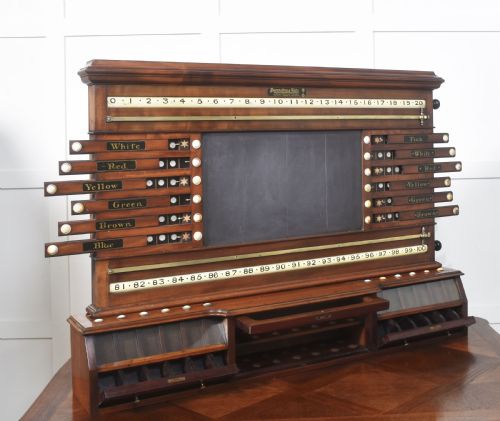

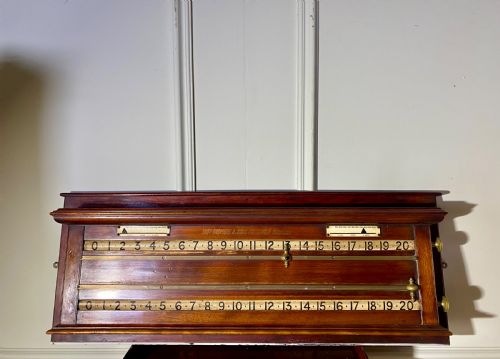

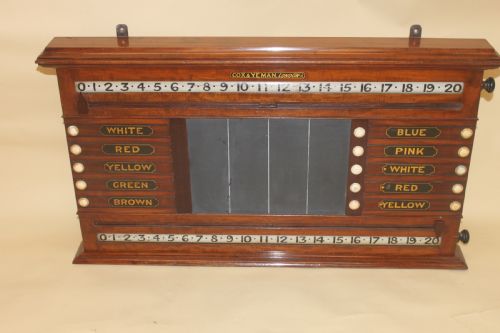
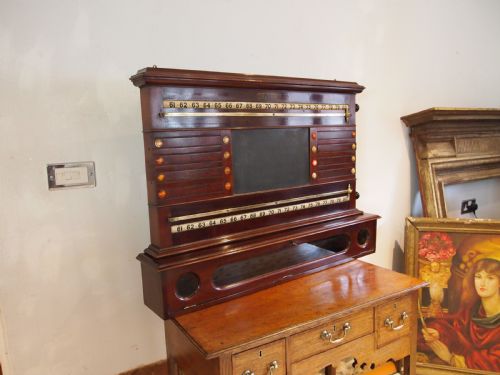
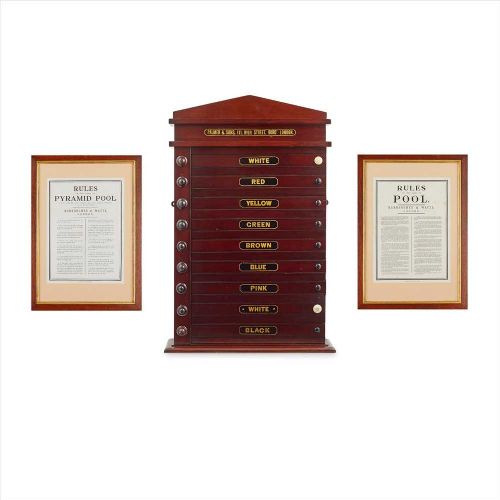
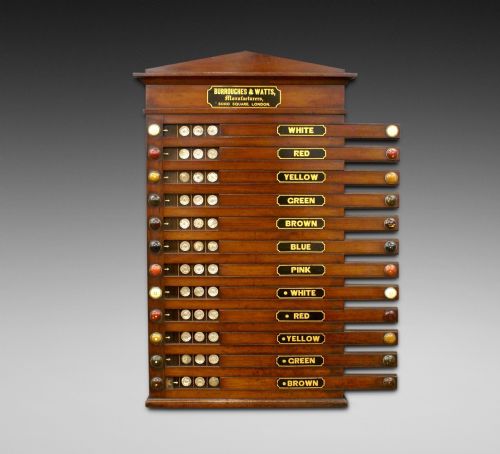
Mahogany Snooker Scoreboard
These mahogany snooker scoreboard examples are solid timber games room accessories built to keep strict tally during Victorian matches.
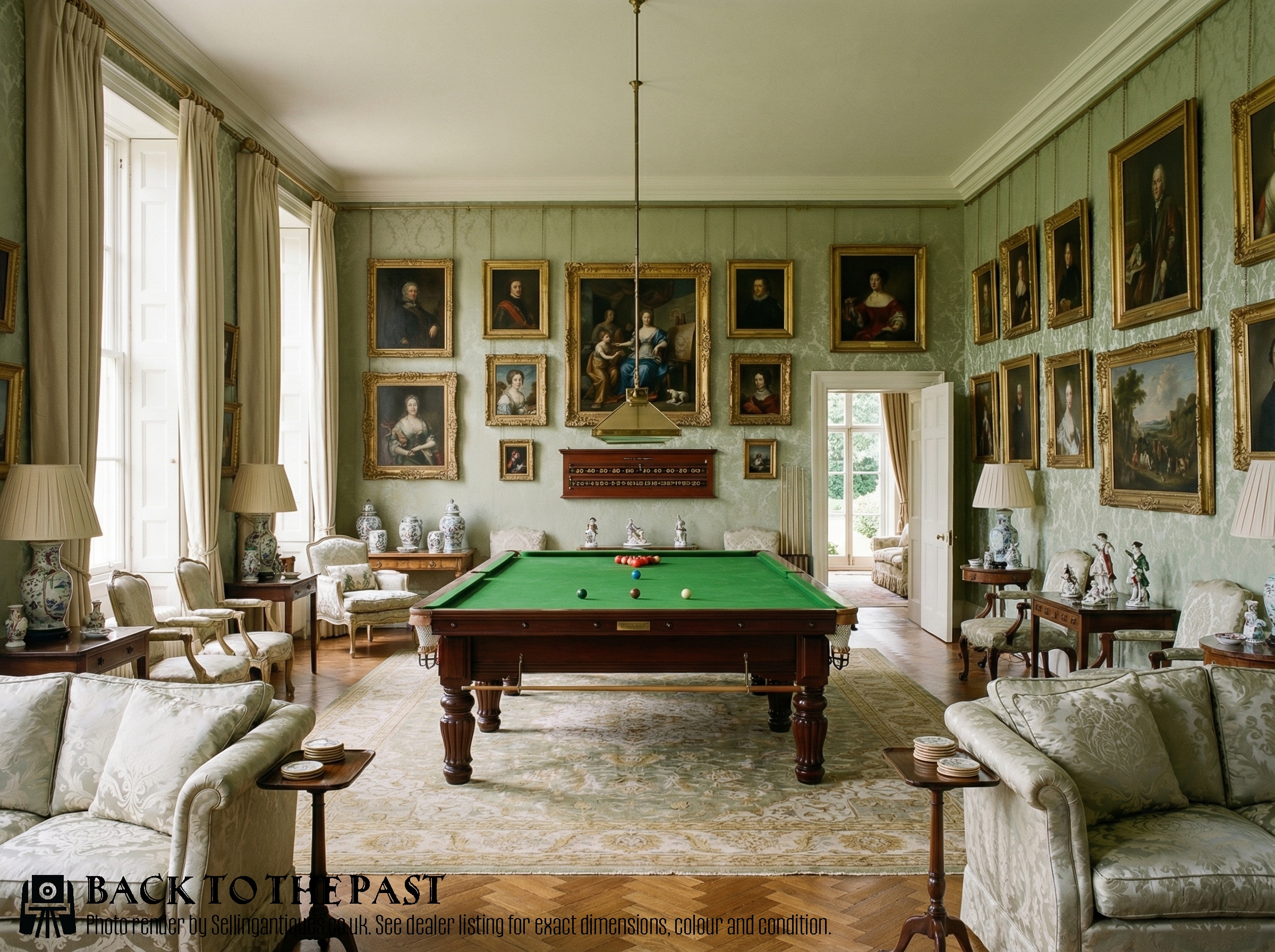
Mahogany Snooker Scoreboard
The pieces listed on this page span the nineteenth century, including specific dates from eighteen-eighty to nineteen-ten, with Victorian styling predominating. Makers such as Orme and Sons, Thurston and Company, Cox and Yeman, and Burroughes and Watts dominate the origins.
Beyond standard snooker scoreboards, the forms encompass billiards scoring boards, life pool score boards, and framed variants that include prints. These utilitarian items served private homes, gentlemen's clubs, and public billiard halls alike.
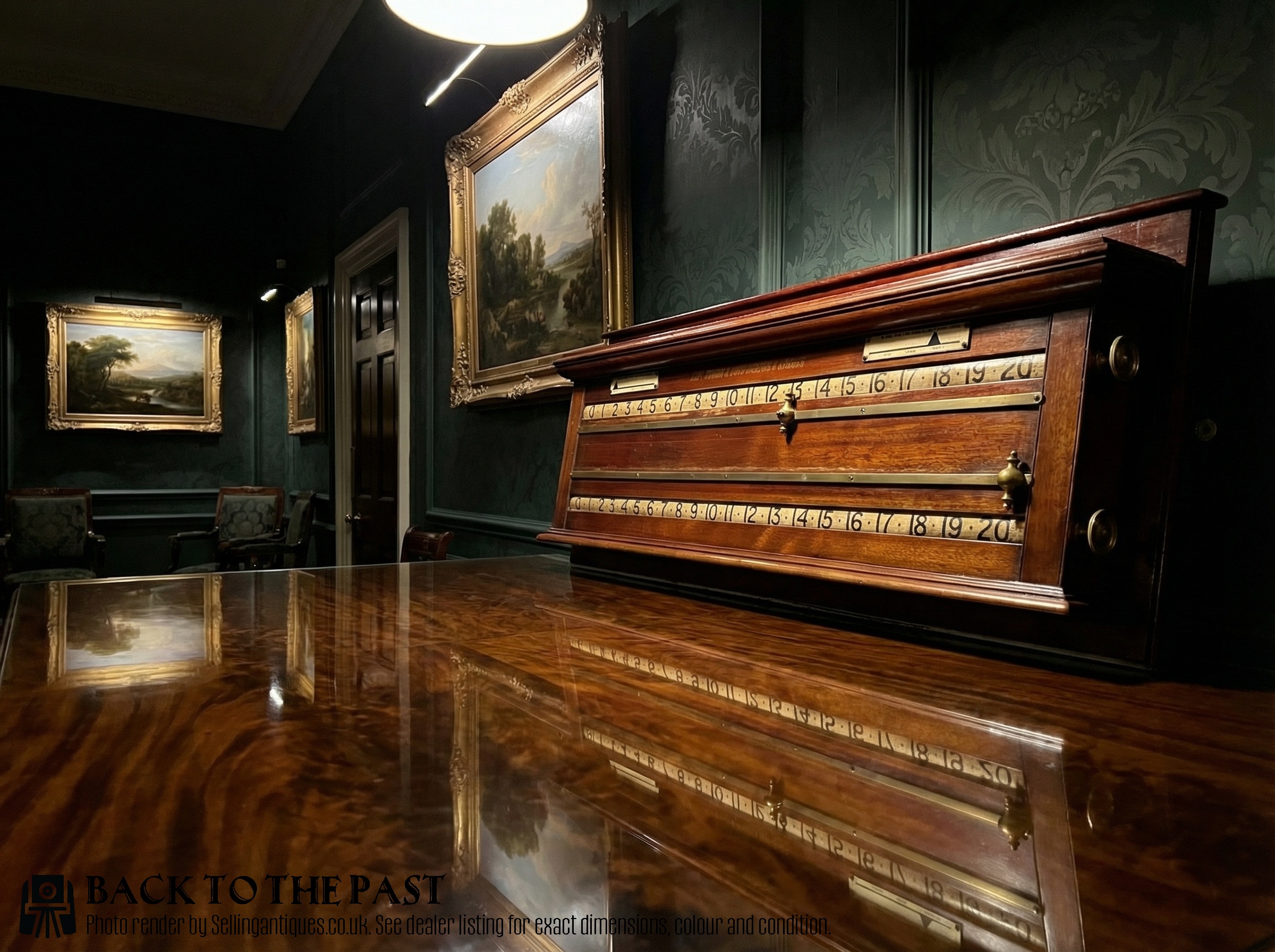
Materials and construction
Mahogany forms the structural chassis of these scoreboards, providing a dark, dense wooden frame that houses the scoring mechanisms. Selected pieces incorporate brass for sliding pointers, maker plates, and mounting fixtures, contrasting sharply with the warm timber.
Additional materials appearing across the evidence include slate, bone, glass, and paper inserts used for subsidiary scoring dials or printed instructions. Joinery relies on robust nineteenth-century cabinet-making techniques to withstand heavy daily use in busy billiard rooms.
Several boards include tiny bone pointers that have faithfully tracked missed shots and century breaks for over a century.
Judging quality and maker standing
Quality in a mahogany snooker scoreboard rests on the reputation of the maker and the crispness of the timber moulding. Pieces bearing signatures from established firms like G Wright and Company or Riley command greater attention for their documented workshop provenance.
The sophistication of the scoring mechanism also elevates a piece, particularly those accommodating multiple games such as life pool and billiards alongside snooker. Intricate brass hardware, well-figured mahogany grain, and complete original pointers separate utilitarian boards from superior examples.
Orme and Sons Manchester·Thurston and Co Ltd·Cox and Yeman London·Burroughes and Watts·G Wright and Co·Riley
The Mahogany Snooker Scoreboard Glossary
- Mahogany
- A durable tropical hardwood prized for its deep reddish-brown colour and stability. It serves as the primary structural timber for Victorian games room furniture.
- Life pool
- A variation of cue sports popular in the nineteenth century where players competed for lives. Scoreboards frequently included dedicated rows of numbers specifically for tracking this game.
- Slate
- A fine-grained metamorphic rock utilised in compact sections within nineteenth-century scoreboards for writing panels or chalkboards. It offers a smooth, dark writing surface that withstands frequent use.
- Bone
- An organic material traditionally used for miniature scoring pointers, subsidiary dials, or maker plaques. It provides a creamy, tactile contrast against dark mahogany timber.
- Victorian
- A design period spanning the nineteenth century characterised by substantial proportions and robust construction. Items from this era show high standards of functional cabinet-making.
Mahogany Snooker Scoreboard: Frequently Asked Questions
How do you mount a mahogany snooker scoreboard?
These heavy wooden boards require secure wall fixings, typically utilising strong screw brackets mounted directly into wall studs or masonry. Because of the dense mahogany and brass mechanisms, weight distribution must be carefully managed.
Most antique examples feature original hanging loops or pre-drilled screw holes in the timber frame. Ensuring proper alignment keeps the internal sliding tracks level for smooth pointer movement.
What games can be scored on these boards?
While primarily designed for snooker, many nineteenth-century boards accommodate multiple cue sports through additional rows of numbers and sliding indicators. References to billiards and life pool frequently appear on the wooden faces.
Complex boards feature combined scoring tracks to handle different rules and player counts simultaneously. Simpler variants focus strictly on standard snooker point totals.
How do I care for the mahogany timber?
Maintain the mahogany frame by applying a light coat of quality beeswax periodically to nourish the grain and preserve the rich finish. Avoid placing the scoreboard in direct sunlight or near heat sources that could dry out the wood.
Dust the brass tracks and glass panels gently with a dry microfiber cloth. Avoid harsh chemical cleaners that might strip the antique polish or damage original paper inserts.
How are Victorian scoreboards dated?
Dating relies on maker signatures, patent stamps, stylistic cues, and timber characteristics typical of nineteenth-century cabinet-making. Specific markers often include engraved brass plates bearing London or Manchester addresses.
Later Edwardian examples from around nineteen-ten tend to feature slightly different labelling and hardware compared to mid-Victorian pieces from eighteen-sixty. Comparing the mechanism type helps narrow down the production era.