




Victorian Mahogany Billiards Board
These Victorian mahogany billiards board examples are the scoreboards and tables that kept count in nineteenth-century games rooms, prized for their handsome timber and sliding pointers.
Victorian Mahogany Billiards Board
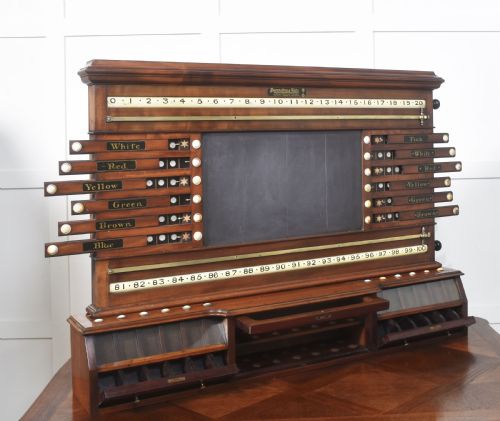
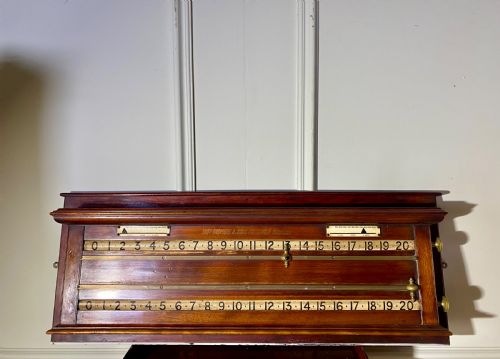
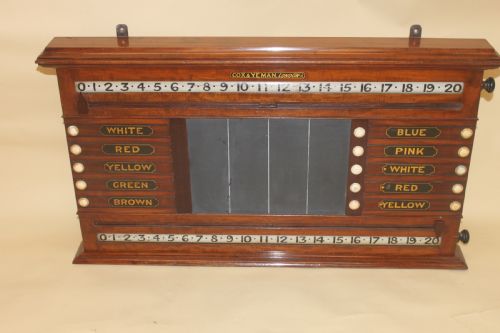
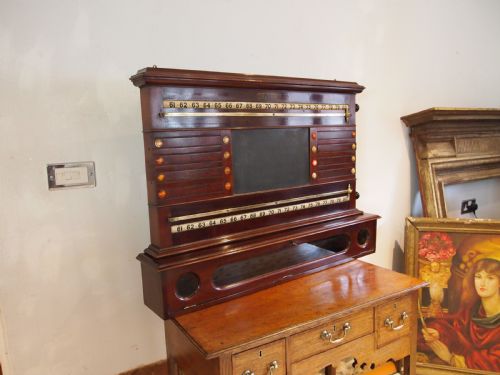
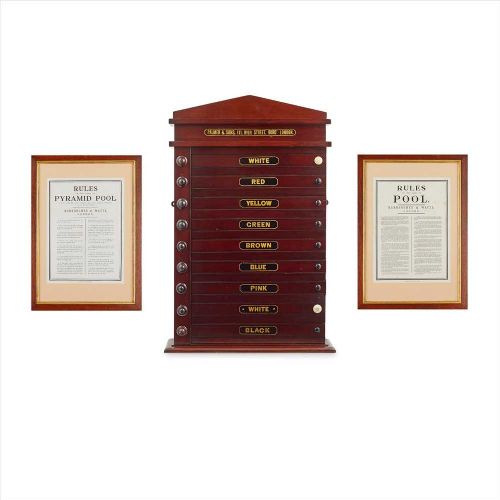
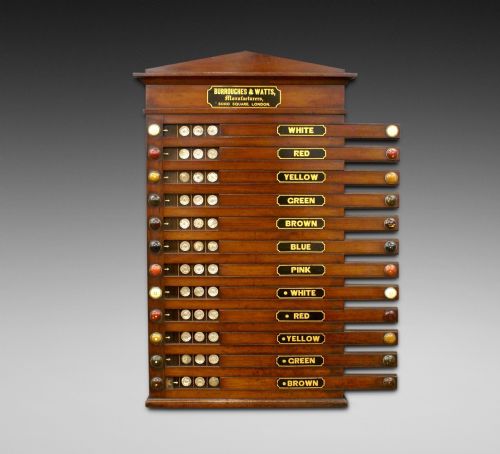
A victorian mahogany billiards board takes the form of a wall-mounted scoreboard or a freestanding bagatelle table originating from the nineteenth century. The wall-mounted scoreboards dominate the selection, designed to track snooker, billiards, pool, and life pool with sliding pointers.
Makers shaped these pieces from rich timber to suit the serious games rooms of the era. They range from simple marker boards to elaborate scoring systems accompanied by prints and brass fittings.
How they were made
Craftsmen built these boards using solid mahogany for the main body, paired with brass fittings and sliding markers to track the score. Many incorporate bone or glass details on the pointers and dials, alongside paper instruction cards or prints.
The larger items incorporate slate and baize within the structure of the tables, while the wall-mounted scoreboards rely on precision carpentry to allow smooth movement along the scoring slots.
Joe Davis watches over the score on one scoreboard, immortalised alongside Palmer & Sons in a print paired with the board.
What varies in quality
Quality rests upon the maker's mark and the complexity of the scoring setup, distinguishing standard club items from those produced by prominent firms. The inclusion of original brasswork, bone pointers, and crisp maker plaques elevates an example above plain utility pieces.
The calibre of the mahogany timber and the crispness of the division markings show the hand of a superior workshop. Simpler boards lack the detailed framing and specialised scoring tracks found on the finer surviving pieces.
Orme & Sons Manchester·Thurston & Co Ltd·Cox & Yeman London·Burroughes and Watts·Palmer & Sons
The Victorian Mahogany Billiards Board Glossary
- Bagatelle
- A table game played by cue and balls, where balls are struck up an inclined board into numbered cups. The bagatelle table listed here dates from the nineteenth century.
- Baize
- A coarse woolen fabric used to cover gaming surfaces and tabletops. It provides the traditional green playing cloth for nineteenth-century tables.
- Life pool
- A variation of pool where players receive lives and lose them upon an opponent potting their ball. Scoreboards often feature dedicated rows to track these remaining lives.
- Slate
- A fine-grained metamorphic rock utilised as the heavy, flat bed beneath the baize on tables. It ensures a perfectly true rolling surface for the balls.
- Scoreboard
- A wall-mounted wooden frame fitted with sliding pointers or rollers to record scores during a game. These units frequently display maker details from Victorian workshops.
Victorian Mahogany Billiards Board: Frequently Asked Questions
How do you mount a wall scoreboard?
These Victorian scoreboards were originally screwed directly to the wall of a billiards room or club using internal fixing points. Modern hanging requires sturdy fixings due to the substantial weight of the mahogany and internal brass mechanisms.
Ensure the weight distributes evenly across the wooden frame rather than relying on a single bracket. Checking the alignment ensures the sliding pointers move freely along their tracks.
What games do these scoreboards track?
The boards are designed for billiards, snooker, pool, and life pool. Different rows and sliding markers accommodate the varied scoring rules of each specific cue sport.
Some boards feature complex multi-game scoring faces to handle several variations on a single mahogany panel.
How do you clean antique mahogany?
Dust the mahogany surface gently with a dry, soft cloth to remove everyday particles. Avoid harsh chemical cleaners that strip the nineteenth-century finish.
Apply a traditional beeswax polish sparingly to maintain the warm lustre of the timber. Buff gently after application to protect the wood without building up a heavy residue.
Are the sliding pointers original?
Many scoreboards retain their original bone, brass, or wooden pointers that slide along the numbered slots. Replacement pointers do occur due to loss over the decades of active use in games rooms.
Examining the patina on the brass and the wear on the markers helps indicate whether the components have stayed together since the nineteenth century.