






Antique Games Room Scoreboard
An antique games room scoreboard brings period character to a billiard room, offering mechanical scoring markers mounted in handsome wood surrounds.
Antique Games Room Scoreboard
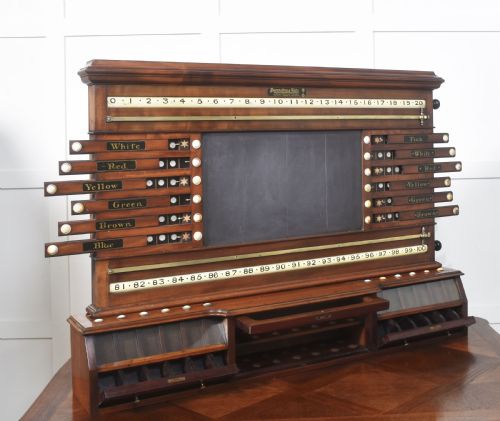
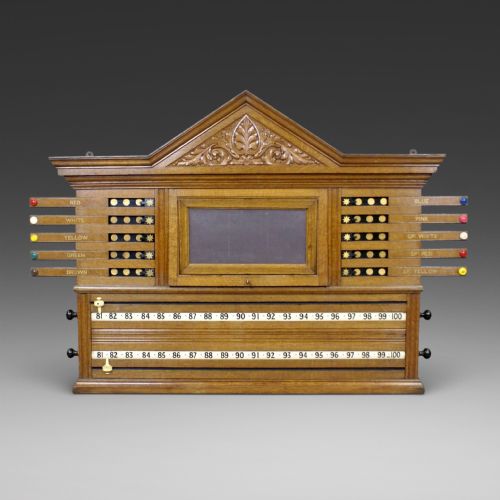
When you search for an antique games room scoreboard, you are looking at wall-mounted apparatus designed to track points for cue sports like billiards, snooker, and pool. The examples seen on this page span the 19th century, the Victorian era, and the Edwardian period, capturing the golden age of parlour and club cue sports.
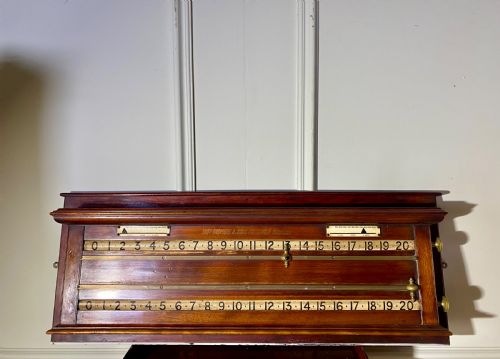
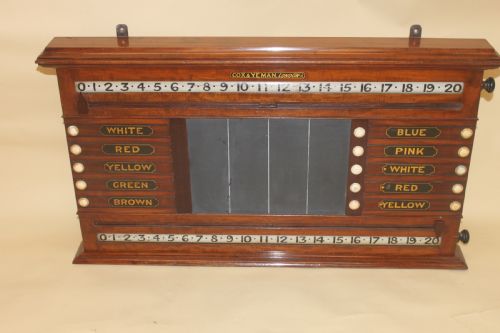
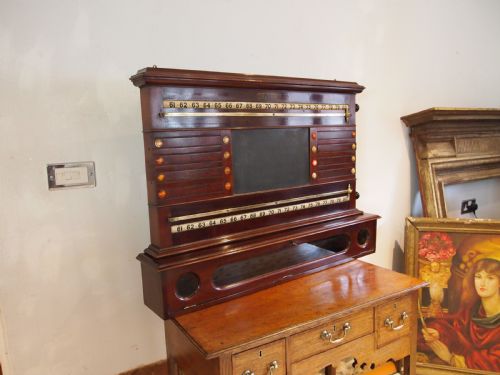
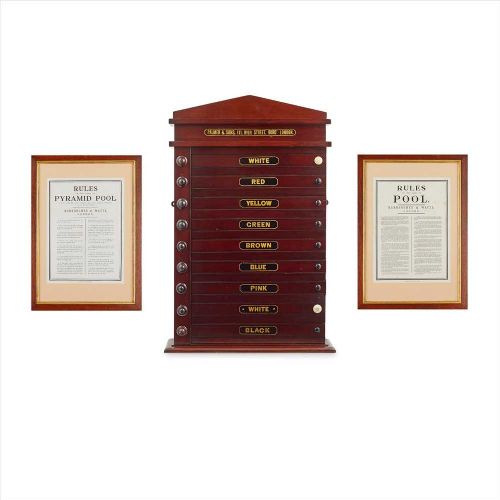
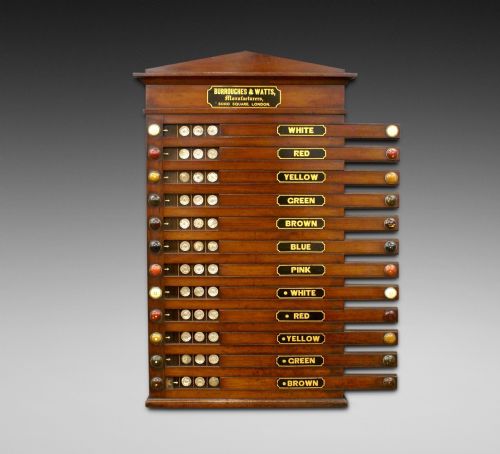
The version you are most likely to meet on this page is a substantial timber board featuring sliding pointers, revolving wooden cylinders, or inset dials. These pieces frequently accommodate multiple games such as billiards, life pool, and snooker on a single register.
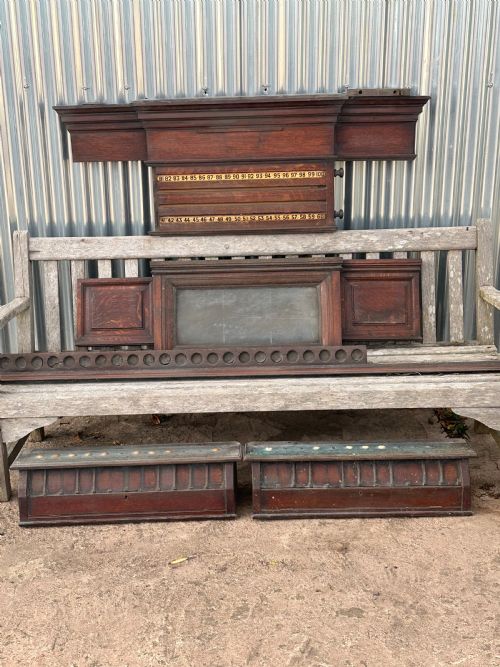
Many survivors take the form of score cabinets, combining the scoring mechanism with enclosed storage space for chalk, rests, and markers. These functional wall pieces reflect the domestic and club interiors of the late 19th and early 20th centuries.
Materials and construction
Cabinetmakers utilised dense hardwoods suited to heavy domestic use, predominantly constructing the main boards and surrounds in mahogany, oak, and English walnut. These timbers were selected for their stability and capacity to accept deep polish or carved detailing.
Makers integrated contrasting materials for the functional elements, mounting brass runners, bone pointers, slate panels, and celluloid or glass indicators into the timber frames. These varied textures ensured the sliding markers and numerical scales remained legible in gas or electric light.
Recorded mechanisms include sliding brass markers, slate panels, and revolving numbered cylinders.
Distinctions in quality
The upper tier of these pieces is distinguished by maker attribution and the complexity of the scoring mechanics. Signed boards by established billiard furnishers demonstrate superior joinery and more refined brasswork than anonymous workshop output.
Quality also reveals itself in the scale and proportion of the timber framing, alongside the presence of integrated cabinets rather than flat boards. Well-preserved dials, original bone or ivory indicators, and smooth sliding mechanisms separate utilitarian examples from finer parlour pieces.
Orme & Sons Manchester·Thurston & Co·Cox & Yeman London·Burroughes and Watts·Palmer & Sons
The Antique Games Room Scoreboard Glossary
- Life pool
- A variation of cue sports involving multiple players who each possess a specific number of lives, tracked using specialised sliding pointers on the scoreboard.
- Score cabinet
- A wall-mounted scoring apparatus featuring enclosed cupboards or shelving for storing chalk and accessories alongside the mechanical dials.
- Sliding pointer
- The brass or bone indicator moving along a numbered scale to register points during a frame.
- Revolving cylinder
- A rotating wooden barrel inscribed with numbers that turns to show changing scores on period boards.
Antique Games Room Scoreboard: Frequently Asked Questions
What games do these scoreboards track?
These pieces record scores for traditional cue sports including English billiards, snooker, and various forms of pool. Many boards incorporate multiple rows to handle complex scoring systems simultaneously.
They reflect the specific rules and scoring increments of 19th-century and Edwardian parlour games, accommodating different matches on a single wall-mounted unit.
How were scoreboards mounted originally?
Scoreboards were typically fixed securely to the wall within a billiard room, positioned at eye level near the table for ease of use by players during a frame. Larger cabinet variants required substantial wall fixings to support the weight of the timber and enclosed storage.
In period settings, they formed a central focal point of the games room decor, often paired with cue stands and matching furniture.
How do I date an antique scoreboard?
Dating relies on timber choice, mechanical style, and maker signatures recorded on the board. Victorian examples frequently utilise rich mahogany or walnut with brass sliding indicators, while Edwardian pieces often feature oak and more decorative carved framing.
Attributions to known London or Manchester billiard furnishers help narrow down the decade of production alongside stylistic cues from the period.
Can I use an antique scoreboard today?
Most surviving boards remain fully functional for modern snooker, pool, or billiard games played at home. The mechanical sliding pointers and rotating cylinders operate much as they did in the 19th century.
Careful handling of the original bone, brass, and timber components ensures these historic scoring instruments continue to serve active tables.