

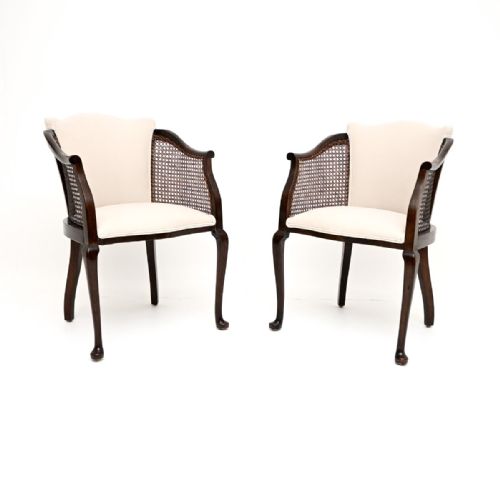
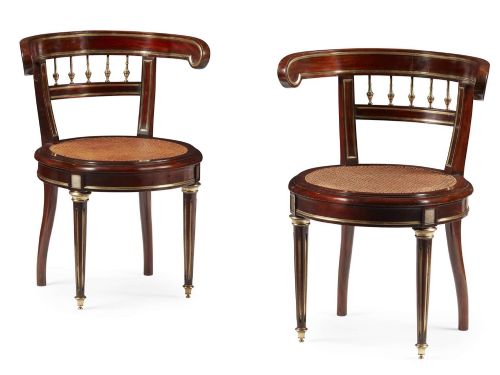
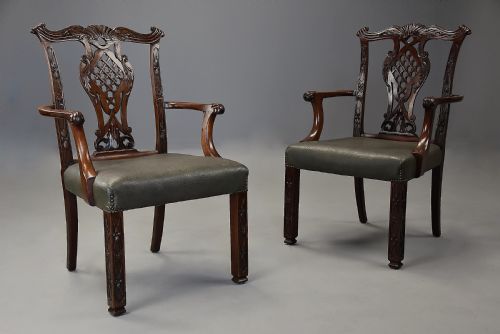
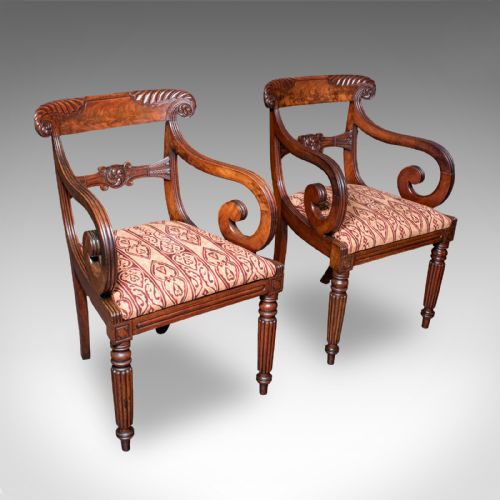
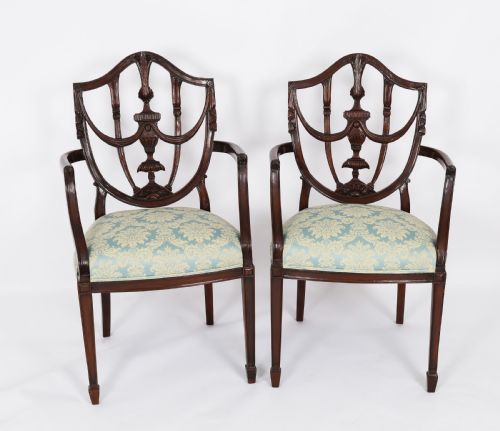


Mahogany Side Armchairs Pair
Mahogany side armchairs pair selections offer matching seating in deep timber, spanning nineteenth-century styles from Regency curves to Edwardian inlay.
Mahogany Side Armchairs Pair
A mahogany side armchairs pair brings matched seating into a room, taking the form of salon chairs, library desk chairs, and occasional seats. These pairs often emerge from the Victorian, Edwardian, and Regency eras, reflecting the shifting domestic fashions of their times.
Buyers meet pairs ranging from carved balloon back designs to inlaid Edwardian salon seats and substantial William IV reception chairs. Many items display specific regional influences, including French salon styles and Swedish neoclassical forms.
Materials and construction
Cabinetmakers built these frames in solid and veneered mahogany, frequently adding satinwood inlay or ebonised details to enrich the timber surface. Workshops utilised traditional joinery to construct stable armchair frames intended for daily use in reception rooms and parlours.
Upholstery completed the chairs, incorporating materials such as damask, velvet, and standard fabric over padded seats. Brass fittings occasionally appear on castors or decorative mounts, complementing the warm tones of the polished wood.
Mahogany Side Armchairs Pair Retail Price Guide 2026
Typical asking prices for mahogany side armchairs pair among the pieces listed under this phrase on Sellingantiques today, from the lower quarter to the upper quarter. They describe what is for sale here now, not the wider market.
Current listings feature mahogany pieces spanning the eighteenth, nineteenth, and early twentieth centuries, including Edwardian, Victorian, and Regency periods.
Judging the standard
Quality rests in the crispness of the timber carving, seen in details like spider web backs, shield backs, and applied string inlay. Finer examples show careful proportion in the arms and legs, alongside timber selection that displays rich grain and deep natural colour.
The integrity of the frame construction and the preservation of original or sympathetic upholstery materials separate standard production pieces from finer cabinet work. Pairs that retain matching proportions and uniform fading across both chairs indicate careful original pairing and preservation.
The Mahogany Side Armchairs Pair Glossary
- Carver armchair
- An armchair with wooden arms, often designed as a head-of-the-table seat or a matching fireside companion. These chairs match simpler side chairs used elsewhere in the room.
- Shield back
- A chair back shaped like a heraldic shield, popularised in the eighteenth century and revisited in later revival periods. This form requires skilled joinery to curve the timber cleanly.
- String inlay
- A narrow line of contrasting light wood, such as satinwood, embedded into the mahogany surface. Cabinetmakers used this technique to define panels and borders on Edwardian furniture.
- Balloon back
- A rounded, oval-shaped chair back resembling a balloon, characteristic of Victorian seating design. This curved frame provides comfortable support for the sitter's back.
- Salon chair
- A light decorative chair intended for formal entertaining rooms rather than heavy daily dining use. These often feature ornate carved details or delicate inlaid woodwork.
Mahogany Side Armchairs Pair: Frequently Asked Questions
How do I arrange a pair of armchairs?
A matching pair works effectively placed opposite a fireplace or flanking a sofa to create a balanced seating arrangement.
They also serve well in bedrooms or studies as comfortable reading seats when positioned near a light source.
What is the difference between a salon chair and a library chair?
Salon chairs are typically lighter, more decorative seating pieces designed for entertaining rooms and formal parlours.
Library desk chairs offer sturdier frames and lower proportions suited for prolonged sitting at a table or desk.
Are these chairs suitable for daily use?
Period mahogany frames possess robust joinery that supports regular sitting when the wooden structure remains sound and stable.
Modern buyers often check the interior webbing and padding condition to ensure everyday comfort matches the historical frame.
How do I identify a Regency period chair?
Regency seating often incorporates classical revival motifs, ebonised highlights, and clean architectural lines inspired by ancient Roman and Greek designs.
Dark mahogany timbers and bold curved arm supports frequently characterise pieces from this early nineteenth-century era.